- July 3, 2026
- by umspcs
- Blog, Latest Notifications, News & Updates
- 431 Views
- 0 Comments
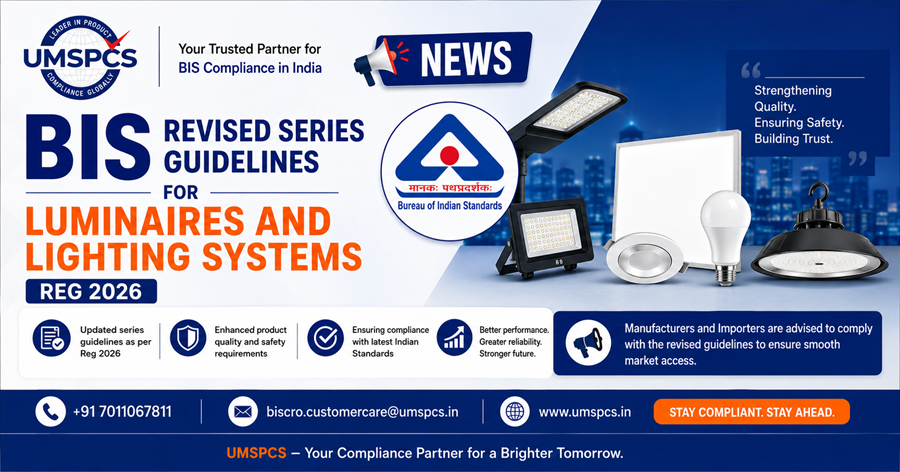
Revised Series Guidelines for Luminaires & Lighting Systems 2026: What Manufacturers Need to Know
A key development from the Ministry of Electronics and Information Technology (MeitY) in terms of regulations is the recent announcement related to the LED lighting products being manufactured in India. MeitY has released a circular dated 3 June 2026 introducing revised series guidelines with the revision of the Indian Standards IS 16102 (Part 1):2026 and IS 10322:2026.
With the introduction of revised guidelines, there will be clear criteria on the basis of which one may form a single series of products for registration with the BIS; there would also be clarity on the criteria and tests required.
If you are a manufacturer/importer of LED lamps, luminaires, chandeliers, emergency lights, or any other lighting products covered under the BIS Compulsory Registration Scheme (CRS), it is important to understand these revised guidelines before seeking registration/extension of your licence with the BIS.
At UMSPCS, we have provided a brief on all of this in easy-to-understand language.
Why Has MeitY Revised the Series Guidelines?
- Definition of a product family
- Creation of valid product series
- Selection of representative samples
- Consistency in design from a safety point of view
- Clarification of the BIS certification process
Definition of a Product Family
- Common design
- Similar construction
- Same safety critical components
- Common assemblies for compliance
Maximum Number of Models Allowed in a Series
| Product Category | Maximum Models Allowed |
|---|---|
Most product categories |
10 Models |
Fancy Lights / Chandeliers (Item No. 22 – Fixed General Purpose LED Luminaires) |
50 Models |
Item No. 21, Item No. 32–37 & Item No. 46 under CRO |
Up to 20 Models |
Additional Testing Requirements
- Unless stated otherwise, a single representative sample needs to be tested only.
- Such samples should always represent the worst case scenario in terms of safety design.
Revised Series Guidelines under IS 16102 (Part 1):2026
| Requirements | Condition |
|---|---|
Rated Input Voltage |
Same across all models |
LED Driver / Ballast |
Same rating |
Main PCB Design |
Same PCB design and layout |
PCB Configuration |
If mains and secondary are on the same PCB, the mains section must remain identical |
Lamp Cap |
Same cap design |
IP Rating |
Same IP rating |
Battery Chemistry |
Same chemistry throughout the series (Li-ion and Ni-based batteries cannot be mixed) |
Charging & Protection Circuit |
Same PCB layout and design |
Battery Capacity |
Different capacities are allowed, provided the representative sample has the highest battery capacity |
This is to make sure that all the products in the series have the same safety characteristics irrespective of their power levels.
Revised Series Guidelines under IS 10322:2026
The new standard also provides common criteria for all luminaries. Only when the following requirements have been met can manufacturers put their products under one range.
Common Criteria for All Products
| Parameter | Requirement |
|---|---|
| Class of Construction | Same |
| Electronic Control Gear | Same type (AC, DC, Adapter, IT Cable Powered or PoE Powered) |
| Adapter | Must possess a valid BIS Registration Number where applicable |
| Input Voltage | Same AC/DC rated input voltage |
| Enclosure Material | Same |
| IP Rating | Same |
| Luminaire Type | Different luminaire types must be placed in separate series |
| Connection Mechanism | Same |
| Insulation Class | Same (SELV, PELV or Non-SELV) |
| Energy Storage Technology | Same technology (Battery or EDLC) |
| Battery Chemistry | Same chemistry across all models |
| Battery Charging PCB | Same design and layout |
| Nominal Battery Voltage | Same |
| Replaceable Batteries | Separate series |
| Rechargeable Batteries | Separate series |
Additional Criteria Wherever Applicable
In addition to the common criteria, manufacturers need to take into account the following parameters, wherever applicable.
| Parameter | Requirement |
|---|---|
| Mains Socket Outlet | Products with and without socket outlets must be in separate series |
| Thermal Management | Same cooling mechanism (Passive or Active Cooling) |
| Ambient Temperature Rating | Same rating if different from 25°C |
| Impulse Withstand Category | Category II and Category III products cannot be grouped together |
| Adapter Output | Same output voltage and current rating complying with IS 302 |
These additional conditions ensure consistency of products during the certification process.
Special Guidelines for Fancy Lights and Chandeliers
- A series can have up to 50 models.
- Three sample models need to be submitted, which include Highest rated model, Middle rated model, and Lowest rated model
- Additionally, three different weight groups need to be tested for hanging/fixing where applicable.
- Safety testing would only be done on the electrical housing and parts up to the driver.
What Does This Mean for Manufacturers?
- Examine all existing BIS-certified lines of products
- Check if the current model meets the modified criteria of grouping
- Redesign PCB layout, battery arrangement, insulation class, and driver requirements
- Select samples that represent the worst-case scenario in terms of safety
- Follow the new rules in future BIS applications
Why Choose UMSPCS?
- Assessment of product applicability
- Formation of series according to the latest MeitY guidelines
- Preparation of documentation
- Arrangement with BIS-accredited laboratories
- BIS CRS Application Filing
- Technical compliance
- Modification in Licence and scope extension
- End-to-end assistance until certification is received
Conclusion
Companies producing or importing LED lamps, luminaires, emergency lighting or decorative lighting products must take a look at their product portfolio and reorganize them as per the new guidelines as soon as possible.
In case you need assistance in obtaining BIS CRS certification or reorganising your product series according to the new guidelines, contact UMSPCS. Our compliance experts will make sure that the whole certification process goes smoothly and without any hassle.
Connect with UMSPCS now for expert assistance with BIS certification.
Read more also: BIS Guidelines for Revised Standards for LED Luminaires 2026
Frequently Asked Questions (FAQs)
The modified guidelines specify how lighting products should be categorized into a product series for BIS certification according to the new standards.
The modified guidelines cover IS 16102 (Part 1):2026 and IS 10322:2026 standards.
Usually, a number of models within one series cannot exceed 10 unless the limit is specified otherwise.
Up to 50 models can be included into the series of fixed general-purpose LED fancy lights or chandeliers.
No, the products with different battery chemistries cannot be included into one series.
No, fixed, portable, track-mounted, and semi-luminaires should be certified separately in various series.
Yes, unless specified otherwise, one sample per series based on the worst-case safety configuration is tested.
❓ Ask a Question
Have any doubts? Fill the form below and our team will respond shortly.