Chennai is one of the largest manufacturing and import cities in India, which has products from its seaports that are supplied to industries in India. Many of the foreign manufacturers use Chennai as the starting point for entering their products into the Indian market. But having a good product and a reliable importer is not enough; for many regulated products, BIS FMCS Certification is a must-have to enter the Indian market and sell the product.
The challenge comes when the manufacturers realise that their products require mandatory BIS certification after they have been produced. This causes problems such as customs delays of shipments and postponement of product launches due to the lack of a BIS licence for the company. The BIS FMCS certification process for foreign manufacturers might prove to be quite a complicated task, from the identification of the standard to the appointment of the AIR, technical documentation, and BIS requirements.
This is where an experienced BIS FMCS Certification Consultant in Chennai comes into play. From the identification of the Indian standard to the acquisition of the BIS licence, UMSPCS helps manufacturers get all the required certifications without any hassle.
Why Do Foreign Manufacturers Need BIS FMCS Certification in Chennai?
The Government of India has made BIS certification mandatory for several products by issuing Quality Control Orders (QCOs) from all the ministries. These regulations provide for the Indian market access of products with the quality, safety, and performance as specified in Indian standards.
In obtaining BIS FMCS certification, foreign manufacturers benefit in the following ways:
- Comply with Indian regulatory requirements.
- Obtain legal access to the Indian market.
- Show compliance with Indian Standards.
- Establish a trust relationship between importers, distributors, and consumers.
- Minimise import restrictions or regulations.
- Enhance their brand’s credibility in India.
FMCS certification is important not only from the point of view of regulation but also from that of strategy because companies seek to leave their mark on the Indian market.
What is BIS FMCS Certification?
The Foreign Manufacturers Certification Scheme (FMCS) is a manufacturer’s certification scheme run by the Bureau of Indian Standards (BIS) for foreign manufacturers.
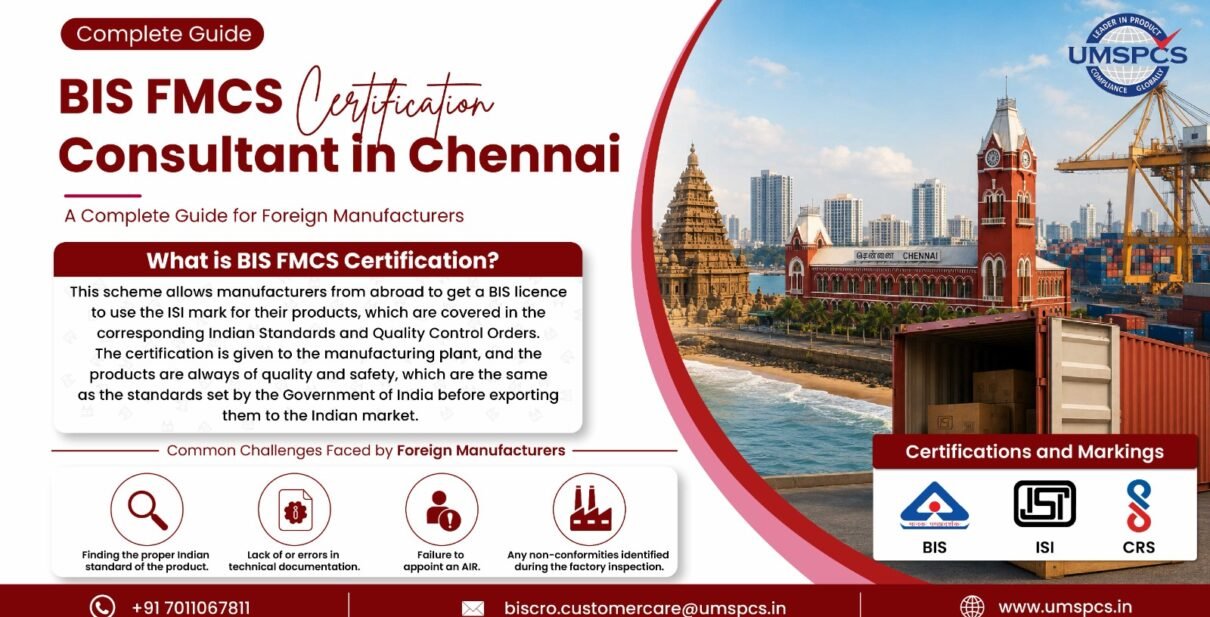
This scheme allows manufacturers from abroad to get a BIS licence to use the ISI mark for their products, which are covered in the corresponding Indian Standards and Quality Control Orders. The certification is given to the manufacturing plant, and the products are always of quality and safety, which are the same as the standards set by the Government of India before exporting them to the Indian market.
Why Do You Need an Authorised Indian Representative?
Appointment of an AIR is one of the most important requirements of the Foreign Manufacturer Certification Scheme (FMCS).
As BIS does not have a direct interface with the manufacturers outside India regarding the regulatory aspects, all foreign manufacturers need to have an AIR in India.
Typical duties of an AIR are:
- Arranging for the foreign manufacturer with BIS.
- Supporting application completion and documentation.
- Answering BIS enquiries and compliance.
- Assisting in the scheduling of factory inspections.
- Keeping them in touch with post-certification responsibilities.
By choosing an experienced AIR, the whole application process will be much smoother and will minimise potential delays.
Complete BIS FMCS Certification Process in Chennai
The BIS FMCS certification process in Chennai comprises various steps to ensure that the manufacturing facility, as well as the products, fulfil the relevant Indian standards.
Step 1: Product Evaluation & Compliance Assessment
The first step is to know which Indian Standard (IS) is applicable to the product and whether it is covered under the ambit of BIS mandatory certification.
This consists of:
- Product category evaluation
- Finding the Appropriate Indian Standards
- Assessing the Certification’s Applicability
- Preliminary review of compliance
Step 2: Documentation Preparation
Manufacturers must prepare all technical and legal documentation that may be required for the certification.
These include:
- Company & Factory Registration Document
- Description of Product
- Manufacturing Process Documentation
- Documentation of Quality Control
- Drawings of the Products
- Testing Results
- Trademark Recordings
- AIR Authorisation Documents
Step 3: Product Testing & Compliance Verification
BIS-approved laboratories test the samples of products for conformity to the relevant Indian Standard.
It contains tests for:
- Safety of products
- Standards of performance
- Features of quality
- Technical compatibility
Non-conformities must be resolved before any process can be initiated.
Step 4: Appointment of Authorised Indian Representative (AIR)
Foreign producers shall nominate an Authorised Indian Representative (AIR) to be the authorised representative of BIS.
The duties:
- Correspondence of BIS
- Compliance cooperation
- The Indian producer
Step 5: Submission of BIS Application
Once testing and documentation are complete, the application is sent to BIS for review.
The application generally includes:
- Applications to the Bank for International Settlements
- Specifications
- Product testing
- Production Unit Details
- Statements and agreements
Step 6: Factory Audit by BIS
In this step, the BIS will inspect the manufacturing unit to see the capacity of manufacturing and quality control.
A factory audit comprises the following:
- Production process
- Testing facilities
- Quality control scheme
- Product consistency monitoring
Step 7: Licence Approval & ISI Mark Authorisation
Once tests, verification and factory inspection are complete, BIS finally issues the FMCS licence.
As the licence is approved:
- License from BIS is obtained
- Authorisation for the ISI marking is obtained
- Products can be legally imported and sold in India
The Documents used for BIS FMCS Certification in Chennai
The requirements for documentation could differ as per product category and the Indian Standard. But in general, foreign manufacturers must file:
Required general documents
- Simple information on the production unit and product category.
- Indian Standard Test Report from a BIS/NABL-recognised laboratory
- Proof of ownership of the manufacturing plant
- Trade mark registrations
- Statutory body licences and approvals.
- Product design drawings/schematic
- Manufacturing capacities installed.
- Raw materials data
- The machines used to produce the product.
- This is an example of a specification and a list of machines used in the manufacture.
- This flowchart of the manufacturing process illustrates the activities involved in the creation of the product.
- Packaging types and procedures
- Calibration of the manufacturing unit test equipment list.
- Quality control personnel data.
- Market disposal of low-quality products.
- Production unit map
- A factory organogram is given below.
Other documents for foreign manufacturers
- The appointee will be notified of the appointment by letter. A letter of appointment will be sent to the authorised Indian representative (AIR).
- Letter of Appointment of Authorised Indian Representative (AIR)
- Other factory documents (layout, machines, quality control setup, etc.) are shown from overseas factories.
- Undertaking an Affidavit as per BIS format
Good and complete documentation is important in preventing delays at the certification phase.
Fees & Timeline for BIS Certificate for Foreign Manufacturers in Chennai
The price of a BIS certificate for overseas producers. The product category, testing requirements, and inspection costs influence the total cost of the BIS certificate.
| Particulars | Estimated Cost (Dollars) |
| Application Fees (BIS) | $12.00 |
| Per Diem Expenses for BIS Officers – 3 Days | $900.00 |
| Charges for the Visit | $466.66 |
| Contingency Funds | $111.11 |
| Bis charges travel, visas, etc. Estimate | $2173.00 |
| Marking Fee (Min.) | $2744.00 |
| Sample Testing | $400 to $3000 |
| Total BIS Cost | $6850.77 to $10000.77 |
Costs incurred in travelling to and from inspection locations and in the course of inspections. The cost of certification will vary from project to project and from manufacturer to manufacturer.
The whole process of certification will depend on how fast the documents are processed, and also the factory inspection and testing times.
Generally, the time frame for completing the BIS FMCS certification process is approximately 5-6 months from the date of submission of the complete application. The whole certification process can take time, like documentation, product testing, factory inspection or responses to BIS observations.
Common Challenges Faced by Foreign Manufacturers
The FMCS process is well established, but many foreign manufacturers have problems that can be avoided and cause delays.
The most frequent problems are:
- Finding the proper Indian standard of the product.
- Lack of or errors in technical documentation.
- Failure to appoint an AIR.
- Any non-conformities identified during the factory inspection.
- Slow reaction to BIS technical enquiries.
- Understanding of the Indian regulatory requirements is lacking.
By engaging a seasoned BIS FMCS certification consultant, manufacturers can tackle these challenges effectively and streamline the certification process, saving time and effort.
Why Hire a BIS FMCS Certification Consultant in Chennai?
Chennai is one of India’s major import and industrial hubs, making professional BIS compliance support valuable for overseas manufacturers working with Indian importers and distributors.
The BIS FMCS certification process requires several regulatory requirements, such as product applicability assessment, product documentation, appointment of an Authorised Indian Representative (AIR), factory inspection, etc.
Foreign manufacturers can receive help from an experienced BIS FMCS Certification Consultant in Chennai, who will help in managing these aspects efficiently. There will not be any unnecessary delays due to the professional way in which the documentation process will be carried out.
Why Choose UMSPCS for BIS Certification in Chennai?
UMSPCS also offers all-around support to overseas manufacturers to have a BIS certification consultant in Chennai for their products to be sold in India. From initial application to successful certification, our expert compliance team ensures that businesses navigate the process with confidence, ensuring compliance with BIS standards.
Our services include:
- Product applicability assessment
- Identification of the applicable Indian Standard
- Preparation and review of documentation.
- Authorised Indian Representative (AIR) support.
- Coordination with BIS authorities
- Factory inspection assistance
- The registration of applications at BIS and its follow-up.
- Reply to queries from BIS (assistance)
- Post-certification compliance support
UMSPCS will be handling the bis certification process, allowing manufacturers to concentrate on expanding their business, while we handle the regulatory requirements.
Conclusion
BIS FMCS certification is a must for foreign manufacturers before they export regulated products to India. The certification procedure includes technical documentation, an AIR appointment, factory inspection, product evaluation, and conforming to the appropriate Indian standards.
For the BIS FMCS certification, you can opt for expert help.
Considering exporting regulated products to India? UMSPCS offers full support for BIS FMCS certification, including document support, AIR appointment, BIS application filing, factory inspection coordination, and post-certification compliance. Get in touch with our specialists today and streamline your BIS FMCS certification journey and enter the Indian market confidently.
Read more about BIS ISI Certification for Carbon Steel Cast Billet under IS 2830
FAQs
- Is BIS FMCS Certification compulsory for foreign producers in Chennai?
Yes, BIS FMCS certification is compulsory for foreign producers whose products fall under the relevant Quality Control Order (QCO). The products can be exported to India only after obtaining BIS FMCS certification. This license must be obtained by the foreign producer before importing into India.
- Who needs BIS FMCS Certification in Chennai?
Foreign manufacturers making regulated products in the framework of the relevant Quality Control Orders (QCOs) need to acquire BIS FMCS certification in order to export them to the Indian market.
- Is an Authorised Indian Representative (AIR) mandatory in Chennai?
Yes. All foreign manufacturers who apply for the FMCS scheme are required to have an Authorised Indian Representative (AIR) who acts as a liaison between the foreign manufacturer and the BIS and handles compliance-related matters in India.
- How long does the BIS FMCS Certification process take in Chennai?
Generally, the BIS FMCS Certification process takes 5-6 months, depending on the documentation readiness, scheduling of the inspection in the factory, evaluation of the product, and the processing of the BIS.
- What documents are required for BIS FMCS Certification in Chennai?
Typical documents needed are the business registration information, factory information, product specifications, quality control records, AIR documents, technical documentation, etc., as required by BIS.
- Why should I hire a BIS FMCS Certification Consultant in Chennai?
A professional consultant assists foreign manufacturers in managing documentation, appointment of AIR, filing of applications on BIS, preparations for factory inspection and compliance with requirements, minimising delays and optimising the overall certification process.
❓ Ask a Question
Have any doubts? Fill the form below and our team will respond shortly.