The quality of buildings, bridges, industrial structures, or any infrastructure project is directly dependent on the quality of the steel used during the construction process. But the quality of steel starts far earlier than that of the semi-finished products used in the manufacturing process.
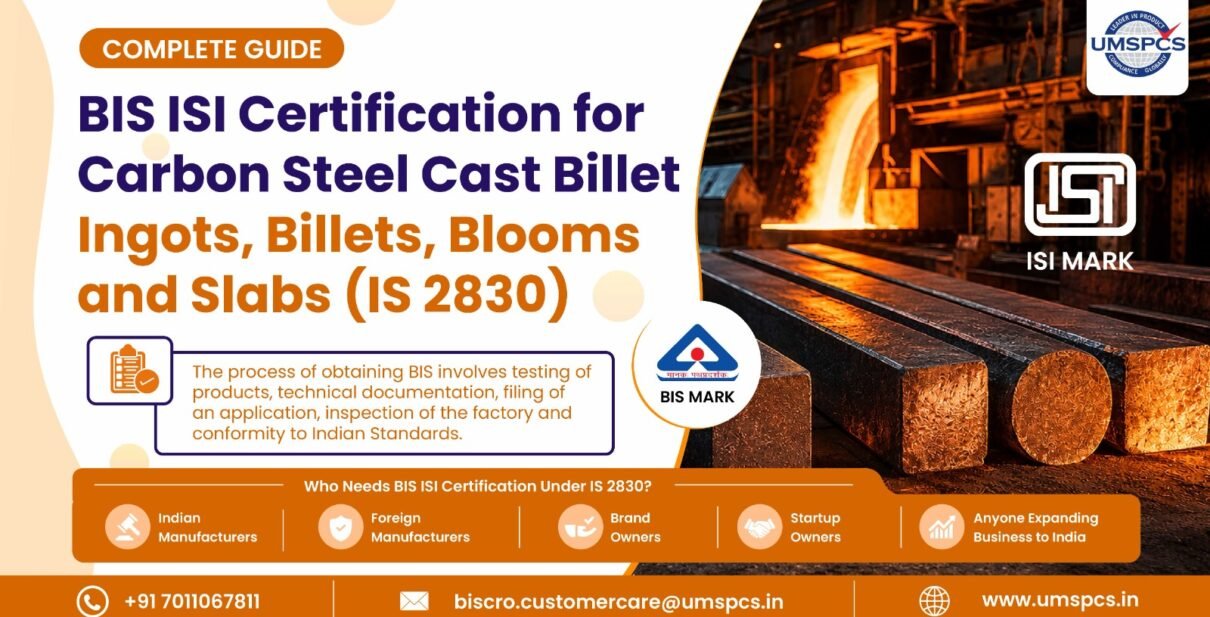
In order to ensure consistent quality and safety for people, the Government of India has made BIS ISI Certification for Carbon Steel Cast Billet Ingots, Billets, Blooms and slabs for re-rolling into steel for general structural purposes mandatory under IS 2830, wherever applicable under the relevant Quality Control Order (QCO).
In this blog, we’ll tell you everything you need to know about BIS ISI Certification under IS 2830, including product applicability, certification requirements, documentation, the certification process, cost, and time, and how UMSPCS can help manufacturers get certified.
What are Carbon Steel Cast Billet Ingots, Billets, Blooms & Slabs?
These are semi-finished steel products made of carbon steel cast billet ingots, billets, blooms, and slabs, which are intended for manufacturing different types of structural steel products.
1. Billet Ingots
Billet ingots are semi-finished cast steel products produced during the initial steel-making process and are further rolled into billets, blooms, slabs, and other finished steel products.
2. Billets
Billets are steel bars that are long and have a relatively small cross-sectional area. They are often used to make steel bars, rods, angles, channels, and other structural products.
3. Blooms
Blooms are larger than billets and are commonly used for manufacturing heavy structural sections, rails, and engineering components.
4. Slabs
Slabs are flat, semi-finished steel products that are further rolled into steel plates, sheets, strips, and other flat steel products.
Why is BIS ISI Certification Mandatory Under IS 2830?
To ensure that only steel products that meet the quality standards are manufactured and sold in the market, the Government of India has introduced the Quality Control Orders (QCOs) for various steel products.
BIS ISI Certification under IS 2830 helps ensure carbon steel cast billet ingots, billets, blooms, and slabs:
- Conform to the standards set by IS 2830.
- Maintain uniformity in chemical composition and quality of manufacture.
- Increase the safety and efficiency of structural steel products.
- Adhere to the relevant quality control orders.
- Build up customers’ faith and credibility in the market.
- Avoid the circulation of inferior steel products.
The manufacturers certified under the compulsory certification regime are not legally allowed to manufacture or sell such products without having a valid BIS licence and applying the ISI Mark.
Complete Process of BIS ISI Certification for Carbon Steel Cast
The following steps have to be taken by the manufacturers to get a BIS licence for compliance with IS 2830.
Step 1: Determine the proper IS code.
One of the first steps is to identify the relevant Indian Standard (IS code).
Manufacturers are required to:
- Know product requirements
- Manufacture of Products as per IS Standards
- If necessary, increase production techniques
Step 2: Product Test & Documentation
Testing should be done in a BIS-approved & NABL-accredited laboratory.
At this point:
- This is tested on samples of the product.
- Technical documentation is written.
- Data is collected on factories and manufacturing.
- Application forms duly filled.
Step 3: Application Submission
The BIS application is available online and contains an application letter, a BIS form, and a copy of the DHS grant letter.
- Test reports
- Plant Info
- Government fees apply.
- The application is verified by the BIS authority after it is made.
Step 4: BIS Factory Inspection
The BIS officials come to inspect the manufacturing plant and check the following:
- Production process
- Production Environment
- Quality control scheme
- Testing capacity
- During the inspection, samples of the product may also be taken for independent analysis.
Step 5: Testing Products and Uploading Lab Reports
Samples are analysed in accredited laboratories. The Lab Test Report (LTR) is then sent directly to the laboratory to be evaluated by the BIS.
Step 6: Close Non-Conformities (If Any)
If BIS finds any problem during inspection/testing:
- It has to be corrected and action taken.
- Documents to be filed afresh
- Any nonconformance has to be dealt with
Step 7: Payment of Marking & Licence Fees
Once the BIS certification process is completed, the manufacturer has to pay the following:
- Annual Licence Fee
- Marking fee of ISI.
Step 8: Issuance of the ISI Licence
Upon successful completion of testing, inspection, and payment procedures, BIS issues an ISI licence. This enables the manufacturer to put the ISI mark on the certified goods.
Documents Required for BIS ISI Certification for Carbon Steel Cast
In general, the following documents are required for manufacturers to apply for BIS ISI Certification under IS 2830:
- Manufacturing unit and fundamental data product segment
- Proof of address for the manufacturing unit
- Trademark registration certificate (in case the brand name is used and registered)
- Manufacture licence / statutory approvals
- Product drawings/design schematics.
- Manufacturing Capacity Installed
- And the specifications list, materials used
- Details of machinery and equipment for manufacture
- The factory layout plan shows production and testing areas and storage areas
- The flow of the manufacturing process is described in detail.
- Internal test equipment and calibration data
- Quality Control Personnel Information
- Factory Organisational Chart
Having all the required and proper documentation in place ahead of time can cut down on delays with certification.
Cost and Timeline of BIS ISI Certification Cast Billet
The typical costs of certification are:
| Particulars |
| Application Fees (BIS) |
| Testing Charges (Lab Fees) |
| Factory Inspection Charges |
| Annual License Fees |
| Marking Fees (ISI Mark Usage) |
| Consultancy Charges (UMSPCS) |
The above charges are subject to change depending on the nature of the products to be certified. A BIS certificate for foreign manufacturers can also be obtained.
The certification timeline may vary depending on product testing, documentation, factory inspection, and BIS processing.
- Estimated time: 30 – 40 working days
- AIF Products: Up to 180 days in some cases
Advantages of BIS ISI Certification Under IS 2830
Besides being compliant, there are several other benefits that manufacturers gain by acquiring BIS ISI certification.
Here are some of the benefits of this:
- The legal authorisation for manufacturing and selling the products covered by the relevant QCO.
- Documentation preparation and review are mentioned in IS 2830.
- Enhanced consumer, buyer, and project authority confidence.
- Better brand reputation and credibility.
- Improved chances to get involved in government and infrastructure initiatives.
- Lower chance of non-compliance penalties from regulators.
- Industry competitive edge in the steel and construction industries.
The manufacturers getting BIS ISI Certification show their willingness to manufacture quality steel products that comply with the prescribed Indian standards.
Why Choose to Apply for UMSPCS for BIS Certification?
To get BIS ISI Certification for Carbon Steel Cast IS 2830, one has to possess technical expertise, documentation, product testing, and coordination with the BIS authorities. Small mistakes in applying or complying can result in a delay in certification.
UMSPCS offers full support to manufacturers for obtaining BIS ISI Certification for carbon steel cast billet ingots, billets, blooms, and slabs. Our team of experts can guide businesses throughout the entire certification process, ensuring a smooth and timely experience in achieving compliance.
Our services include:
- Product applicability assessment
- To identify the applicable Indian standards
- The creation and examination of documents.
- Coordination with BIS-recognised laboratories
- The application form, follow-up, and online registration of BIS.
- Support is given while the factory is being inspected.
- Assistance in responding to BIS queries
- Post-certification compliance support
Manufacturers can concentrate on production, as we take care of the bis certification process for you.
Conclusion
Carbon Steel Cast Billet Ingots, Billets, Blooms and slabs are integral components for manufacturing Structural Steels in the Construction and Engineering sector. It is essential to ensure compliance of these products with the requirements for quality stated in IS 2830, as it guarantees the reliability of the products, their structural performance and compliance with the regulations.
Manufacturers subject to the respective Quality Control Order are required to get BIS ISI Certification before manufacturing or selling these products in India. This is an approval process which involves product testing, documentation, factory inspection and certification by the Bureau of Indian Standards.
With UMSPCS’s team of experts, you can make the process of getting certification very easy with their help.
UMSPCS offers complete documentation services, product testing arrangements, BIS application filing facilities, factory inspections, and more after the certificate has been obtained.
Contact our experts now and get your BIS certification process made very easy.
Read more also: BIS ISI Certification for uPVC Injection Moulded Fittings IS 14735
FAQs
- Is ISI certification mandatory for the products that fall under IS 2830?
Yes. Before manufacturing or selling the products in India, the manufacturer of Carbon Steel Cast Billet Ingots, Billets, Blooms and slabs covered under the applicable quality control order is required to get BIS ISI certification.
- What does IS 2830 specify?
‘Quality requirements, process requirements, chemical composition, sampling method, testing method, inspection requirement, and marking requirement for Carbon Steel Cast Billet Ingots, Billets, Blooms, and slabs for re-rolling into structural steel as per IS 2830’ describes the standard.
- Who should receive the BIS ISI Certificate for IS 2830?
Manufacturers of Carbon Steel Cast Billet Ingots, Billets, Blooms, and slabs falling under the mandatory certification scope need to obtain the BIS ISI Certification before marketing their product.
- What are the documents needed for BIS ISI Certification of cast billet ingots?
Business registration information, factory licence, manufacturing process information, product specifications, quality control records, calibration certificates and other supporting documents, as prescribed by BIS, are commonly required.
- How much time does it take to get the BIS ISI Certification of cast billet ingots?
The time period of certification depends on the general process of product testing, documentation, factory inspection and BIS processing. Complete documentation and preparation allow manufacturers to complete the process in a more efficient manner.
- Why opt for UMSPCS for BIS ISI Certification for cast billet ingots?
From its product evaluation to product documentation, laboratory coordination, filing of BIS application, support for factory inspections, and even compliance post-certification, UMSPCS provides end-to-end services for obtaining BIS ISI Certification without compromising on timelines.
❓ Ask a Question
Have any doubts? Fill the form below and our team will respond shortly.