What will be the scenario after spending many months on the manufacture of superior quality uPVC injection moulded fittings to learn that your products cannot be legally marketed in India due to failure to comply with the mandatory standards. It is now more than a necessity for manufacturers, importers, and exporters to comply with various regulations and laws.
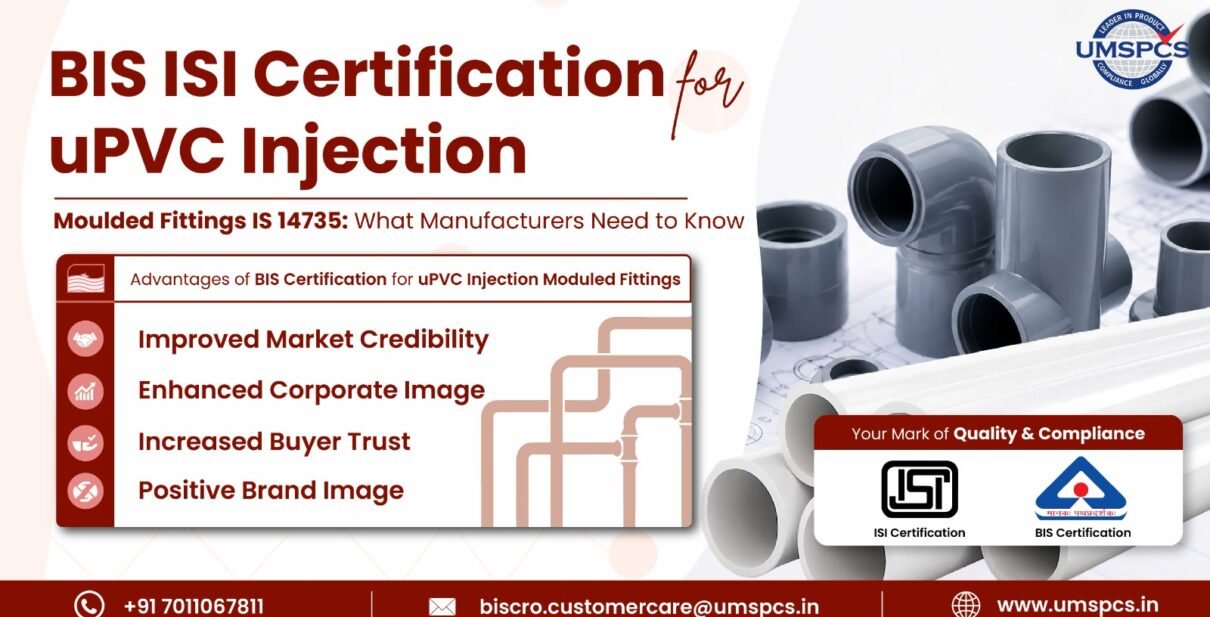
In view of the growing concern for the quality and safety of products and their consumers, the Bureau of Indian Standards (BIS) has made stringent demands regarding the use of uPVC injection moulded fittings used in water supply and pipe work. Not only do the compliance of IS 14735 guarantee access to the market, but they also build confidence among the customers, distributors, and government purchasing agencies.
This guide provides you with all the necessary information you should know about BIS certification for uPVC injection moulded fittings.
Understanding IS 14735 for uPVC Injection Moulded Fittings.
The IS 14735 Indian Standard lays down requirements for Injection Moulded Unplasticized Polyvinyl Chloride (uPVC) Fittings for use in conjunction with uPVC Piping Systems. Such fittings find application in:
- Systems for water distribution
- Irrigation systems for agriculture
- Plumbing system
- Fluid conveyance in industrial process lines
- Fittings in pipework applications
This standard makes sure that the fittings have sufficient mechanical strength, dimensional stability, durability, and pressure and environmental resistance.
Manufacturers who wish to access the Indian market should follow this standard and get themselves certified by BIS ISI Certification Scheme for Indian Manufacturers.
Why BIS Certification Matters for uPVC Injection Moulded Fittings
BIS certification not only fulfills the regulatory obligations but goes much beyond that.
- Legally Recognized Market Entry Requirement: Products under compulsory BIS regulations need to have proper certification for manufacture, import, distribution, and sale.
- Increased Customer Trust: The ISI Mark shows the quality standards have been fulfilled.
- Competitive Edge: Certification offers a competitive edge in government tenders and institutional procurement.
- Low Product Liability Risk: It reduces product liability risks due to any quality deficiencies.
- Enhanced Brand Credibility: It enables manufacturers to build their reputation in national and international markets.
Products Covered Under IS 14735
The standard usually covers injection molded uPVC fittings for use in piping systems.
Some of the common types are:
- Elbows
- Tees
- Reducers
- Couplers
- Adaptors
- End Caps
- Bends
- Socket Fittings
- Junction Fittings
- Threaded Fittings
- Service Saddles
- Molded pipe fittings other than those listed above are also included in the standard.
It is recommended that the manufacturer confirm whether their specific products qualify for the certification process.
Key Technical Requirements Under IS 14735
The manufacturers should ensure compliance with the following essential criteria, namely:
- Quality of Material: The quality of raw material used should conform to the prescribed criteria.
- Dimensional Specifications: The fittings should conform to the dimensional criteria as per the standard.
- Mechanical Resistance: The products should withstand loads and pressure.
- Workmanship and Finishing: The products should not have any defect affecting performance.
- Marking Criteria: The products should conform to marking criteria, including the ISI mark, after approval.
Step-by-Step BIS Certification Process for uPVC Injection Moulded Fittings
Step 1: Identify the Applicable Indian Standard
The first step is to identify the Indian Standard applicable to the product. The manufacturers of uPVC Injection Moulded Fittings should follow IS 14735 standards and ensure their products meet all the stipulated quality and performance parameters.
Step 2: Testing of Product and Preparation of Documentation
Product testing is done by a BIS-approved and NABL accredited laboratory in accordance with IS 14735. In parallel with that, manufacturers need to prepare all technical documents, quality control records, manufacturing documents, and other necessary documentation needed for certification.
Step 3: Application to BIS
With the completion of testing and documentation, the BIS application along with test reports, factory data, product data, declaration form, and necessary government fees will be submitted. An initial scrutiny of the application will be conducted by BIS.
Step 4: BIS Inspection of Manufacturing Facility
An inspection of the manufacturing facilities is conducted by the BIS personnel, where they check the manufacturing process, quality control system, testing facilities, and manufacturing facilities.
Step 5: Sample Testing and Evaluation
The inspectors can take the product samples and submit them for laboratory tests in approved labs. These test results will then be submitted to BIS for assessment and compliance.
Step 6: Closing of Non-Conformities
In the event that there are any deficiencies or non-conformities found from the testing and inspection of the products, the manufacturer will have to take the necessary action to rectify all the observations made by BIS.
Step 7: Payment of Fees
Once the BIS is convinced with the compliance of the product and its manufacturing process, the manufacturer has to pay the license fee, annual fee and the ISI marking fee.
Step 8: Granting of ISI License
After completion of testing, inspection and the verification of documents and fees, the ISI license will be granted by BIS. This enables the manufacturer to apply ISI mark on their uPVC injection molded fittings.
Documents Required for BIS Certification
These may typically consist of:
- Basic details of the manufacturing facility and the product range
- Proof of manufacturing facility location (ownership/rental documents, utility bills, etc.)
- Trademarks certification, if the brand is to be used (if the product is to be trademarked)
- Manufacturing facility license / other statutory certificates (if applicable – e.g. pollution control, other industry-specific certificates)
- Drawings/ design schematics of the product
- Installed manufacturing capacity
- Raw material requirement list and specifications
- Manufacturing facility equipment and machinery details
- Facility floor plan – production and testing areas, storage areas, etc.
- A comprehensive manufacturing process flow diagram has been included
- In-house testing equipment details along with calibration details
- Quality control staff details
- Organizational structure of the manufacturing facility
Cost of BIS Certification for uPVC Injection Moulded Fittings
Factors affecting certification cost include:
- Variations in product
- Testing requirements
- Location of factory
- Cost of BIS
| Particulars | Estimated Cost (INR) |
| Application Fees (BIS) | ₹1,000 |
| Testing Charges (Lab Fees) | ₹15000 – ₹2,50,000 |
| Factory Inspection Charges | ₹7000 |
| Annual License Fees | ₹1,000 |
| Marking Fees (ISI Mark Usage) | As per BIS norms (based on production) |
| Consultancy Charges (UMSPCS) | ₹ 50000 |
Producers should undertake cost evaluation before engaging in this process.
A comprehensive application will help minimize delay in the process. The estimated time frame is 30 – 40 working days, and in case of AIF products, 180 days.
Common Challenges Faced by Manufacturers
The following are some of the causes of delays in most applications:
- Incomplete Documentation: Incomplete documents cause several inquiries to be made.
- Incorrect Classification of the Product: Incorrect choice of standards can cause the application to be rejected.
- Testing Failures: Products that do not meet compliance need to be tested again.
- Issues of Factory Readiness: Poor quality control systems may affect inspection results.
- Inquiries Not Answered On Time: This also leads to delays in approvals.
Working with experienced consultants can significantly reduce these risks.
Why Choose UMSPCS for BIS Certification?
At UMSPCS, we offer a vast amount of experience in the field of product compliance and regulatory approvals, with experience in more than 600+ product categories. The compliance specialists will take care of all the procedures associated with obtaining BIS certification including product evaluation, documentation, testing, application, queries, and certification.
Advantages of working with UMSPCS
- Quick and easy certification process
- Minimal compliance risks
- Proper documentation
- Regulatory consultancy
- Project management
Whether you require BIS certification in India or BIS certification for foreign manufacturers, our consultants can assist you with everything.
Future-Proofing Your Business Through Compliance
The Indian market has started valuing products that are certified for quality. Companies that take the initiative to certify their products according to the BIS standards not only comply but also gain credibility in the market.
This will benefit the uPVC fittings manufacturers immensely once they obtain the certification from IS 14735.
Read more about FMCS Consultant in Hyderabad
Conclusion
BIS Certification for uPVC Injection Moulded Fittings according to IS 14735 is critical for those manufacturers who wish to enter the market of India legally by proving their compliance with the quality standards that have been set.
The process of certification requires a range of actions such as product testing, documentation preparation, plant inspection, and continuous compliance management. The whole process may be rather complicated, but expert help will allow you to simplify it.
We offer BIS Certification in India and BIS Certification for Foreign Manufacturers. Our compliance experts will help you receive the certification of your product easily and quickly.
Ready to Obtain BIS Certification for uPVC Injection Moulded Fittings?
Contact UMSPCS today for expert consultation, documentation support, testing coordination, and complete certification assistance.
Read more about BIS Certification Consultant in UK
FAQs
- Is BIS Certification mandatory for uPVC Injection Moulded Fittings?
If the product falls under the mandatory BIS certification criteria and Quality Control Orders, then the product must get certified before being sold or distributed in India.
- What is the Indian Standard for uPVC Injection Moulded Fittings?
The relevant Indian Standard for uPVC Injection Moulded Fittings is IS 14735.
- Can foreign manufacturers apply for BIS Certification?
Yes, foreign manufacturers can apply for BIS Certification for Foreign Manufacturers under FMCS.
- What is the duration of the BIS certification process?
It is usually 30 – 40 working days, depending on many factors such as testing, availability of documents, inspection dates, etc.
- What are the necessary documents for BIS Certification for uPVC Injection Moulded Fittings?
Documents vary according to the application but can include company registration documents, product details, manufacturing process, test reports, etc.
❓ Ask a Question
Have any doubts? Fill the form below and our team will respond shortly.