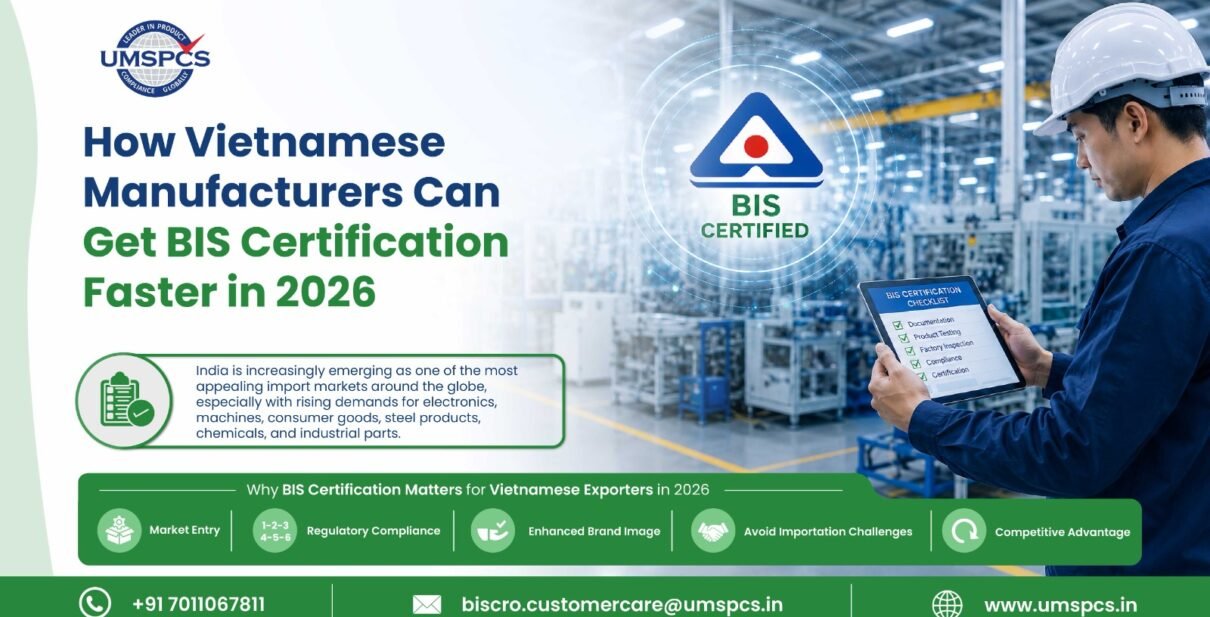
India is increasingly emerging as one of the most appealing import markets around the globe, especially with rising demands for electronics, machines, consumer goods, steel products, chemicals, and industrial parts. Vietnamese manufacturers have been making efforts to search for ways to penetrate the Indian market.
However, there is something that decides if your goods are going to be imported without any problem into India or if they are going to remain in the customs house: the BIS certification of India.
Every year, many companies face difficulties due to a lack of proper documentation, incorrect testing processes, mistakes in regulations, and non-compliance with conditions laid down by BIS. In 2026, when India is tightening its regulations regarding quality control, getting BIS certification effectively becomes crucially important.
This guide will show you how to speed up the process, save money, and successfully enter the Indian market with the help of an expert BIS Certification Consultant in Vietnam.
What does BIS Certification mean in India?
The Bureau of Indian Standards (BIS) is the National Standards Body of India, and its function is to ensure product quality and safety.
Certifications for products are mandatory in India under the Government of India as per Quality Control Orders (QCOs).
Products subject to BIS regulations are not permitted to be imported into, marketed in, or sold in India without being certified.
Some popular schemes of certification are as follows:
- ISI Certification Scheme
- Compulsory Registration Scheme (CRS)
- Foreign Manufacturers Certification Scheme (FMCS)
- Hallmarking Scheme
In the case of manufacturers from Vietnam and elsewhere, the scheme BIS certification for foreign manufacturers is the most appropriate.
Why BIS Certification Matters for Vietnamese Exporters in 2026
The regulations in India continue to become more extensive each year. More products continue to be subjected to mandatory testing and certification.
Certification by BIS brings about many benefits:
- Market Entry: Legally trade your products in India.
- Regulatory Compliance: Fulfil all the mandatory requirements.
- Enhanced Brand Image: Improve the image of the brand amongst Indian distributors and customers.
- Avoid Importation Challenges: Make sure there are no challenges at the point of customs clearance.
- Competitive Advantage: Gain a competitive advantage over other firms that are not certified.
- Business Success: Enjoy business success in one of the largest consumer markets in the world.
Products Commonly Covered Under BIS Certification
Products manufactured in Vietnam are typically exported to India only after they have been certified.
- Electronic & IT products
This product line generally needs to be registered under the CRS scheme:
- Mobile phones
- Laptops
- Tablets
- Wrist watches
- LED lighting, etc.
It is highly recommended that you hire a professional BIS CRS Consultant for your electronic products to get approvals quickly.
- Industrial Products
- Steel products
- Cement
- Chemical products
- Machinery
- Fasteners
- Pipes and fittings
- And more
- Consumer products
- Toys
- Home appliances
- Kitchenware products
- Furniture parts
- And more
- Automotive components
Many automotive products fall under Quality Control Orders.
Key Eligibility Requirements for BIS Certification
The applicants must fulfil the set criteria before applying for the license.
- Manufacturing Facility: The applicant should be the producer of the goods.
- Quality Management System: The quality management system should be present in the facility.
- Product Testing: It is required for the products to comply with the corresponding Indian standard.
- Authorised Indian Representative (AIR): Foreign manufacturers have to designate an AIR in India.
- Technical Documentation: Technical documentation has to be provided.
Essential Documents Required for BIS Certification in Vietnam
Accuracy in the documentation is very important in the successful submission of the BIS application. The general requirement includes:
- Basic information about the manufacturing facility and the type of product category
- Test report from a laboratory accredited by BIS/NABL as per the Indian Standard
- Evidence of ownership of manufacturing facility (Ownership deed/Utility Bill/Any other evidence)
- Trademark registration
- License and Approval of Statutory Bodies
- Manufacturing Design drawing/ Block Diagram
- Production Capacity of the product
- List of raw materials details
- Detailed Specification and list of manufacturing machinery
- Specification and list of manufacturing machinery
- Diagram of the manufacturing process flow
- Package type and package process
- Testing equipment list, along with the calibration list, is available in the manufacturing facility.
- List of Quality Control personnel
- Process of disposing of nonconformities of the product
- Plan of Manufacturing Facility
Other documentation from foreign manufacturers
- Letter of Appointment of Authorised Indian Representative (AIR)
- Document of overseas factory (Layout/Machinery/QC Setup)
- Undertaking and Affidavit of BIS format
Working with an expert BIS certification consultant in Vietnam can help avoid mistakes in the documentation process.
Applicable Product Testing Requirements
Testing is considered one of the most important stages in the process of certification. The product must meet the appropriate Indian Standard (IS). Among the various tests are:
- Safety Tests
- Performance Tests
- Environmental Tests
- Material Tests
Testing should be done in a laboratory approved by BIS.
Step-by-Step BIS Certification Process for Vietnamese Manufacturers
Step 1: Application Submission
The whole procedure starts with the submission of the BIS application with all the necessary documentation.
- Preparation of technical and company documents
- Submissions of BIS application forms
- Submission of required fees
- Generation of application number
- Preliminary scrutiny by BIS
Step 2: Handling Queries from BIS
In the course of reviewing, BIS may have some questions that need to be clarified in a timely manner.
- Review of observations by BIS
- Submission of supporting documents
- Answers to the queries
- Interaction with BIS officers
Step 3: Audit of the factory
BIS performs an audit of the factory to check its compliance with all relevant Indian Standards.
- Review of manufacturing processes
- Analysis of the quality control system
- Testing facility inspection
- Production capability verification
Step 4: Product Sample Testing
Samples of the products are tested at BIS-accredited labs to ensure conformance to applicable standards.
- Sampling & Sealing of Samples
- Testing Laboratory
- Test Results Validation
- Submittal of Test Reports
- Technical Conformance Assessment
Step 5: Issuance of BIS Licence
The licence is then issued when BIS is satisfied with the results of the audit and testing.
- Review of Inspection and Testing Results
- Acceptance of Certification Application
- Payment of Marking & Licensing Fees
- Grant of BIS Licence
- Permitting the use of the ISI Mark
Step 6: Indemnity Bond & Performance Bank Guarantee
This involves the foreign manufacturers and the Authorised Indian Representative (AIR).
- Indemnity Bond Execution
- Performance Bank Guarantee Submittal (PBG)
- Legal Document Verification
- Final BIS Conformance Check
- Licensing Completion Process
How to Get BIS Certification Faster in 2026
There are some strategies that can help Vietnamese manufacturers minimise certification times greatly:
- Select the Appropriate Standard in Advance: Wrong standard choice is one of the main reasons for rejection.
- Do Pre-Compliance Audits: Discover compliance gaps before undergoing any tests.
- Have Accurate Technical Documentation: Inaccuracies in documentation result in unnecessary delays.
- Use BIS-Accredited Test Labs: Prevent any re-testing because of inappropriate lab reports.
- Answer All Queries Promptly: This will facilitate the approval process greatly.
- Work Together with a Consultant: A specialised BIS Certification Consultant in Vietnam can handle the entire process efficiently.
Common Challenges Faced by Vietnamese Manufacturers
- Complex Regulations: The Indian regulations are always changing.
- Technical Documentation Mistakes: Incorrect or incomplete documentation causes delays.
- Test Failure of Products: Sometimes, products fail to conform to Indian standards on the first attempt.
- Difficulty in Communication: There could be problems in communicating between the manufacturer, laboratory, and regulatory agency.
- Inspection Preparation: Preparation for factory inspection can sometimes require professional assistance.
Estimated Cost of BIS Certification for Vietnamese Manufacturers
Costs for certification depend on:
- Type of products
- The number of models
- Testing needs
- Costs of factory inspections
- Requirements for consulting
Getting a tailor-made evaluation of the BIS certificate for foreign manufacturers specialists allows one to calculate the cost of the project.
With professional project management, the process of certification may go much quicker, but usually it takes 5-6 months to complete.
Why UMSPCS is the Preferred BIS Certification Partner in Vietnam
UMSPCS has been very successful in helping manufacturers around the world secure approvals for India.
Why choose UMSPCS?
- 600+ Product Approvals
- Product Management
- Rapid Approvals
- Support for Manufacturers Globally
If you require help with ISI certification for Indian manufacturers, Foreign manufacturer approval or a BIS CRS consultant for electronics products, then you can look to UMSPCS for all your compliance needs.
Key Takeaways for Vietnamese Manufacturers
If your business intends to export its goods to India in 2026, getting BIS certification will definitely be one of your priorities.
With an effective compliance approach, you will be able to:
- Access the Indian market quickly
- Decrease risks associated with certification
- Prevent customs delays
- Enhance brand credibility
- Generate more sales
Proper compliance can be a factor that makes the difference between long waits and an efficient certification process.
Conclusion
Product quality regulations continue to get enhanced by India, hence making BIS Certification in India an important factor that Vietnam exporters need to comply with. Knowledge about the required standards, proper document preparation, testing of the product according to the standards, and efficient handling of the regulations are key factors towards obtaining the certifications without any hitches.
UMSPCS guides you through each stage of the BIS certification journey, including product evaluation, testing arrangement, filing applications, and obtaining the certification approvals.
Ready to Export Your Product to India?
Contact us at UMSPCS for professional help regarding BIS Certification Consultant in Vietnam, BIS Certification for foreign manufacturers, BIS CRS Consultant for electronic products, and any other BIS Compliance.
FAQs
- Is it possible for companies from Vietnam to obtain BIS certification in India directly?
Yes, it is possible to get BIS certified even if the company is not located in India, using the FMCS, which includes appointing an AIR.
- How does a BIS certification consultant in Vietnam assist with the certification process?
The help will involve product classification, testing, documentation, application, and BIS queries.
- Which electronic items should be registered under BIS CRS in Vietnam?
Mobile phones, laptops, LED lightings, TV, power adapters, and other electronic items should be registered under BIS CRS.
- How long does it take for Vietnamese manufacturers to get BIS certification?
Time period can vary depending on different circumstances; however, normally it takes about 5 – 6 months for BIS certification of foreign manufacturers.
- Is factory inspection mandatory for Vietnamese manufacturers?
Yes, generally, BIS conducts factory inspection for Vietnamese manufacturers before issuing a BIS license.
- What are the documents needed for BIS certification in Vietnam?
There are several documents, such as company registration documents, manufacturing license, product specification, etc.
- What are the main difficulties encountered by Vietnamese enterprises when getting certified by BIS?
Difficulties may include choosing the right Indian Standard, preparing proper documentation, product testing, and answering questions from BIS.
❓ Ask a Question
Have any doubts? Fill the form below and our team will respond shortly.