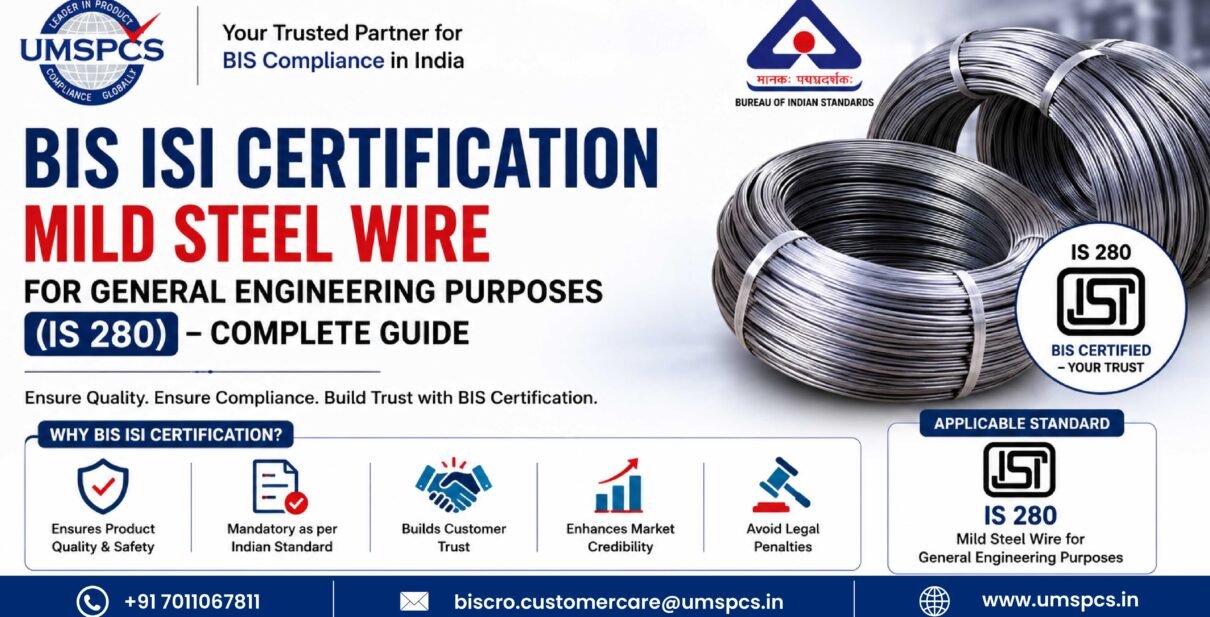
Once you step inside an engineering shop, fabricating centre, construction project, or manufacturing plant, you will find mild steel wire employed in numerous industrial uses. Mild steel wire is applied in a variety of purposes, such as wire products, fasteners, and general engineering applications, due to its strength and flexibility. But poor wire quality can cause breakages, a decrease in the durability of products, product failure, and safety issues.
Therefore, ensuring the quality of mild steel wire is not just a manufacturing requirement but also a regulatory requirement.
This is used for general engineering purposes and has to be compulsorily certified by BIS ISI Certification for Mild Steel Wire as per IS 280. It is illegal to manufacture, trade, deal, and supply any products in the Indian market unless the manufacturer has the BIS ISI certificate and the BIS ISI Mark.
What is the BIS ISI certification for Mild Steel Wire for General Engineering?
It is an obligatory conformity test for the product that falls within the scope of the relevant Quality Control Order (QCO) issued by BIS. The manufacturer needs to confirm that the mild steel wire is in compliance with IS 280 before making it available in the Indian market for use in general engineering.
This certificate means that the product is certified according to the relevant requirements laid out in the Indian Standard. Upon successful inspection, the manufacturer obtains the right to affix the ISI mark.
What is mild steel wire for General Engineering Purposes?
Mild Steel Wire for General Engineering Purpose is a steel wire with low carbon content. It is commonly employed in many industries that require high strength, flexibility, and workability.
Common applications include:
- The production of wire products.
- Fasteners and industrial components
- Wire mesh and fencing.
- Works of construction and fabrication.
- Construct springs and engineering assemblies.
- This information has been provided for agricultural and industrial use.
Because of their versatility in many industries, it is important to have consistent quality and performance from these wires.
Why is the BIS ISI Certification for Mild Steel Wire Mandatory?
The Government of India made BIS ISI Certification for Mild Steel Wire mandatory, as it ensures that the manufactured and supplied in the Indian market is of the prescribed quality as per IS 280.
Certification helps ensure:
- Consistent product quality
- Pre-compliant with Indian Standards
- Improved mechanical performance
- Improved durability and reliability
- Enhanced consumer confidence
- Compliance with BIS regulations is legal.
Products that are not licensed by BIS are not legally manufactured or sold in the areas covered by the Quality Control Order.
Products Covered Under IS 280
The standard details the quality requirements of the manufacturing and performance of the mild steel wire intended for general engineering use.
The standard mainly focuses on:
- Mild Steel Wire for engineering purposes
- The steel wire used has a varying diameter. The steel wires provided are of different diameters.
- Both annealed and unannealed wire (when applicable)
- General-purpose industrial wire
Before applying for the BIS certification, the manufacturers are advised to ensure that their products are covered by the scope of IS 280.
Applicable Tests for Mild Steel Wire (IS 280)
Product samples are tested in a BIS-recognised testing laboratory to check their compliance with IS 280. The tests are usually comprised of:
- Tensile Strength Test
- Wrapping Test
- Bend Test
- Checking the diameter and tolerance.
- Chemical Composition Test
- Surface Finish Examination
- Mass and Dimensional Checks
Passing the tests is a prerequisite for the award of the BIS licence.
Process of BIS ISI Certification for Mild Steel Wire
The average time for the BIS ISI Certificate for Indian Manufacturer procedure is around 30-40 working days if there are no incidents during testing and inspection.
Step 1: Choose the Appropriate Indian Standard
First, find the Indian Standard (IS code) applicable to the product.
Manufacturers must:
- Know product requirements
- Make products according to the BIS standards
- Increase production techniques if necessary
- Increase production techniques if necessary
Step 2: Test the Product & Document
The product has to be tested in a BIS-recognised and NABL-accredited lab.
At this point, samples of the product are tested for this.
- Technical documents are created.
- Data is collected relating to the factory and manufacturing.
- Completed application forms and manufacturing.
Step 3: Submit Application
The BIS application is an online application that includes an application letter, a BIS form and a copy of the DHS grant letter.
- Required documents: report of test
- Plant Info
- Government fees apply.
- On submission of the application, it is processed by the BIS authority.
Step 4: BIS Factory Inspection
The BIS officials visit the manufacturing plant to verify
- Production process
- Production Environment
- Quality control scheme
- Testing capacity
During the inspection, samples of the product may also be taken for independent analysis.
Step 5: Testing Products and Uploading Lab Reports
Samples collected are sent for analysis to approved laboratories. The Lab Test Report (LTR) is then sent directly to the BIS for evaluation by the lab.
Step 6: Closure of Non-Conformities (if any)
If BIS finds any issues in its inspection or testing, there is a need for corrective measures to be taken.
- Will need to provide new documents
- Any non-conformance is to be taken care of
Step 7: Payment of Licence & Marking Fees
Once BIS has completed the certification process, the manufacturer must pay the following:
- Annual licence fee
- ISI marking fee
Step 8: Granting of ISI Licence
The BIS issues an ISI licence after the testing, inspection and payment procedures are completed. This allows the manufacturer to use the ISI mark of certified products.
Necessary documents
- Documents required for BIS ISI Certificate for Indian Manufacture List
- Documentation is the key to getting approval and certification fast.
Documents Required for Mild Steel Wire Typical
- Manufacturing unit and basic data product segment
- Certificate regarding manufacturing facility proof of address (Ownership certificate/rent agreement/certificate from the utility department)
- Registration Certificate for the Trade Mark
- Manufacturing licence / statutory clearances
- Product drawings/design schematics.
- Manufacturing Capacity Installed
- Specification & list of materials used
- Details of machinery and equipment for manufacture
- The factory layout plan shows production and testing areas and storage areas
- The manufacturing process flow is described in detail. A detailed manufacturing process flow is provided.
- Calibration data and internal test equipment
- Information about quality control personnel
- Organisational chart of the factory
When the documentation is correct and complete, delays and objections are minimised in the certification process.
Cost and Timeline of BIS ISI Certification for Mild Steel Wire
The fee for BIS ISI Certification for Mild Steel Wire varies according to the following:
- Product category
- Testing requirements
- Factory size
- Documentation complexity
| Particulars | Estimated Cost (INR) |
| Application Fees (BIS) | ₹1,000 |
| Testing Charges (Lab Fees) | 15000 – ₹250,000 |
| Factory Inspection Charges | ₹ 7,000 |
| Annual Licence Fees | ₹ 1,000 |
| Marking Fees (ISI Mark Usage) | As per BIS norms (based on production) |
| Consultancy Charges (UMSPCS) | ₹ 50,000 |
Estimated Timeline
- Estimated length of time: 30 – 40 working days
- AIF Products: As long as 180 days in some cases
Benefits of BIS ISI Certification for Mild Steel Wire
For manufacturers, getting a BIS ISI Certification for Mild Steel Wire brings some benefits.
- Legal Compliance: Allows the manufacturer to legally produce and market products under the relevant quality control order.
- Better Product Quality: Ensures conforming product quality as per the quality requirements as specified in IS 280.
- Increased Customer Confidence: The ISI mark assures the product quality standard.
- Improved Market Access: Supports manufacturers in being involved in the institutional procurement and government projects.
- Certified products are more accepted than non-certified products because of their competitive advantage.
- Improved Brand Reputation: Indicates the manufacturer’s quality and regulatory standards.
Common Challenges Faced by Manufacturers
Manufacturers may experience difficulties like the following:
- Incorrect product classification
- Incomplete documentation
- Product testing failures
- Delays in laboratory testing
- BIS technical queries
- Factory inspection observations
- Non-compliance with IS 280 norms
If these matters are not sorted out properly, they will delay the process of certification and increase costs for the project. Also can get information about BIS Certification for Electronic Product.
Why Choose UMSPCS for BIS Certification Mild Steel Wire?
To get BIS ISI Certification for Mild Steel Wire, one requires technical knowledge and expertise in the BIS procedure. UMSPCS provides end-to-end assistance to manufacturers, ensuring a smooth and efficient certification process.
Our services include:
- Product applicability assessment
- Indian Standard identification
- Documentation support
- Laboratory coordination
- BIS application filing
- Factory inspection assistance
- BIS query handling
- Post-certification compliance support
UMSPCS has vast expertise in the BIS certification industry to secure a manufacturer’s BIS licence without any delays and ensure adherence to the regulations.
Conclusion
The manufacturers who plan to sell Mild Steel Wire for General Engineering Purposes (IS 280) in the Indian market are required to have BIS ISI Certification for Mild Steel Wire. The certification helps to meet the prescribed quality and performance requirements and boosts customer confidence and market acceptance.
The process of getting BIS certification can be complicated and time-consuming for both Indian manufacturers and foreign manufacturers looking to export their products to India, and can involve testing, documentation, factory inspection, and regulatory compliance. UMSPCS can offer complete assistance to you during the entire process, helping you get a BIS licence hassle-free.
Read more also: BIS CRS Certification Consultant in Chennai: Complete Guide
Frequently Asked Questions
- Is BIS ISI certification mandatory for Mild Steel Wire?
Yes. Any manufacturer or dealer of Mild Steel Wire covered in IS 280 should get BIS ISI Certification before entering the market of India.
- Are applications from foreign companies for BIS ISI certification accepted?
Yes, applications for certification by foreign manufacturers are accepted via the FMCS programme.
- What is the time taken for the BIS certification process?
It usually takes around 30-45 business days to get the certification done.
- What documents are required for BIS certification?
Business registration documents, factory information, product specifications, quality control information and other supporting documents are usually required by manufacturers.
- How can UMSPCS assist in obtaining BIS ISI certification?
Documentation, product testing, application filing, factory inspection, and post-certification compliance are fully supported by UMSPCS, making it easy for your product to be certified.
❓ Ask a Question
Have any doubts? Fill the form below and our team will respond shortly.