Consider the number of rechargeable batteries you use every day. Right from your mobile phones, laptops, and power banks to other Bluetooth devices, sealed secondary cells are an essential part of your everyday life today. However, with the rising cases of heating up, leaking, fire hazards, and exploding batteries, it becomes vital to ensure the safety of the same.
For the safety of the consumers as well as maintaining certain standards of quality, it has been made mandatory by the Bureau of Indian Standards (BIS) that these products get their BIS Certification for Sealed Secondary Cells according to the Compulsory Registration Scheme (CRS). Any manufacturer wanting to sell their product in the country needs to get themselves registered with BIS as per the Indian Standard.
In this detailed guide, you will find everything that you need to know about IS 16046:2015 as explained by UMSPCS.
What is BIS Certification for Sealed Secondary Cells?
BIS Certification for Sealed Secondary Cells is a requirement for compulsory registration according to the BIS Compulsory Registration Scheme.
This scheme requires that rechargeable batteries/ cells with alkaline or any other non-acid electrolyte adhere to certain standards for their safe use before they can be marketed or imported into India.
This standard is harmonised with IEC 62133 and provides safety specifications for rechargeable battery technology in portable electronics.
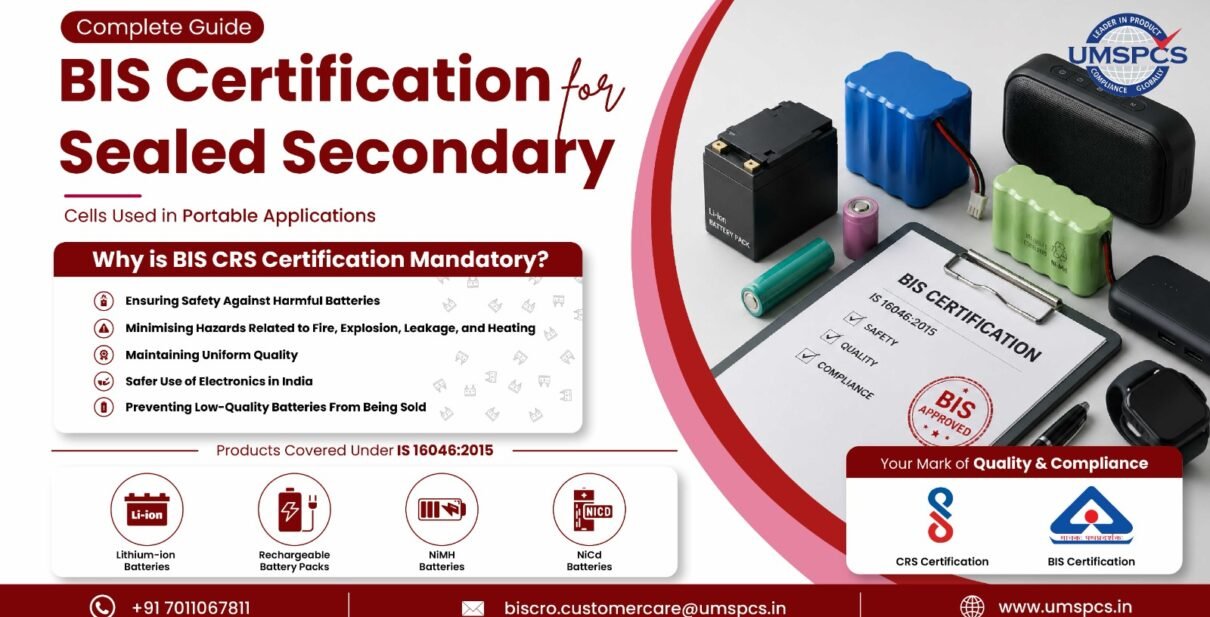
Why is BIS CRS Certification Mandatory?
The Indian government brought in compulsory registration for:
- Ensuring safety against harmful batteries
- Minimising hazards related to fire, explosion, leakage, and heating
- Maintaining uniform quality
- Safer use of electronics in India
- Preventing low-quality batteries from being sold
- Improved compliance within the electronics industry
Without BIS certification, producers have no legal right to manufacture, import, store, distribute, or sell relevant products in India.
Products Covered Under IS 16046:2015
This standard applies to portable secondary cells and batteries having alkaline or other non-acid electrolyte systems.
Some typical products are:
Lithium Batteries
- Lithium-ion Batteries
- Lithium Polymer Batteries
- Rechargeable Battery Packs
- Phone Batteries
- Tablet Batteries
- Laptop Batteries
- Camera Batteries
Nickel Batteries
- NiMH Batteries
- NiCd Batteries
This standard is explicitly applicable to the safety requirements of portable equipment applications.
Key Safety Requirements Under IS 16046:2015
The purpose of the standard is to ensure safety in normal use and foreseeable misuse.
Important areas include:
- Electrical Safety
- Mechanical Safety
- Thermal Safety
- Construction Requirements
This standard greatly eliminates risks from batteries.
Applicable Tests for BIS Certification
Sample tests should be conducted in a laboratory recognised by BIS before registration.
Testing includes the following:
- Electric Testing
- Mechanical Testing
- Environmental Testing
- Safety Testing
It confirms that the product meets the safety standards of IS 16046 before approval.
Eligibility Requirements for BIS Registration
For application purposes, the applicant needs to have:
- Legally established manufacturing facility
- Product testing carried out at laboratories accredited by BIS
- Process of manufacturing the product
- Procedures for quality management
- Product labeling details
- Technical specification
- Relevant documents
Domestic manufacturers can apply as well as foreign manufacturers.
Documents Required for BIS Certification
The following are some of the documents that are typically needed:
- Business Registration Certificate – Proof of incorporation/ legal registration of the company
- Details and specifications of Product – Technical details of the product
- Test Reports – Provided by BIS-certified labs for compliance
- Trademark certificate – Proof of trademark (if any)
- Letter of authorisation – For the signatory authorised person
- AIR Documents – Mandatory for foreign companies having an Authorised Indian Representative
Proper documentation is essential to avoid application delays.
BIS Certification Procedure for Sealed Secondary Cells
1. Product Profiling & Standard Identification
Step one involves evaluation of the product specifications and identifying the relevant Indian Standard (IS) in the BIS CRS system. It is imperative to get the right standard since it determines compliance with the requirements.
Identification of the right standard will help to avoid:
- Inappropriate classification of the product
- Errors during testing
- Application objection
- Product Testing and BIS Laboratory Coordination
After identification of the relevant standard, product samples are tested by recognised BIS laboratories. The whole process of testing is coordinated by UMSPCS.
These include:
- Test planning and scheduling
- Laboratory coordination
- Assessment of product specifications in terms of BIS requirements
- Collection of test results
This ensures that the product complies with all BIS requirements.
3. Documentation Preparation & Application Support
BIS CRS certification entails elaborate technical documentation and regulatory requirements that our professionals prepare and compile in the form of an entire application.
Documentation services comprise:
- Technical documentation and specifications
- Electrical circuit diagrams and schematics
- Product manuals and labeling details
- Process information on manufacturing
- Quality control documents
- Declarations
- AIR documents for foreign manufacturers
Properly prepared documentation will minimise objections and expedite the certification procedure.
4. Application Filing & BIS Coordination
After completion of tests and documentation, we file the application at the BIS CRS Portal. Our team coordinates with BIS for all aspects of the review process.
We facilitate:
- Online submission of the application
- Technical clarifications
- Answering BIS queries
- Certification authority follow-ups
A timely response to BIS observations will ensure smooth certification.
5. Issuance of BIS Registration & R Number
The registration certificate, along with the R Number, will be issued by BIS upon satisfactory review.
BIS registration entails:
- Authorisation of R Number
The registration is typically valid for two years and will allow you to manufacture, import, distribute and sell the BIS-registered products in India.
6. Marking & Labelling Compliance
Products that have been certified should conform to the marking and labelling requirements laid down by BIS. UMSPCS will guide you on how to properly implement all mandatory label provisions.
Our assistance will include:
- Proper use of the BIS standard mark
- Presentation of the assigned R-number
- Labelling requirements on the products and packages
- Label placement compliance
- Checking the package compliance
Proper labelling of products is crucial for regulatory compliance.
7. Post-Certification Compliance & Renewal Assistance
Compliance with BIS standards does not cease once certification has been issued. We offer post-certification assistance in ensuring that manufacturers’ BIS compliance is continuous.
Our services will include:
- Re-registration of CRS
- Introduction of new models of products
- BIS surveillance support
- Notification of changes in regulations
- BIS standard revision compliance
This will guarantee manufacturers’ BIS compliance at all times.
Costing & Timeline of BIS Certification for Sealed Secondary Cells
The total cost normally includes:
- Laboratory Testing Fee
- BIS Registration Fee
- Professional Consultancy Fee
- Documentation Fee
- AIR Fee (for foreign manufacturers)
Costs will be different for each product due to the product complexity, the chemical type of batteries, and the number of different models.
It is normally 20-30 days, but it may vary depending on how ready you are for testing and documentation.
Common Challenges Faced by Manufacturers
Although it is a simple process, manufacturers may experience:
- Misclassification of Products: Inadequate identification of relevant standards leads to delays.
- Failing Tests: Design errors lead to the failure of safety tests on the products.
- Incorrect Documentation: Absence of documentation may trigger objections.
- AIR Approval Challenges: Non-compliance issues may occur due to foreign manufacturers.
- Delays in Approvals: Incorrect application processes cause lengthy processing times.
Professional assistance may assist in mitigating such risks.
Benefits of BIS Certification for Sealed Secondary Cells
There are several benefits associated with attaining BIS certification as follows:
- Regulatory Compliance: Guarantees entry into the legal market of India.
- Consumer Confidence: Battery certificates ensure that the batteries are safe for use.
- Image Creation: Proves commitment to excellence and safety of the products.
- Advantage over Competition: Helps create a good image among distributors and OEMs.
- Product Recall Prevention: Eliminates the chances of having products recalled.
Why Choose UMSPCS for BIS CRS Certification?
UMSPCS is a reliable consultancy for BIS compliance, helping domestic as well as international companies to obtain CRS, ISI, and FMCS certificates. We help you with full support, right from standard identification to testing, documentation, application submission, and other compliance processes.
We offer:
- Project Management
- Technical Documentation
- Laboratory Support
- AIR Service for Foreign Manufacturers
- Quick Compliance Solutions
- Compliance Experts
UMSPCS helps with every step in getting the BIS registration, whether it’s a BIS CRS Certification for Indian Manufacturers or a BIS registration for foreign manufacturers.
The Future of Battery Compliance in India
With the continued growth of India’s electronic device production capacity, safety regulations concerning batteries will become even stricter.
Companies that make an effort to adhere to BIS standards not only secure their right to enter the market legally but also increase their competitiveness in such a demanding market.
Making investments in certification today is important for ensuring future success.
Conclusion
There has been a rising demand for rechargeable batteries and mobile electronics in India. BIS Certification for Sealed Secondary Cells according to IS 16046:2015 is therefore a must for any exporter or manufacturer to guarantee safety, reliability, and BIS compliance.
Whether you are an Indian manufacturer intending to sell batteries locally or an international company selling batteries to India, it is mandatory to be registered at BIS before trading.
Seeking professional help for your BIS CRS Certification for Sealed Secondary Cells?
At UMSPCS, we provide full support in testing, documentation, the application process, AIR services, BIS compliance, and more. Talk to us today!
Read more also: BIS Certification for Polyethene Films and Sheets – Guide 2026
FAQs
- Is BIS Certification for Sealed Secondary Cells Mandatory in India?
Yes, all kinds of sealed secondary cells and batteries falling within the scope of the relevant BIS standard need to be registered in India for being sold, imported, or distributed.
- Who can apply for BIS CRS Certification for Indian Manufacturers?
All Indian manufacturers manufacturing the products that fall within the scope of the notified BIS standard can apply for registration with BIS CRS.
- Can Foreign Manufacturers Get BIS Certification for Exporting Batteries to India?
Foreign manufacturers can also avail themselves of BIS certification, but they need to appoint an Authorised Indian Representative for coordination with BIS.
- How long will BIS Certification for Sealed Secondary Cells take?
Certification is usually completed within 20-30 working days from the time of application.
- What Tests are Performed Under IS 16046:2015?
Electrical, Mechanical, Environmental and Safety testing, like Short Circuit Testing, Vibration Test, Thermal Test, and Overcharge Test, are performed under this standard.
- Why should Manufacturers Hire a BIS CRS Consultant in India?
Because they help the applicant in avoiding any mistakes, problems or errors related to documentation, testing, compliance or registration.
❓ Ask a Question
Have any doubts? Fill the form below and our team will respond shortly.