Just think about spending lots of money on making high-grade Polyethene Films and Sheets, only to find out later that your products will not have the legal right to enter the Indian market without being compliant. This may seem like an unrealistic scenario, but it happens all the time for both manufacturers, importers, and foreign producers.
With the ever-evolving Indian quality standards, BIS Certification is now becoming a must-have certificate for several industries. If you belong to the list of Polyethene Film & Sheet Manufacturers under IS 2508, then BIS ISI Certification is a must-have for you.
In this blog, we bring to you a complete guide to BIS Certification for Polyethene Films and Sheets.
Understanding BIS Certification for Polyethene Films and Sheets (IS 2508)
The Certification Scheme called BIS Certification is a conformity assessment scheme carried out by the Bureau of Indian Standards (BIS), which is the national standards organisation of India.
The standard applicable for ‘Polyethene Films and Sheets for Industrial and Commercial Applications‘ is IS 2508 – Polyethene Films and Sheets – Specification.
For manufacturers to achieve compliance with IS 2508, it is necessary for them to acquire a BIS license and affix the ISI Mark on their products once successfully tested and cleared by BIS.
The BIS Certification will ensure the product fulfils all the quality, safety, dimensional and performance parameters required by the Indian Standard.
Products Covered Under IS 2508
This standard normally covers:
- Polyethene Films
- Film for Packaging
- Protective Film
- Industrial Film
- Wrapping Film
- Polyethene Sheets
- Commercial Sheet
- Industrial Sheet
- Protective Sheet
- Agricultural Sheet
- Related Polyethene Products
- General Purpose Polyethene Sheets
- Flexible Polyethene Materials
- Thin-Gauge Polyethene Films
Product applicability may vary according to the nature of the particular product specification. Product classification is very important before the BIS application.
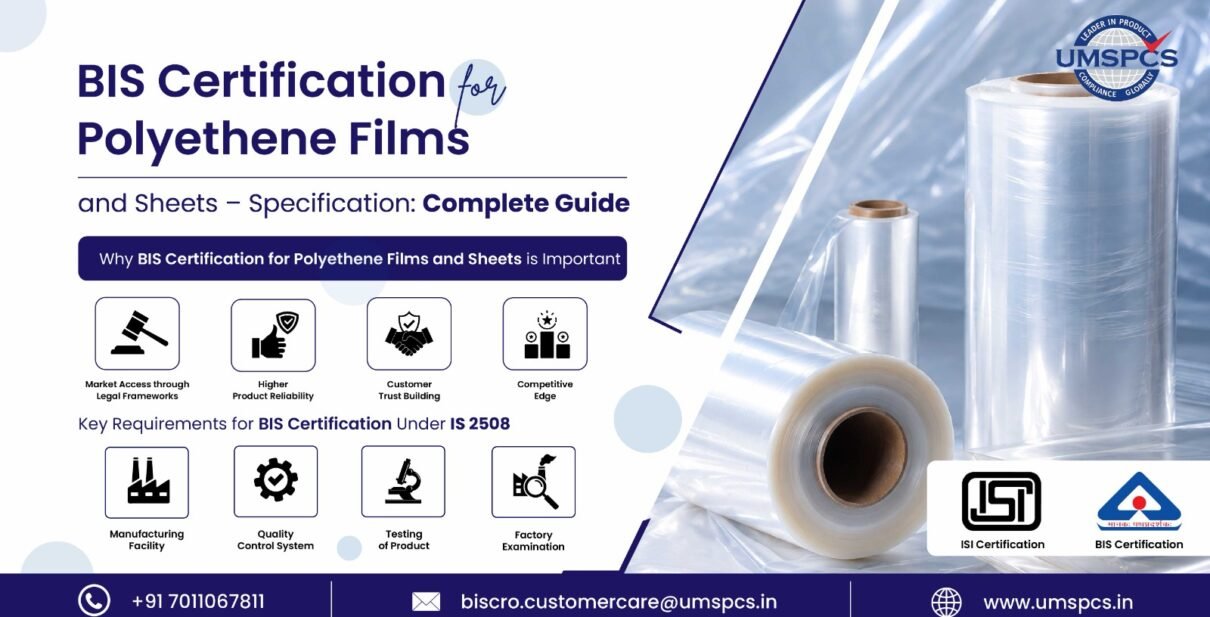
Why BIS Certification for Polyethene Films and Sheets is Important
There are various benefits of getting BIS certification for manufacturers.
- Market Access through Legal Frameworks: Manufacturers can sell their goods under the Indian standards of quality via BIS certification.
- Higher Product Reliability: ISI is an indicator of reliability and quality for customers.
- Customer Trust Building: This increases trust in the products of the manufacturer by wholesalers, contractors, government purchasers, and industrialists.
- Competitive Edge: Products that have been certified by BIS are favoured in many projects.
- Quality Control: BIS certification ensures that the products are produced using standard procedures.
- Market Security: It protects manufacturers from legal issues and other risks involved in the marketplace.
Key Requirements for BIS Certification Under IS 2508
Several conditions must be fulfilled in order for the manufacturer to obtain a certificate.
- Manufacturing Facility: Applicants should have a functional manufacturing facility that can manufacture goods based on IS 2508 specifications.
- Quality Control System: Adequate testing facilities for ensuring quality control are required.
- Testing of Product: All products need to pass IS 2508 testing criteria.
- Technical Data: Technical and manufacturing data needs to be submitted to BIS.
- Factory Examination: Factory examination can be conducted by BIS officers.
Eligibility Requirements for BIS Certification
Some of the parties that are allowed to use BIS certification include:
- Manufacturers of Indian Origin – Manufacturers of polyethene films and sheets produced in India.
- Manufacturers of Foreign Origin – Those who manufacture products outside of India and wish to export them to India using the BIS certification route.
- Industrial Size Manufacturers – Large-scale manufacturers of polyethene products.
- SMEs – Small and medium enterprises that fulfil the manufacturing and quality criteria.
This makes BIS certification for foreign manufacturers particularly important for global suppliers planning to enter the Indian market.
Documents Required for BIS Certification
Documentation usually involves the following:
- Base data of the manufacturing plant and the product category
- Evidence of the manufacturing plant’s location (e.g. ownership/leasing document,
- utility bills, etc.)
- Brand trademark certificate (if the brand name is registered)
- Manufacturing license / statutory clearances (wherever applicable, such as environmental
- and sectorial)
- Product designs/schematic drawings
- Manufacturing capacity installed
- Listing of material composition along with its specification
- List of manufacturing machines/ equipment utilised
- Layout plans of the factory comprising manufacturing and testing facilities, along with a storage facility
- A complete manufacturing process flow chart is provided.
- The manufacturing process flow chart is provided.
- In-house testing equipment details and calibration process
- Details about the quality control team members
- Organisational chart for the factory
Proper documentation ensures a faster approval process.
Step-by-Step BIS Certification Procedure for Polyethene Films and Sheets
Step 1: Identify the Applicable Standard
The manufacturers should evaluate whether the IS 2508 applies to the product or not, and should check whether the product meets the standard requirements.
Important Activities:
- Check whether the product falls under the scope of IS 2508
- Review product specifications
- Ensure that the manufacturing process complies with BIS requirements
Step 2: Product Testing & Documentation
Testing of the product is done in an accredited laboratory, and documents are prepared.
Involves:
- Sample Testing
- Technical Documentation
- Factory Information
- Application Preparation
Step 3: Application Filing
The BIS application is filed along with the necessary documents and fees.
Documents needed for application:
- Test Report
- Factory Details
- Technical Document
- Fees Applicable
Step 4: BIS Factory Visit
Visit of BIS officials to the manufacturing factory
Involves:
- Manufacturing Process
- Quality Control System
- Testing Facilities
- Production Set-Up
Step 5: Sampling Testing & Evaluation
Testing of samples collected during the inspection and submitting the report to BIS.
Involves:
- Product Testing
- Verification of Compliance
- Evaluation of BIS
Step 6: Resolution of Non-Conformity
Observations from BIS have to be addressed before getting approval.
May involve:
- Corrective Actions
- Further Documentation
- Process Improvement
Step 7: Payment of Fees
Payment of fees following successful evaluation.
Involves:
- License Fee
- ISI Marking Fee
Step 8: Grant of ISI License
Upon meeting all the requirements, BIS will award the ISI license.
Advantages:
- Permission to use the ISI mark
- Conformity to Indian Standards
- Market credibility
Cost & Timeline of BIS Certification for Polyethene Films and Sheets
Total costs would depend on the following:
- BIS licensing fee
- Testing fee
- Cost of consulting services
- Documents required
| Particulars | Estimated Cost (INR) |
| Application Fees (BIS) | ₹1,000 |
| Testing Charges (Lab Fees) | 15000- ₹2,50,000 |
| Factory Inspection Charges | ₹7000 |
| Annual License Fees | ₹1,000 |
| Marking Fees (ISI Mark Usage) | As per BIS norms (based on production) |
| Consultancy Charges (UMSPCS) | ₹ 50000 |
As there is variation in specifications and production locations, the total cost of certification varies from case to case.
On average, it takes 30-40 days to obtain the certification.
Common Challenges Faced by Manufacturers
The majority of candidates have some problem in their certification process.
- Wrong Product Classification: Choosing the wrong standard results in refusal.
- Testing Problems: The failure of products may occur from the violation of technical conditions.
- Documentation Mistakes: Incomplete data is another common issue causing delays.
- Preparation Problems for Inspection: Manufacturing plants may not comply with BIS demands.
- Issues for Foreign Manufacturers: Meeting the AIR criteria and inspection is difficult.
Professional assistance will assist in overcoming these barriers.
BIS Certification vs Other BIS Schemes
There is a lot of confusion amongst many producers regarding ISI Certification and CRS Registration.
- BIS ISI Certification
Applied to products that fall under Indian Standard mandates needing factory-based certification and ISI Mark utilisation.
- BIS CRS Registration
Normally applied to electronic equipment.
The key point here is that the former, BIS ISI Certification for electronic products, is subject to different standards than Polyethene Films and Sheets as per IS 2508.
Why Choose UMSPCS for BIS Certification?
UMSPCS makes it easier for BIS certification by providing complete assistance with compliance, including standard identification, testing coordination, documentation, and BIS approvals. With experience in more than 600 compliance projects, we assist Indian and international manufacturers in obtaining certification and compliance to enter the Indian market.
These services encompass:
- Product Applicability Evaluation: Determining the right BIS certification scheme and Indian Standard.
- Documentation Assistance: Development of complete compliance documentation.
- Lab Coordination: Help with sample testing and test reports.
- Submission of Application: Submission of the BIS application on the BIS portal.
- Factory Inspection: Helping manufacturers prepare for BIS inspection.
- Foreign Manufacturers: Comprehensive assistance to foreign manufacturers, including help with AIR.
- Post-Certification Compliance: Assistance in compliance after certification.
Our team’s extensive experience with BIS compliance makes us a preferred partner for manufacturers.
Future Market Opportunities for Certified Manufacturers
As regulations for quality keep increasing by the day, ISI-certified manufacturing firms become more advantageous.
Advantages that a BIS Certification for Polyethene Film and Sheets manufacturing firm can enjoy include:
- Market acceptance
- Credibility
- Procurement
- Export/Import confidence
- Regulatory compliance
The ISI mark is a clear sign of quality and compliance with standards.
Conclusion
There is a growing need for quality-approved industrial products in India. In this regard, the importance of BIS Certification for Polyethene Films and Sheets manufacturing cannot be overlooked by companies covered by IS 2508. It is important to plan and execute this process in the best way possible.
This includes testing of products, preparing documentation, conducting plant inspections, and getting the ISI Mark. Both domestic manufacturers and international suppliers can benefit from the expert advice of professionals in getting BIS Certification for foreign manufacturers.
Looking for BIS Certification for Polyethene Films and Sheets (IS 2508)?
At UMSPCS, we provide complete assistance with regard to BIS Registration, arranging for product testing, preparing documentation, factory inspections, ISI Mark Approval, and managing compliance after getting approval.
Contact UMSPCS now and get on with the process of BIS Certification with ease.
Read more also: Best BIS Consultant Chennai in 2026: CRS, ISI, & FMCS
FAQs
- Is BIS Certification Mandatory for Polyethene Films & Sheets according to IS 2508?
This would depend on existing regulations set by BIS and the Quality Control Order. It is advised that manufacturers check if their product type requires mandatory BIS Certification.
- How many months will it take to get the BIS Certification for Polyethene Films and Sheets?
It normally takes 30-40 working days for BIS Certification, depending on the various stages involved.
- Can foreign manufacturers get BIS Certification for Polyethene Films and Sheets according to IS 2508?
Yes, they can do this within the existing BIS Certification procedure with the assistance of an Authorised Indian Representative.
- What kind of tests are carried out during Polyethene Films & Sheets certification?
The tests could include thickness verification, tensile strength, elongation, dimensional testing, density verification, and workmanship inspection, among others, as per IS 2508.
- How much is the cost for BIS Certification for Polyethene Films & Sheets?
Cost will depend on several factors, including the type of product, the cost of testing and documentation, among others.
- Why do manufacturers need a BIS ISI Consultant in India?
A skilled BIS ISI Consultant in India will ensure that manufacturers remain compliant with all requirements, help in avoiding approval delays, handle documentation issues, conduct tests, and increase the probability of certification.
❓ Ask a Question
Have any doubts? Fill the form below and our team will respond shortly.