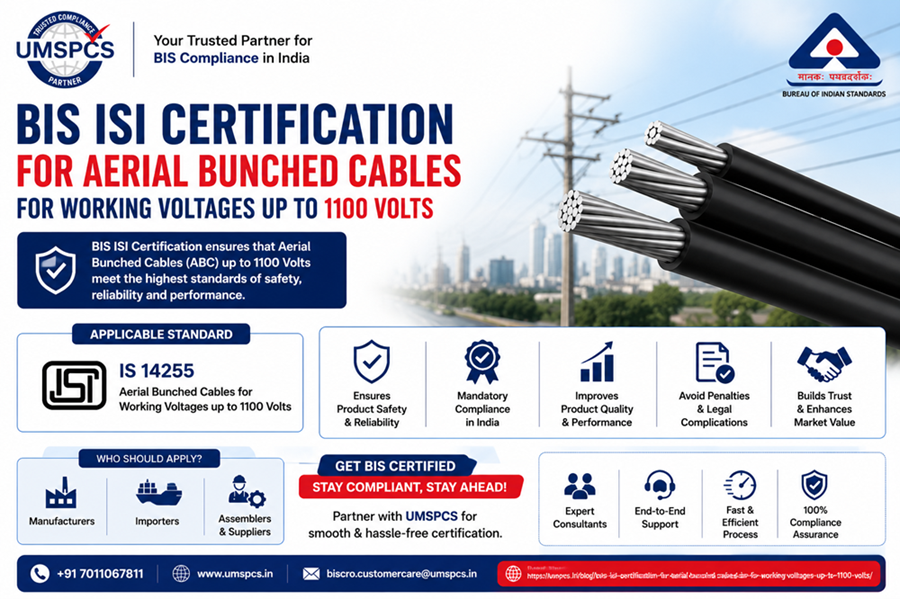
Any manufacturer who wishes to manufacture ABC Cables to be sold within India should be certified through the BIS ISI certification process as per the QCO governing their manufacture. As per the QCO governing the manufacturing of aerial bunched cables, cables meant for an operating voltage of 1100 volts or less have to conform to IS 14255.
Aerial bunched cables are commonly employed in overhead power distribution networks, both in urban and rural settings. These cables provide superior safety, power theft protection, low maintenance, and enhanced reliability.
The process of BIS ISI certification for aerial bunched cables according to IS 14255 would be necessary for any firm intending to produce, import, or sell such cables in India. Knowledge of how to apply for the certificate and all the other related processes would come in handy here.
What is BIS ISI Certification for Aerial Bunched Cables?
BIS ISI Certification is a system of certification managed by the Bureau of Indian Standards (BIS). BIS ISI certification for aerial bunched cables is a certification that guarantees your products comply with the requirements of IS 14255.
This certification can assist businesses:
- Comply with Indian regulations
- Demonstrate the quality and safety of products
- Build customer confidence
- Improve market credibility
- Reduce compliance risks
- Do business legally in India.
Understanding IS 14255 for Aerial Bunched Cables
IS 14255 lays down the specifications for polyethene and XLPE insulated aerial bunched cables having aluminium conductors twisted over the messenger aluminium alloy wire for use in overhead distribution systems.
The standard covers:
- Conductor requirements
- Insulation specifications
- Construction requirements
- Mechanical performance
- Electrical performance
- Identification and marking requirements.
- Testing procedures
Compliance with IS 14255 enables the cables to be supplied to the market with safety and performance to the prescribed limits.
Who Needs BIS ISI Certification for Aerial Bunched Cables?
1. Indian Manufacturers
All the manufacturers who manufacture aerial-bunched cables for sale in the Indian market are required to get a valid BIS ISI certification for Indian manufacturers, according to IS 14255. Certification is the process of establishing conformity of a product with the required quality, safety, and performance standards before its manufacture and supply in the Indian market.
2. Foreign Manufacturers
Foreign suppliers must obtain Bureau of Indian Standards (BIS) certification before they can import aerial bunched cables into India. Additionally, they have to designate an Indian Representative (AIR) for BIS for Foreign manufacturers certification to handle certification and compliance-related matters of foreign manufacturers.
3. Importers and brand owners
Importer owners will be responsible for ensuring that the aerial bunched cables being introduced to the Indian market meet the BIS requirements. They have to ensure that the products have a valid ISI Mark and are certified before distribution in India.
4. Dealers and Retailers
All the traders and distributors of aerial bunched cables should deal only in ISI-marked cables as per BIS standards. It ensures adherence to regulations, confidence in product quality, and continued acceptance in the marketplace.
BIS ISI Certification Process for Aerial Bunched Cables
There are various stages involved in the BIS ISI certification procedure that ensure that the product being certified meets the standards. Manufacturers may apply for BIS ISI certification through the applicable BIS certification procedure based on product eligibility and compliance readiness.
Step 1: Determine Which Indian Standard Applies
The first step is to determine which Indian Standard (IS) code is appropriate for the product. Manufacturers must:
- Recognise the needs of the product
- Produce goods in compliance with BIS guidelines.
- If needed, enhance production methods.
Step 2: Documentation and Product Testing
The product must be tested in a lab accredited by NABL and recognised by BIS.
At this point:
- Product samples are analysed for this.
- Technical documents are created.
- Data is collected regarding the factory and manufacturing. Filled out application forms.
- Completed application forms.
Step 3: Submit Your Application
The BIS application is online and includes an application letter, a BIS form, and a copy of the DHS grant letter.
Required documents:
- Test reports
- Factory Info
- Other government charges
- The application, once submitted, is put under review by the BIS authority.
Step 4: BIS Factory Inspection
The BIS officials visit the manufacturing plant to check the following:
- Production process
- Environment of Production
- Quality control system
- Facilities for testing
- During the inspection, samples of the product may be collected for independent testing.
Step 5: Submission of Lab Reports and Product Testing
Authorised laboratories receive the collected samples for analysis. After that, the lab sends the Lab Test Report (LTR) straight to BIS for evaluation.
Step 6. Close Non-Conformities
If BIS finds any issues during its inspection or testing, there is a need for corrective measures to be taken.
- New documents will have to be provided
- Any non-conformity should be dealt with
Step 7: Licence and Marking Fee Payment
- The manufacturer is required to pay the following after BIS has finished the certification process: an annual licence fee.
- ISI marking charge
Step 8: ISI Licence Issuance
BIS issues the ISI licence following the completion of the testing, inspection, and payment processes. The ISI mark on certified products can then be used by the manufacturer.
Documents Required for BIS ISI Certification for Aerial Bunched Cables
The significance of accurate and comprehensive documentation in securing a BIS certificate quickly and easily.
Frequently Needed Documents:
- Basic information about the product category and manufacturing facility.
- Address of manufacturer (lease deed, electricity bill, production details, etc.)
- Certification for registration of a trademark (in case of registration of any brand)
- Any statutory clearance and manufacturing licence (as required)
- Technical drawings and designs of the product
- Details about the installed production capacity.
- The list of raw materials used and the specifications.
- Technical details about the production of machinery and equipment
- The factory layout plan shows every area used for testing, production, and storage.
- A detailed flow chart of the manufacturing process.
- Information about calibration documents and on-site testing.
- Information about the personnel responsible for quality control.
Documentation that is properly prepared can speed up the certification process and help avoid questions and processing delays.
BIS ISI Certification Cost and Timeline
Several factors determine the cost of certification:
- Product category
- Testing requirements
- Factory inspection requirements
- Documentation complexity
- BIS government fees
- Consultant support requirements
Estimated Timeline
Products may take longer to be available than indicated due to product readiness and BIS processing.
| Activity | Estimated Time |
| Documentation Preparation | 1–2 Weeks |
| Application Review | 1–2 Weeks |
| Factory Inspection | As Scheduled by BIS |
| Product Testing | 2–4 Weeks |
| Licence Approval | Subject to Compliance Review |
The certification timeline depends on product readiness, testing requirements, factory inspection schedules, and BIS processing timelines.
Benefits of BIS ISI Certification for Aerial Bunched Cables
- Legal market access
- The product complies with Indian standards.
- Improved product credibility
- Enhanced customer trust
- Reduced regulatory risks
- Better business opportunities
- Stronger market reputation
Certification for manufacturers in the power distribution infrastructure market can help increase trust in the long term by bringing utilities, contractors, and buyers into a long-term partnership.
Why Would You Choose to Apply for BIS Certification with UMSPCS?
UMSPCS will offer you complete assistance throughout the certification procedure.
There are lots of consultancies out there. However, few can match UMSPCS’s breadth of experience and practical assistance.
Our track record is proof of 600+ successful BIS projects. We have assisted different manufacturers from various product categories in being certified on time, with many years of BIS consultant experience.
Our Services Include
- Product applicability assessment
- Indian Standard identification
- Documentation support
- Product testing coordination
- BIS application filing
- Factory inspection support
- Compliance management
- Licence renewal assistance
Our team has vast expertise in BIS certification projects, and we assist manufacturers in completing the certification process efficiently with regulatory compliance. Also can get information about Bis certification for LED Lights.
Conclusion
ISI Certification for Aerial Bunched Cable IS 14255 is compulsory for manufacturers who want to sell these products in India. This certification ensures both the quality and safety of the product as per Indian standards and allows legal entry into the market.
Testing of products, documentation, inspection of the manufacturing plant, and compliance management are some of the things that are required here. With proper assistance and planning, the manufacturers will be able to go through this process of certification without any hassles.
At UMSPCS, we provide comprehensive services in relation to BIS ISI Certification for Aerial Bunched Cables. This service includes everything from document creation and filing of applications to testing of products and factory inspection.
Read more also: BIS ISI Registration Consultant Delhi: Guide for Manufacturers
FAQs
- Is BIS certification mandatory for Aerial Bunched Cables?
Yes, all aerial bunched cables as per IS 14255 have to be BIS certified prior to being sold in India.
- Which Indian standard applies to aerial bunched cables?
IS 14255 – Aerial Bunched Cables for working voltages up to and including 1100 volts is applicable.
- Aerial-bunched cables are used for what?
These cables are used for overhead power distribution and offer better environmental protection, reliability and safety.
- Does the factory inspection need to be taken for BIS certification?
Yes, typically, a factory inspection will be carried out before the BIS is likely to issue the licence.
- Will foreign manufacturers be able to receive certification?
Yes, foreign manufacturers can avail themselves of the applicable BIS certification scheme and may be required to appoint an Authorised Indian Representative (AIR).
- How can UMSPCS help with BIS certification for Aerial Bunched Cables?
UMSPCS helps with documentation, test coordination, application filing, inspection preparation, and overall management of BIS compliance.
❓ Ask a Question
Have any doubts? Fill the form below and our team will respond shortly.