Launching a solar power inverter in India is a task. It is not about making a product and selling it. The solar power inverter has to follow the rules and regulations of the country. Before it reaches the customers or the people who sell it, the solar power inverter has to meet all the requirements.
One important thing that solar power inverter companies have to do is register with the Bureau of Indian Standards. This is called the Compulsory Registration Scheme.
The Bureau of Indian Standards Compulsory Registration Scheme for solar power inverters helps make sure that BIS Certification for power inverters use in photovoltaic power systems IS 16221 (Part 2): 2015 ensures these products are safe for use. It does this by checking if the solar power inverters meet safety rules before they are sold in India. If companies that make or import solar power inverters understand how to register their products, they can avoid a lot of problems.
If you are a company that makes solar power inverters in India or in another country or if you import them, you should know about the Bureau of Indian Standards Compulsory Registration Scheme requirements for power inverters. This will help you plan how to get your solar power inverter certified and sold in India.
Understanding the Bureau of Indian Standards Compulsory Registration Scheme for solar power inverters is key to selling power inverters in India.
Why is BIS Certification Mandatory for Power Inverters for Use in Photovoltaic Power Systems?
Power inverters are really important for photovoltaic systems. They take the current from solar panels and turn it into alternating current that we can use to power things or send to the power grid.
Power inverters deal with electricity. Work in different conditions. This means they have to meet safety rules. BIS certification for Power Inverters is necessary to make sure they are safe to use in photovoltaic power systems. BIS CRS registration helps verify that the product has been evaluated against the relevant Indian Standard before being sold in India.
Some key objectives of BIS certification include:
- Making sure products are safe and work well
- Reducing hazards
- Showing that products meet requirements
- Making customers more confident
- Helping products get into the market legally
- Reducing risks related to regulations
For manufacturers and importers getting BIS CRS registered is a step before selling products in India. BIS CRS registration helps them achieve these objectives. Suppliers need to get registered before entering the market.
What is IS 16221 (Part 2):2015
IS 16221 (Part 2):2015 is the Indian standard for safety. This Indian Standard is about the safety of power converters and power inverters used in photovoltaic power systems.
The IS 16221 (Part 2):2015 standard covers safety.
It covers safety aspects for IS 16221 (Part 2):2015 including:
- Protection against electric shock
- Insulation requirements for IS 16221 (Part 2): 2015.
- Temperature limits
- Protection against abnormal operating conditions
- Safe product construction
- Performance under intended operating conditions
Conformance to this standard helps to ensure that inverters in photovoltaic power systems operate safely and reliably over their service life.
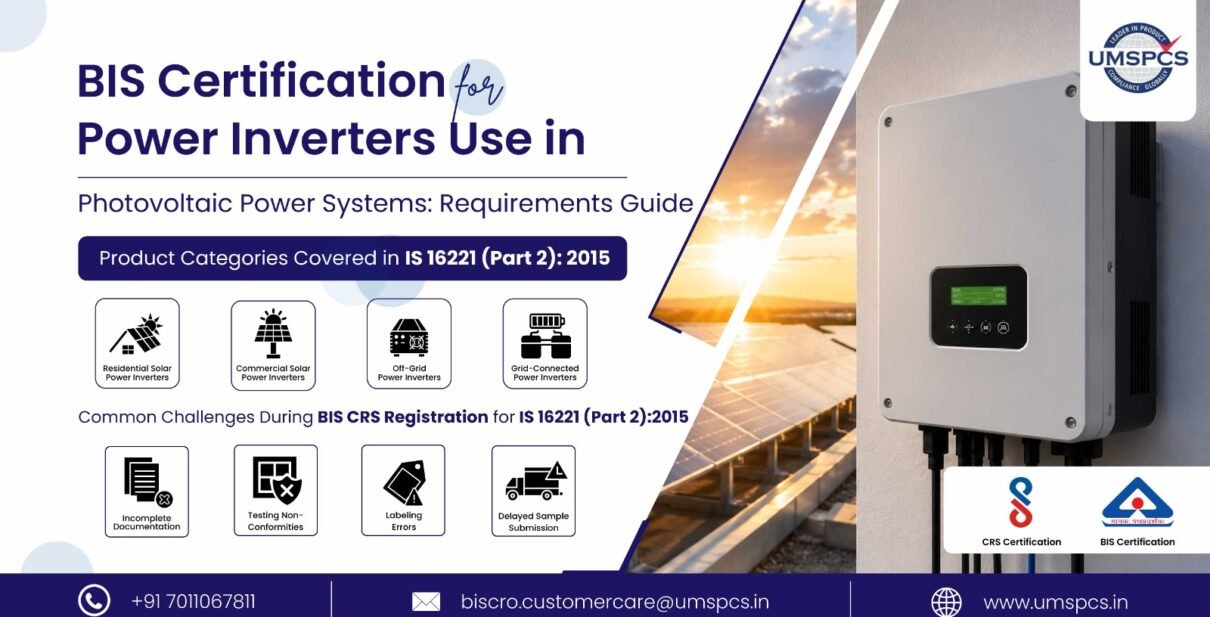
Product Categories Covered in IS 16221 (Part 2): 2015
Power inverters covered under IS 16221 (Part 2):2015 may include:
- Residential solar power inverters
- Commercial solar power inverters
- Industrial solar power inverters
- Grid-connected power inverters
- Off-grid power inverters
- Hybrid solar inverters are a type of inverter.
- Single-phase photovoltaic inverters and
- Three-phase photovoltaic inverters are also types of inverters.
When it comes to making these inverters, manufacturers need to be careful. They should check the product specifications. This assists them in determining if their goods satisfy the BIS CRS standards. You also need to check the specs of single-phase photovoltaic inverter manufacturers and three-phase photovoltaic inverter manufacturers. This assessment defines whether these inverters come under the BIS CRS regulations.
Who Needs BIS CRS Registration for Power Inverters under IS 16221 (Part 2):2015?
BIS CRS Registration for Power Inverters in India as per IS 16221 (Part 2):2015 applies to the business engaged in manufacturing/importing/branding/ supplying Power Inverters for use in photovoltaic power systems in India. These products have to be compliant with the Compulsory Registration Scheme (CRS) before they can be legally available in the Indian market.
Indian Manufacturers
Indian manufacturers are the manufacturers of a power inverter used in photovoltaic power systems in India. It is mandatory for Indian manufacturers to get a BIS ISI certificate for Indian manufacturers to sell these products in the Indian market via the BIS CRS Registration process. The certification ensures that the product meets the safety and performance standards in India. Under the Compulsory Registration Scheme (CRS), manufacturers will be responsible for product testing, documentation, application submission and compliance. Compliance is a way to reinforce market credibility and regulatory acceptance.
Foreign Manufacturers
Foreign manufacturers are those organizations which have their manufacturing base in other countries, manufacturing solar inverters and Power Inverters for use in the Indian market in PV power systems. The manufacturers who produce such inverters should get a BIS certificate for foreign manufacture. Under IS 16221 (Part 2):2015, before importing or selling their products in India. They will need to designate an Authorised Indian Representative (AIR) to lead the certification process most of the time. The registration ensures compliance with Indian regulatory requirements and product safety standards. This also allows for seamless customs clearance and market access.
Brand Owners
Businesses that promote and sell Power Inverters for Use in a photovoltaic power system under their own brand name, regardless of the manufacturer, are called ‘brand owners’. They are required to make sure that the products are manufactured by manufacturers who have a valid BIS Certification for Power Inverters and a BIS CRS registration. It is the responsibility of the brand owner to check compliance, labelling and validity of certification. Compliance with IS 16221 (Part 2):2015 results in safeguarding the brand’s reputation and preventing regulatory problems. It also guarantees that only solar inverters that are certified and comply with the standards are provided to customers.
Step-by-Step BIS CRS Registration Process for IS 16221 (Part 2):2015
IS 16221 (Part 2):2015 BIS CRS The process for registration of BS O HS IS5169:2020 & adding SDoC (to be) information. Good planning can lead to fewer delays and shorter approval periods.
1. Product Profiling and Standard Identification
The first step is identifying the applicable Indian Standard and confirming whether the product falls under BIS CRS requirements.
This helps avoid:
- Incorrect product classification
- Application errors
- Testing complications
2. Product Testing
The product must be tested in a BIS-recognised laboratory.
At this stage:
- Product samples are tested
- Technical compliance is evaluated
- Test reports are generated
3. Documentation Preparation
All required technical and business documents are prepared and reviewed before application submission.
This includes:
- Product specifications
- Technical documents
- User manuals
- Quality-related records
- Authorization documents
4. Application Submission
The BIS CRS application is submitted through the designated registration system along with supporting documents and test reports.
5. BIS Review and Registration Grant
BIS reviews the submitted documents and test reports. Upon successful evaluation, a registration certificate and R number are issued.
6. Product Marking and Labeling Compliance
Manufacturers have to make sure that they label their products the way the Bureau of Indian Standards wants them to.
This includes:
- BIS Standard Mark
- Registration Number (R-Number)
- Required product details
7. Renewal and Ongoing Compliance
Businesses have to keep an eye on their product marking and labelling compliance records. They also need to renew their registration on time for product marking and labelling compliance. This is something that businesses need to do when it is required for product marking and labelling compliance.
Documents Required for BIS CRS Registration for IS 16221 (Part 2): 2015
Having the documents is very important for the registration process. If you have the documents, it will not take as long to register. This is because the right documents help with the BIS certification process for IS 16221 (Part 2):2015 products.
The right documents also help to get products approved quickly and reduce the chance of them being rejected.
If some documents are missing or wrong, the application might be. Delayed. So it is very important to prepare every document. You have to make sure that every document is what the BIS guidelines say it should be for BIS CRS Registration.
Businesses need to follow the BIS guidelines for their product marking and labelling compliance.
Required Key Documents
- A business registration certificate is proof of the company’s incorporation or legal status.
- Product Specifications & Details: All technical information about the product
- Test Reports: Compliance certification from BIS-approved laboratories
- A trademark certificate, if applicable, is evidence of brand ownership.
- Authorisation Letter for Authorised Signatory or Representative
- AIR Documents: An authorised Indian representative must be appointed by foreign manufacturers.
Accurate and comprehensive document support:
- A faster procedure for approval
- Fewer opportunities for objections
- A simple procedure for certification
- Increased adherence to BIS specifications
For the BIS CRS certification in India, the documentation process becomes straightforward, allowing companies to obtain certification quickly. Moreover, UMSPCS offers
Cost and Timeline of BIS CRS Registration IS 16221 (Part 2):2015
The cost of BIS CRS registration for IS 16221 (Part 2): 2015 depends on several factors, including:
- Product category
- Testing requirements
- Number of product models
- Documentation complexity
- Government fees
- Compliance requirements
On average, it takes 20 to 30 working days, depending on product readiness and documentation completeness.
Common Challenges During BIS CRS Registration for IS 16221 (Part 2):2015
Many businesses experience delays because of avoidable compliance issues.
Some common challenges include:
Incomplete Documentation
Missing or inaccurate documents often result in application queries and approval delays.
Testing Non-Conformities
Products that fail testing may require modifications and re-testing.
Incorrect Product Classification
Selecting the wrong product category can create additional compliance issues.
Labeling Errors
Incorrect use of BIS markings or registration details can lead to compliance concerns.
Delayed Sample Submission
Late sample submission may increase project timelines and delay certification.
Advantages of Certification in BIS CRS for Power Inverters
Obtaining BIS Certification for power inverters used in photovoltaic power systems offers several advantages.
Principal Advantages
- Improved market accessibility
- Increased client trust
- Enhanced product credibility
- Decreased risks associated with compliance
- Improved reputation of the brand
- Enhanced adherence to regulations
- Enhanced commercial prospects
For manufacturers and importers, certification supports long-term business growth and market acceptance.
How UMSPCS Helps You Obtain BIS CRS Certification for Power Inverters
UMSPCS 600+ successful BIS projects are evidence of our track record. We have helped numerous manufacturers across a range of product categories obtain timely certification. Managing technical standards, testing requirements, and regulatory documentation can be challenging without proper guidance.
UMSPCS supports businesses through every stage of the certification process, including:
- Documentation assistance
- Product testing coordination
- Application filing support
- Regulatory guidance
- Compliance management
- Support for Indian and foreign manufacturers
Conclusion
Getting a BIS CRS for power inverters for use in photovoltaic power systems is a must for people who make or sell power inverters in India. This is because BIS Certification for power inverters use in photovoltaic power systems IS 16221 (Part 2): 2015 is necessary to follow the rules.
For this, companies need to test their products, fill out the paperwork correctly and register on time. If they do all these things they can meet the rules. Avoid waiting for a long time.
BIS Certification for power inverters use in photovoltaic power systems is very important for businesses. If they get help from someone who knows what they are doing they can finish the registration process easily. And sell their products without any problems. UMSPCS has proven expertise in product compliance and certification support, focusing on efficient navigation of the BIS CRS registration process.
Read more about: Why Businesses Need BIS Registration Consultant in Delhi 2026
Frequently Asked Questions
BIS CRS for Power Inverters
Under the BIS Compulsory Registration Scheme, it is a registration requirement for power inverters applicable to photovoltaic power systems.
What is the standard for inverters of photovoltaic power systems?
The IS standard which is applicable is IS 16221 (Part 2):2015.
Can a foreign manufacturer apply for BIS CRS registration?
Yes. Foreign manufacturers can apply under the defined procedure and may require appointing an Authorised Indian Representative (AIR).
Is product testing mandatory?
Yes. Testing of the product needs to be performed at a BIS-accredited laboratory before registration.
Time to complete the BIS CRS registration
It needs an average of 20–30 working days based on how quickly your documentation is ready and what timeframe your testing takes.
Reasons why registration is delayed
Some of the most common delays are due to incomplete documentation, testing failures
How can UMSPCS assist with BIS CRS registration?
UMSPCS provides end-to-end support, including documentation preparation, testing coordination, application filing, and compliance guidance
❓ Ask a Question
Have any doubts? Fill the form below and our team will respond shortly.