The food safety and quality regulations in India are getting stricter, particularly for critical food items such as iodized salt. Quality standards applicable to the manufacturers/importers in iodized salt products are required for ensuring consumer safety and ensuring legal market access. One of the major compliances is BIS Certification for Iodized Salt as per IS 7224.
This clarifies the quality requirements for the three types of iodised salt; namely, iodine in iodised salt, in vacuum evaporated iodised salt and in refined iodised salt, as per Bureau of Indian Standards (BIS) regulations. The certification entitles the manufacturer to put the ISI Mark on the product showing that the product fulfills the Indian standards laid down.
What is BIS Certification for Iodized Salt?
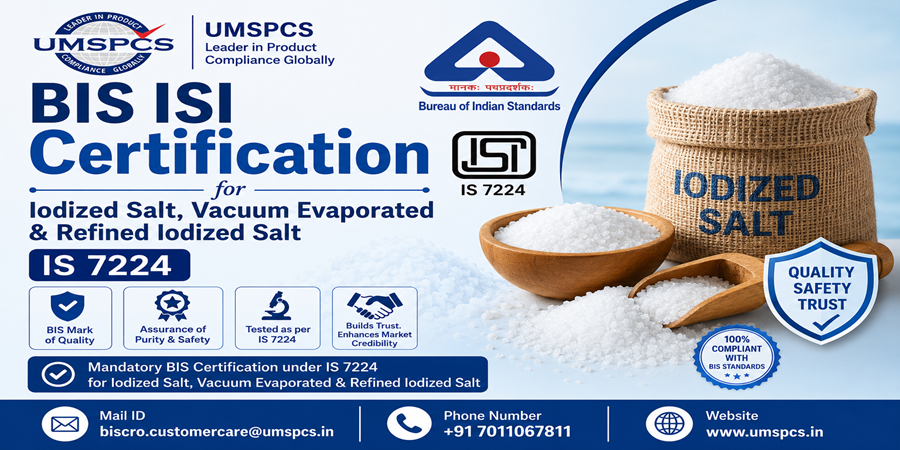
Iodized salt should be required to be mandatory quality certified by BIS, based on IS 7224:2006 for:
- Iodized Salt
- Vacuum Evaporated Iodized Salt
- Refined Iodized Salt
The certification confirms that the product meets some requirements regarding the iodine content, purity, moisture, packaging, labeling and safety aspects.
Products with the ISI Mark are a sure sign of compliance with the standards, as it increases consumer confidence and compliance.
Benefits of Obtaining ISI Mark for Iodized Salt Products
The ISI Mark Certification for Iodized Salt Products is a commercial and regulatory benefit to the manufacturers and importers.
- Legal Compliance: BIS certification is one way to ensure legal compliances to the quality standards and mandatory standards set by the government in India for salt products.
- Increased Market Credibility: Customers are selective of ISI Mark products as it assures them consistency, safety and quality.
- Improved Branding: Certified products are more widely accepted in the retail and government procurement and institutional supply chains.
- Assured Product Quality: The certification is to ensure that the product meets the quality parameters which are defined for the iodine content, purity and packaging.
- Competitive Advantage: Manufacturers certified with BIS certification may be in a better competitive position in the Indian food market.
- Consumer Safety Assurance: Iodine deficiency disorders are preventable and consumer health goals can be met with proper iodization.
Process for BIS ISI Mark Certification of Iodized Salt Products
The manufacturers who want to get Bis ISI Mark for Salt Products certified should adhere to a structured certification process as laid out in IS 7224.
Step 1: Align Manufacturing Unit
The Indian Standard for the products of iodized salt is:
- IS 7224:2006 – Iodized Salt, Vacuum Evaporated Iodized Salt and Refined Iodized Salt
Manufacturers need to synchronize their production process, quality control system and test lab with BIS requirements.
Step 2: Application Filing & Documentation
The applicants are required to obtain the product testing from a BIS recognized and NABL accredited laboratory and have all necessary technical, manufacturing and legal documents prior to submitting the application.
The BIS application is then submitted online, along with the required fee.
Step 3: BIS Factory Inspection
The BIS officials carry out the inspection of the factory to ensure that:
- Manufacturing infrastructure
- Production process
- Quality control systems
- In-house testing capabilities
Product samples can also be taken for independent laboratory testing during the inspection.
Step 4: Product Testing & Lab Test Report (LTR)
The samples of all products are tested in the sealed form in BIS approved laboratories as per the requirements of IS-7224.
Testing generally includes:
- Iodine content
- Moisture content
- Chloride content
- Insoluble matter
- Heavy metals
- Purity parameters
The Lab Test Report (LTR) is directly submitted to the BIS by the laboratory.
Step 5: Non-Conformities (If Any) Closures
During the inspection or testing process, if BIS finds any non-conformance, the manufacturer will have to rectify the issue and submit the corrective action reports for the approval of compliance.
Step 6: License & Marking Fees Payment
On successful compliance, the applicant has to pay BIS license fee and ISI marking fee.
Step 7: ISI Licence Grant
Upon successful inspection, testing and payment of fees, BIS awards the ISI license, which will enable the manufacturer to affix the ISI Mark on the products that have been assessed as certified iodized salt.
Products Covered Under IS 7224
The below products are certified with IS 7224:
| Product Type | Applicable Standard |
| Iodized Salt | IS 7224:2006 |
| Vacuum Evaporated Iodized Salt | IS 7224:2006 |
| Refined Iodized Salt | IS 7224:2006 |
These categories have quality and safety requirements specified by the standard.
Documentation Required for BIS ISI Mark Certification
If you are a manufacturer you will need to submit the following documents when requesting BIS certification for Iodized salt:
- Simple data related to manufacturing plant and product type
- The address from the manufacturing unit as proof.
- Trademark registration certificate
- Manufacturing license / statutory approvals, if applicable,
- Product drawings/design schematics
- Installed manufacturing capacity
- List and specifications of raw materials used.
- Details of manufacturing machinery and equipment
- Factory layout plan
- The manufacturing process flow is described in detail.
- In house test equipment and calibration information is listed.
- Information relating to Quality Control personnel.
- Factory organizational chart
Good documentation leads to less delay in the approval process.
Cost of BIS ISI Certification for Iodized Salts
Generally, the estimated time frame for the BIS ISI certification for iodized salt products in India are:
| Particulars | Estimated Cost |
| Application Fees (BIS) | ₹1000 |
| Testing Charges (Lab Fees) | ₹15,000 – ₹2,50,000 |
| Factory Inspection Charges | ₹7000 |
| Annual license fees | ₹1000 |
| Marking Fees (ISI Mark Usage) | As per BIS norms (based on production) |
| Consultancy Charges (UMSPCS) | ₹50,000 |
This may be different if the product is more complex and the documentation is more accurate.
Read more also: BIS ISI Certificate for Foreign Manufacture
Important Quality Requirements Under IS 7224
IS 7224 defines some parameters of quality for the iodized salt products which are as follows:
- Minimum iodine content
- Moisture limits
- Purity standards
- Packaging requirements
- Labeling requirements
- Permissible use of anti-caking agents
The standard also sets minimum prescribed levels for the amount of iodine to be maintained in the course of their manufacture and retail distribution.
Why Choose UMSPCS for BIS Certification for Iodized Salt?
With over 600+ years of experience, UMSPCS assures a hassle-free and smooth certification process based on a thorough knowledge of both BIS regulations and industry needs. The right compliance partner can help facilitate the certification process and eliminate delays in the approval.
- Complete Assistance for BIS Certification Process & Standards: UMSPCS offers complete assistance in BIS certification process and standards.
- End-to-End Documentation Support: Our technical and legal documentation experts help you to prepare and review all technical and legal documents required for certification.
- Minimization of Errors: We do our utmost to minimize the number of errors as well. Rapid Approval: We do our best to facilitate the BIS approval process.
- Communication & Coordination with BIS Authorities: There is communication and coordination with BIS authorities throughout the inspection and certification process.
- Product Testing: Coordination assistance for the product testing with BIS recognised laboratories.
UMSPCS helps manufacturers and importers from all over India to obtain multiple types of BIS certification.
Conclusion
For the quality of the product, consumer confidence in the Indian market and legal compliances, BIS certification for Iodized salt according to IS 7224 is mandatory. ISI Mark signifies the product conforms to the safety and quality norms that have been set in India for iodized salt products.
If you are a manufacturer looking to sell iodized salt, refined iodized salt or vacuum evaporated iodized salt in India, it is imperative that you follow BIS standards on time to reduce the chances of regulatory hassles and enhance market confidence.
Talk to UMSPCS today and get hassle free, reliable BIS certification for iodized salt products and expert guidance in all steps of approval.
Read more also: MTCTE Certification Process in India: TEC Compliance
FAQs- BIS Certification for Iodized Salt
- Are the products that are sold as iodized salt mandatory to be BIS certified?
Yes, all the products which are prepared from the iodized salt (IS 7224) should be required to be compulsorily certified by ISI.
- What does the certification for iodized salt mean?
The products from the iodized salt are certified based on IS 7224:2006.
- Is it possible that Salt products can be obtained from outside which are BIS certified?
Yes, the foreign manufacturers can obtain a BIS certificate as per the BIS scheme.
- Which lab can certify the products of iodine salt?
All tests should be carried out in a NABL recognized and accredited lab by BIS.
- How much is the validity of the BIS ISI license of salt?
The validity period for BIS ISI licence can be renewed after a year.
❓ Ask a Question
Have any doubts? Fill the form below and our team will respond shortly.