Welcome to the definitive resource for BIS Certification in India. For every manufacturer, regardless of whether they are local or international, who wants to get into the Indian market in compliance with the Bureau of Indian Standards (BIS) is not only a regulatory requirement but it is a passport to consumer trust and industrial credibility.
India is one among the largest and fastest-growing economies over the world. There is a high demand for quality assured products in accordance with a population exceeding 1.4 billion. The government of India holds the charge of the Bureau of Indian Standards (BIS) to work as the key regulator for product quality to safeguard consumers and confirm national security.
Heavy machinery in Berlin, or consumer products in India, where the ISI Mark or the BIS Registration is often the mandatory part that you should get to sell products lawfully on Indian soil, regardless of whether you’re manufacturing high-tech electronics in Seoul.
What is BIS? (The Bureau of Indian Standards)
The Bureau of Indian Standards (BIS) is the National Standard Body of India which operates under the guardianship of the Ministry of Consumer Affairs, Food & Public Distribution. It is held the responsibility of the harmonious development of the activities of standardisation, marking, and quality certification of goods, which is established through the BIS Act of 1986 (and moreover got strengthened by the BIS Act of 2016.
The Vision of BIS Certification
The core vision of BIS is to offer safe, reliable, and high-quality goods while reducing health risks to consumers and safeguarding the environment. It gets this by the following:
- Standard Formulation: Generating technical benchmarks (Indian Standards) for various products.
- Product Certification: Issuing licenses to use the ISI mark or registration numbers.
- Laboratory Services: Running a network of labs to test product compliance.
- Hallmarking: Confirming the purity of precious metals like gold and silver.
The Critical Importance of BIS Certification in India
Why should a business invest their time and resources into BIS Certification? The reason is far beyond the legal adherence.
A. Consumer Trust and Brand Reputation
The ISI Mark is a household name in India. Consumers are trained from a young age to get this mark as a sign of safety. Showing the BIS logo overhead immediately its status from unknown commodity to a certified quality product for a brand.
B. Risk Mitigation and Safety
Several standards are formed to avoid catastrophic failures. For instance, BIS standards for pressure cookers avoid explosions while the standards for electrical cables avoid fire dangers. Manufacturers notably minimise their legal liability and the risk of product recall by getting compliance.
C. Market Entry and Expansion
BIS Certification is compulsory for hundreds of products. Products can get seized at Indian customs without certification, and local manufacturers have to face severe penalties or even factory closures. Compliance is just a legal way to get into the base of Indian consumers.
D. Global Competitiveness
Sticking to Indian Standards often gets in line with foreign standards like (ISO or IEC). This assists Indian manufacturers to compete on a global scale through giving surety of their production procedure that meets high-level benchmarks.
Applicability: Is Your Product Covered for BIS Certification in India?
BIS Certification is applicable to both Indian and foreign manufacturers. The applicability is usually divided into two types which are Voluntary and Mandatory.
Voluntary Certification
Manufacturers are able to apply for certification to demonstrate their commitment to quality for products which are not covered yet under a Quality Control Order (QCO).
Mandatory Certification (The QCO System)
The Government of India grants Quality Control Orders (QCOs), which list certain products that should have the BIS Certification. It is not legal to manufacture, import, store, or sell such products without having a valid BIS licence.
Key Industries and Product Categories for BIS Certification in India
The scope of BIS is wide which covers nearly each sector of the economy. The primary industries where BIS Certification is most important which is given below:
a. Electronics and IT Goods (CRS)
BIS checks the electronic products to confirm that they don’t get harmful radiation or cause electrical risks under the Compulsory Registration Scheme (CRS)
- Products: Laptops, tablets, mobile phones, power banks, LED TVs, and smartwatches.
b. Steel and Metal Products
Gives surety to structural integrity of India’s infrastructure where steel should get aligned with solid standards.
- Products: Stainless steel sheets, carbon steel bars, tin plates, and galvanised steel.
c. Chemicals and Fertilisers
Chemical industry safety is foremost for environmental protection.
- Products: Caustic soda, Boric acid, various polymers, and chemical fertilisers.
d. Toys and Juvenile Products
Every toy regardless of whether it is electric or non-electric should get BIS Certified to confirm that they are non toxic and physically safe for children from 2021.
e. Automotive Components
- Products: Tires, safety glass, helmets, and wheel rims.
f. Building Materials
- Products: Cement, hollow blocks, and plywood.
Detailed Certification Procedure of BIS Certification in India
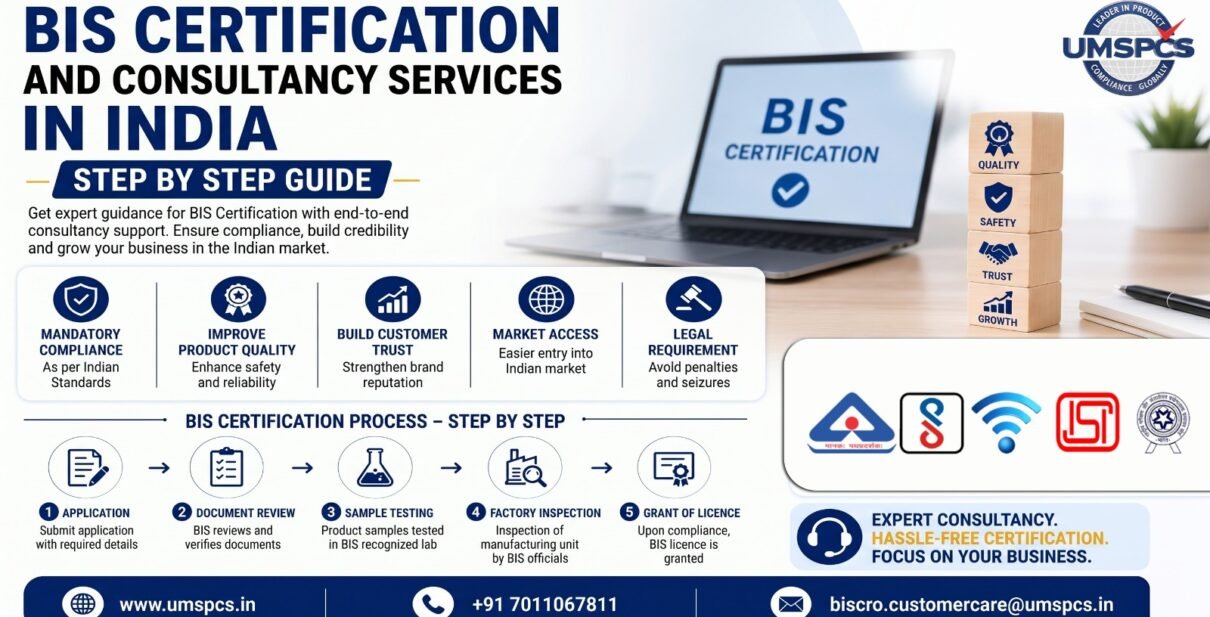
The procedure differ slightly which is based on whether you’re an Indian manufacturer or a foreign one but the main step remains constant which is as follows:
Step 1: Identification of Indian Standard (IS)
Each product comes under a certain IS Number (e.g., IS 1293 for plugs and sockets). The initial task of a consultant is to find the appropriate standard and certain “Scheme” (ISI Mark or CRS).
Step 2: Testing of Samples
Samples of the product should get tested in labs approved by BIS.
- The tests check for durability, safety, performance, and material composition.
- The test report is a critical document for the application.
Step 3: Documentation and Filing
The manufacturer should upload an online application through the Manak Online portal. This consists of factory details, technical specifications and the lab test outcomes.
Step 4: Factory Audit and Inspection
A BIS officer visits the manufacturing unit for the ISI Mark (Scheme I).
- They inspect the machinery and quality control setup.
- They may collect independent samples for a second round of testing.
Step 5: Scrutiny and Grant of License
BIS officials check the inspection report and test outcomes. The license gets issued when everything gets aligned with the Indian Standard. Manufacturers can start to apply for the ISI Mark Certification or Registration Number to their products.
Essential Documents Required For BIS Certification in India
A notable portion of the heavy lifting in BIS Certification consists of documentation. Some of the common required documents consist of the following:
- Identity Proof: Incorporation certificates, GST registration, or Business License.
- Factory Map: A layout showing the production area and storage.
- Manufacturing Flowchart: Step-by-step process of how the product is made.
- Machinery List: Details of all production equipment.
- Testing Equipment List: Evidence that the factory can perform basic quality checks in-house.
- Authorised Indian Representative (AIR): For foreign manufacturers, a legal document appointing a local representative in India.
- Product Manuals: Technical data sheets and user manuals.
Common Challenges and Roadblocks
Several applicants find themselves stuck in a loop of query letters from the BIS. Common challenges consist of the following:
- Language Gaps: Translating technical manuals and factory documents accurately.
- Testing Failures: Products designed for European or US markets might fail specific Indian climatic or voltage tests.
- Logistical Delays: Shipping samples to Indian labs can take weeks and involve complex customs clearances.
- Strict Timelines: Lab reports often have a “shelf life” (usually 90 days); if the application isn’t filed in time, the tests must be repeated.
The Role of a BIS Consultant (UMSPCS)
UMSPCS with 600+ experiences offering unparalleled value. A Bis consultant works as your navigator by the regulatory approvals across India.
Why Professional Support is Essential:
- Pre-Audit Screening: We inspect your factory before the BIS officer does, which helps to find gaps in your quality control that give result to rejection.
- Lab Liaison: We coordinate in line with laboratories to confirm your samples are tested correctly, and reports are issued promptly.
- Document Drafting: We prepare the technical files that confirm that the terminology matches BIS requirements exactly.
- Strategic Advice: We assist you in grouping different product models into “series” to save on testing costs and application fees.
Conclusion and Consultation
The Indian market provides limitless potential, but unlocking the gate to that potential is Quality Compliance. Attempting to trace BIS alone can result in high cost delays and failure to market access.
At UMSPCS, we come to the table with years of technical expertise and a deep understanding of the Bureau of Indian Standards, which confirms that your path to certification is seamless, clear, and successful.
Final Thought: Quality is Not an Act, It’s a Habit
In the words of Aristotle, “Quality is not an act, it is a habit.” By adopting BIS standards, you aren’t just checking a box for the Indian government—you are building a habit of excellence that will sustain your business for decades to come. Let UMSPCS help you make that habit a reality.
Frequently Asked Questions (FAQs)
- What is BIS Certification in India?
BIS Certification is a quality assurance certification issued by the Bureau of Indian Standards. It confirms that a product meets the required Indian safety and quality standards before being sold in the market.
- Is BIS Certification mandatory for all products?
No, BIS Certification is not required for all products. However, it is compulsory for products listed under Quality Control Orders (QCOs). Selling such products without certification is illegal in India.
- What is the ISI Mark?
The ISI Mark is a certification mark issued by BIS for products that comply with Indian Standards. It assures consumers that the product is safe, reliable, and of good quality.
- What is the difference between ISI Mark and CRS Registration?
The ISI Mark applies mainly to products like cement, steel, and appliances under Scheme I, while CRS (Compulsory Registration Scheme) is for electronics like mobile phones, laptops, and LED TVs.
- Who needs BIS Certification?
Both Indian manufacturers and foreign manufacturers who want to sell their products in India must obtain BIS Certification if their products fall under mandatory categories.
- What is a Quality Control Order (QCO)?
A QCO is an order issued by the Government of India that makes BIS Certification mandatory for specific products to ensure safety, quality, and consumer protection.
- What documents are required for BIS Certification?
Common documents include business registration, factory layout, manufacturing process flowchart, machinery details, test reports, and product specifications. Foreign manufacturers also need an Authorised Indian Representative (AIR).
- How long does it take to get BIS Certification?
The timeline usually ranges from 30 to 90 days, depending on product type, testing requirements, and document accuracy.
- What happens if a product fails BIS testing?
If a product fails testing, the manufacturer must make necessary improvements and re-submit samples for testing. Certification will only be granted after meeting all required standards.
- Can foreign companies apply for BIS Certification?
Yes, Bis certification for foreign manufacturers can apply under schemes like FMCS or CRS. They must appoint an Authorised Indian Representative (AIR) to handle compliance in India.
- Why should I hire a BIS consultant?
A BIS consultant helps in documentation, testing coordination, and compliance management. This reduces delays, avoids rejection, and ensures faster approval.
- What are the penalties for selling non-BIS-certified products?
Penalties include product seizure, heavy fines, and even imprisonment in severe cases. Businesses may also face bans on selling in the Indian market.
❓ Ask a Question
Have any doubts? Fill the form below and our team will respond shortly.