Growing into the Indian market provides solid growth in potential, especially for foreign manufacturers who target industrial hubs like Noida. However, receiving certification from the Bureau of Indian Standards (BIS) is compulsory prior to selling regulated products. This procedure comes under the Foreign Manufacturers Certification Scheme (FMCS) for foreign manufacturers.
This blog looks over everything about foreign manufacturers’ needs to know about BIS FMCS Certification in Noida, which consists of requirements, procedure, and how expert consultants like UMSPCS can simplify your compliance.
What is BIS Certification for Foreign Manufacturers in Noida?
BIS Certification gives security to products that align with Indian safety, quality, and performance standards for Foreign manufacturers as BIS gives certification under FMCS which allows them to utilize the ISI mark on their products.
The ISI mark shows the following:
- get aligned with Indian Standards (IS)
- Product safety and reliability
- Foreign approval for sale in India
Foreign manufacturers are not able to export regulated products to India without having FMCS Certification in Noida.
Why Noida is a Key Market for Foreign Manufacturers
Noida has arisen as a huge industrial and commercial hub which attracts foreign manufacturers in sectors such as:
- Electronics and IT products
- Automotive components
- Construction materials
- Consumer goods
Noida provides excellent market access in accordance with its proximity to Delhi NCR and solid infrastructure. However, solid compliance demands make BIS Certification a non-negotiable step for foreign manufacturers who want to get into this region.
Understanding the FMCS (Foreign Manufacturers Certification Scheme) in Noida
The FMCS scheme enables foreign manufacturers to receive a BIS license without setting up a manufacturing unit in India.
Key Features of FMCS:
- Applicable only to foreign manufacturers
- Requires factory inspection by BIS officials
- Mandatory product testing in BIS-recognised labs
- Appointment of an Authorised Indian Representative (AIR)
The AIR works as the local point of contact for regulatory communication and compliance.
Products Covered Under BIS FMCS in Noida
BIS FMCS Certification is compulsory for several of the product categories, which consist of the following:
BIS Product Categories Table for FMCS
| S.No | Product Category |
| 1 | Cement (any variety of cement manufactured or sold in India) |
| 2 | Household Electrical Goods |
| 3 | Batteries |
| 4 | Food & Related Products (De-notified from compulsory BIS certification) |
| 5 | Feeding Bottles |
| 6 | Oil Pressure Stoves |
| 7 | Automobile Accessories |
| 8 | Cylinder, Valves and Regulator |
| 9 | Medical Equipment |
| 10 | Steel and Iron Products |
| 11 | Electrical Transformers |
| 12 | Electrical Motors |
| 13 | Capacitors |
| 14 | Chemicals, Fertilisers, Polymers & Textiles |
| 15 | Kitchen Appliances |
| 16 | Domestic Water Heaters for use with LPG |
| 17 | Air Conditioner and related Parts, Hermetic Compressor & Temperature Controls |
| 18 | Plugs, Socket-Outlets & Prepayment Meters |
| 19 | Domestic Gas Stoves (LPG) |
| 20 | Transparent Float Glass |
| 21 | Domestic Pressure Cooker |
| 22 | Cables |
| 23 | Rubber Hose for LPG |
| 24 | Aluminium Foil |
| 25 | Non-Electric Toys |
| 26 | Electric Toys |
| 27 | Flat Transparent Sheet Glass |
| 28 | Safety Glass |
| 29 | Woven Sacks |
| 30 | Butterfly Valves |
| 31 | Reflectors for Bicycles |
| 32 | Paper |
| 33 | Cattle Feeds |
| 34 | Automobile Wheel Rim Components |
| 35 | Footwear |
| 36 | Press Tool-Punches |
| 37 | Refrigerating Appliances |
| 38 | Cast Iron Pipes (Centrifugally Cast) |
| 39 | Flux Cored Electrodes |
| 40 | Sewing Machine |
| 41 | Water Treatment System |
| 42 | Jute Bags |
| 43 | Viscose Staple Fibres |
| 44 | Geo Textiles |
| 45 | Protective Textiles |
| 46 | Upholstered Composites (Non-Domestic Furniture) |
| 47 | Flame-Producing Lighters |
| 48 | Potable Water Bottles |
| 49 | Welding Rods and Electrodes |
| 50 | Smart Meters |
| 51 | Insulated Flasks, Bottles & Containers |
| 52 | Bolts, Nuts and Fasteners |
| 53 | Cookware, Utensils & Food Cans |
| 54 | Domestic Gas Stoves (PNG) |
| 55 | Fire Extinguishers |
| 56 | Electric Ceiling Fans |
| 57 | Wood-Based Boards |
| 58 | Cast Iron Products |
| 59 | Solar DC Cable & Fire Survival Cable |
| 60 | Metals and Alloys |
| 61 | Plywood & Wooden Flush Door Shutters |
| 62 | Flux Cored Solder Wire |
| 63 | Miscellaneous Steel Products |
| 64 | Aluminium & Aluminium Alloy Products |
| 65 | Roller & Bush Chains with Sprockets |
| 66 | Drinking Water Coolers |
| 67 | Medical Textiles |
| 68 | Agro Textiles |
| 69 | Copper Products |
| 70 | Drums and Tins |
| 71 | Door Fittings |
| 72 | Bottled Water Dispenser |
| 73 | Safety Helmets |
| 74 | Steel Wires, Ropes & Wire Mesh |
| 75 | Length Measuring Instruments |
| 76 | Polyethene Woven Sacks |
| 77 | Safes, Lockers & Key Locks |
| 78 | Hinges |
| 79 | Cycle & Rickshaw Tyres and Tubes |
| 80 | Rubber Gaskets (Pressure Cookers) |
| 81 | Laboratory Glassware |
| 82 | Electrical Accessories |
| 83 | PVC Homopolymers |
| 84 | Polypropylene Materials |
| 85 | Diesel Exhaust Fluid (AUS 32) |
| 86 | Air Coolers & Air Filters |
| 87 | Electrical Appliances |
| 88 | Asbestos / Fibre Cement Products |
| 89 | Water Meters & Accessories |
| 90 | Gypsum Building Materials |
| 91 | Electrical Water Heating Appliances |
| 92 | V-Belts |
| 93 | Telescopic Drawer Slides |
| 94 | Cross Recessed Screws |
| 95 | Safety of Electrical Appliances |
| 96 | Hand Tools |
| 97 | Industrial Textiles (Indutech) |
| 98 | Ropes & Cordages |
| 99 | H Acid, K Acid & Vinyl Sulphone |
| 100 | Solar Thermal Systems |
| 101 | Electric Fence Energisers |
| 102 | Flashlights |
| 103 | Stainless Steel Pipes & Tubes |
| 104 | Furniture |
| 105 | Non-Ferrous Refined Metals |
Certification is granted when every product is aligned with a certain Indian Standard (IS code)
Step-by-Step BIS FMCS Certification Process in Noida
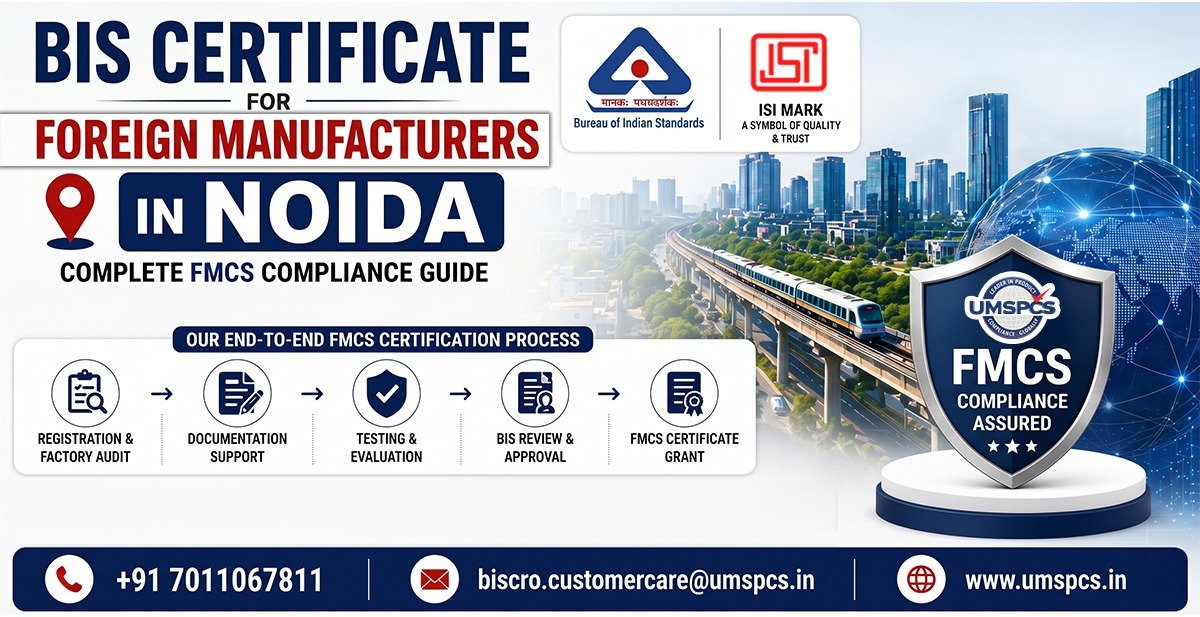
Foreign manufacturers should get in line with a structured procedure to receive BIS FMCS certification in Noida, which is as follows:
1. Identify Applicable Indian Standard
Find out the appropriate IS standard for your product category.
2. Nominate an Authorised Indian Representative (AIR)
The AIR is an Indian entity that holds the responsibility for compliance and interacts with BIS.
3. Submit Application
Upload the FMCS application in line with the following:
- Product details
- Manufacturing process information
- Quality control documents
4. Product Testing
Samples are tested in labs approved by BIS to confirm compliance in line with Indian standards.
5. Factory Inspection
BIS officials visit the manufacturing facility abroad to check the following:
- Production processes
- Quality control systems
- Testing infrastructure
6. Grant of License
BIS grants the license, which allows them to use the ISI mark after getting verified successfully.
Documents Required for FMCS Certification
Foreign manufacturers should prepare detailed documentation that consists of the following:
- Business registration certificate
- Manufacturing unit details
- Product specifications and design
- Quality control manuals
- Test reports from recognised labs
- AIR authorization letter
Correct documentation is necessary to prevent postponements or denials.
Cost and Timeline for BIS FMCS Certification
The charges of BIS certification are based upon the following:
| Particulars | Estimated Cost (INR) |
| Application Fees (BIS) | $12.00 |
| Per Diem Expenses for Bis Officers- 3 Days | $900.00 |
| Charges for the Visit | $466.66 |
| Contingency Funds | $111.11 |
| Bis Charges- Travel/Visa etc. -Estimate | $2173.00 |
| Marking Fee (Min.) | $2744.00 |
| Sample Testing | $400 to $3000 |
| Total Bis Cost | $6850.77 |
Estimated Timeline:
- Documentation & application: 2–4 weeks
- Product testing: 3–6 weeks
- Factory inspection & approval: 4–8 weeks
Total time: 8–12 weeks (approx.)
Common Challenges Faced by Foreign Manufacturers
Foreign manufacturers face practical difficulties during FMCS Certification, which are as follows:
- Difficulty in understanding Indian regulatory standards
- Delays in product testing and approvals
- Complex documentation requirements
- Coordination issues with BIS authorities
- Lack of local compliance support
This is where expert consultancy plays an essential role.
Why FMCS Certification is Important for Foreign Manufacturers in Noida
India is one of the fastest growing consumer markets internationally. The government implemented rigid quality regulations to safeguard consumers and ensure fair competition.
Key Reasons You Need FMCS Certification
1. Legal Market Entry
FMCS certification is compulsory for specific product categories. Your products might get rejected at customs or barred from sale without having the certification.
2. Use of ISI Mark
Certification enables you to connect the ISI mark, which boost trust and credibility in the Indian market.
3. Smooth Import Process
Certified products face lower delays in customs clearance.
4. Enhanced Brand Value
Indian buyers prefer BIS-approved products because of their quality assurance.
5. Competitive Advantage
Compliance assists you in line with local manufacturers on equal terms.
How UMSPCS Helps Foreign Manufacturers with BIS Certification in Noida
Tracing FMCS demands can be difficult without getting any local expertise. UMSPCS provides complete BIS Certification assistance for foreign manufacturers who want to enter markets like Noida.
Key Services Offered by UMSPCS:
- Identification of applicable IS standards
- Documentation preparation and review
- Assistance in appointing the Authorised Indian Representative (AIR)
- Coordination with BIS authorities
- Support for product testing and lab approvals
- Guidance during factory inspection
- Post-certification compliance support
UMSPCS with 600+ experience confirms a seamless and stress-free certification procedure in accordance with a solid understanding of BIS regulations and industry requirements. Get also ISI Mark Certification in Noida.
Final Thoughts
BIS Certification under FMCS is compulsory to get into the Indian market in Noida, which unlocks opportunities for foreign manufacturers. This procedure demands precision, technical understanding, and local expertise from preparing documentation to inspection.
Working together with a reliable consultancy like UMSPCS, which simplifies the whole journey by minimising postponements and confirming complete regulatory compliance. BIS Certification is the first and most essential step towards success for foreign manufacturers who want to build a solid presence in Noida.
Read more also: FMCS Consultant in Gurgaon
Frequently Asked Questions (FAQs)
1. What is FMCS under BIS certification for foreign manufacturers?
FMCS (Foreign Manufacturers Certification Scheme) is a certification provided by the Bureau of Indian Standards that allows foreign manufacturers to sell their products in India with the ISI mark after meeting the required safety and quality standards.
2. Is BIS FMCS certification mandatory for foreign manufacturers?
Yes, FMCS certification is mandatory for foreign manufacturers dealing in products listed under BIS regulations. Without certification, products cannot be legally imported, sold, or distributed in India.
3. What is the role of an Authorised Indian Representative (AIR)?
An AIR acts as a local representative of the foreign manufacturer in India. They handle communication with BIS, ensure regulatory compliance, and are responsible for maintaining certification requirements.
4. How long does it take to get FMCS certification in Noida?
The FMCS certification process typically takes around 8–12 weeks, depending on documentation, product testing timelines, and factory inspection scheduling.
5. What are the key steps in the BIS FMCS certification process?
The main steps include identifying the applicable Indian Standard, appointing an AIR, submitting the application, product testing in BIS-approved labs, factory inspection, and final license approval.
6. What are the common challenges faced during FMCS certification?
Foreign manufacturers often face challenges such as complex documentation, delays in lab testing, lack of clarity on Indian standards, and coordination issues with authorities.
7. What is the cost of BIS FMCS certification?
The cost varies depending on product type, testing requirements, and inspection expenses. It generally includes application fees, inspection costs, lab testing charges, and marking fees.
8. How can a BIS consultant like UMSPCS help in FMCS certification?
A professional consultant like UMSPCS provides end-to-end support, including documentation, application filing, lab coordination, AIR assistance, and inspection guidance, ensuring a faster and hassle-free certification process.
❓ Ask a Question
Have any doubts? Fill the form below and our team will respond shortly.