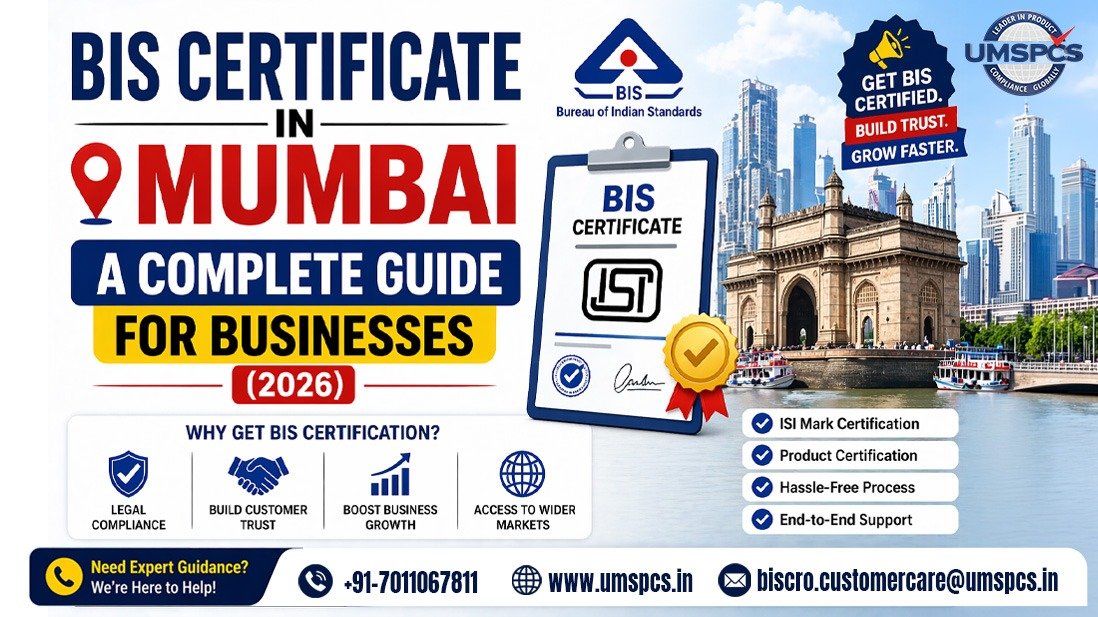
In a rapid commercial hub like Mumbai where businesses work in an excessive competitive and regulated environment. Confirming product quality and regulatory compliance is not just an option but it is necessary from manufacturing units to import export companies. One among the most critical certification in demand for entering and sustaining in the Indian market is the BSI certificate which was issued by the Bureau of Indian Standards.
Receiving BIS certification is not only about compliance but it is a strategic move that boosts credibility, improves consumers trust, and unlocks doors to many market opportunities for businesses in Mumbai. This detailed guide demonstrates everything you need to know about BIS certification in Mumbai which consists of its importance, procedure, and expert support from UMSPCS which simplifies the journey.
Understanding BIS Certification
BIS Certification is a conformity assessment scheme which confirms that a product fulfills certain Indian safety, quality, and performance standards. It works as a benchmark for reliability and protects consumers from substandards or poor products.
Products that get aligned with BIS standards are able to display the ISI mark which is widely known over India as a sign of trust. For several product categories especially those in relation to electronics, construction materials , and consumer goods where BIS certification is mandatory prior to getting sold or distributed in the Indian market.
The certification is governed by the Bureau of Indian Standards which functions under the Ministry of Consumer Affairs, Food and Public Distribution. The organisation formulates standards which perform testing, and grants certification to confirm uniform quality over industries.
Why BIS Certification is Important in Mumbai
Mumbai is a major economic powerhouse in line with diverse industries ranging from infrastructure and real estate to electronics and chemicals. Regulatory compliance works as an essential role in handling product standards and confirms consumer safety because of this industrial diversity.
One among the key reasons BIS certificate in Mumbai is necessary is that it is lawfully compulsory for various products. Businesses are not able to manufacture, import, or sell certain goods in India without having the certificate. Non-compliance can result in fines, product bans or even recalls.
Further legal compliance where BIS Certification significantly boosts brand reputation. Consumers are more likely to trust products that display ISI mark due to its adherence to solid quality standards. This trust can directly influence purchasing decisions and enhance market acceptance.
Another necessary benefit is market growth. BIS certified products are usually preferred in government tenders and huge infrastructure projects. Certification becomes a valuable asset for businesses in Mumbai who want to scale performance or enter fresh markets.
Types of BIS Certification Schemes
Based upon the nature of product where businesses in Mumbai might require to apply under various BIS certification schemes which are as follows:
- The ISI Mark certification scheme is one among the most common and it is applicable to products like cement, steel, and electrical appliances. This scheme consists of rigid testing and factory inspections to confirm consistent quality.
- The compulsory registration scheme (CRS) is mostly applicable to electronics and IT products like mobile phones, LED lights, and laptops. Products should get tested in labs approved by BIS prior to registration under this scheme.
- The Foreign Manufacturers Certification Scheme (FMCS) is applicable for foreign manufacturers who are exporting products to India.
Every scheme has its own set of demands, timelines, and compliance process which makes it necessary for businesses to clearly find out the applicable category.
Step-by-Step BIS Certification Process in Mumbai
Get BIS Certificate in Mumbai consists of a structured procedure which requires careful planning and execution.
- Product Identification
The initial step is to verify regardless of whether your products come under mandatory BIS certification and find out the appropriate Indian standards. Choosing the incorrect standard can give result to postponements or even denials of the application. - Documentation Preparation
Businesses requires to prepare comprehensive documentation after finalising the standard which consist of the followings:- Company registration certificate
- Product specifications
- Quality control details
- Test reports
Proper and accurate documentation is the foundation of a successful application.
The next stage concentrates on checking product quality by testing and formal application uploading.
- Product Testing
Samples are uploaded to labs approved by BIS where they are tested to confirm compliance in line with safety and quality standards. This is a technical step and should get managed in line with precision. - Application Submission
The application is uploaded through the BIS online portal in line with every required document and test outcomes once tested successfully.
Further verification steps are involved for specific certification schemes.
- Factory Inspection (if applicable)
In schemes like ISI certification where BIS officials might perform a factory inspection to examine manufacturing procedure, quality control systems and overall compliance.
The certification is granted after every requirement is satisfied in line with constant compliance responsibilities.
- Certification Grant & Compliance
- BIS certificate is issued after approval
- Businesses can use the ISI mark on their products
- Regular audits and compliance checks are required to maintain validity
This structured approach confirms that products should align with Indian quality standards while assisting businesses to boost trust and credibility in the Indian market.
Key Documents Required
Businesses should prepare a complete set of documents to confirm a seamless approval procedure to apply for BIS certificate.
- Basic Business Documents:
- Business registration certificate
- GST registration
- Product-Related Documents:
- Technical specifications
- Laboratory test reports (from BIS-approved labs)
Manufacturing in relation to information is also necessary to check production quality and consistency further to product information.
- Manufacturing Details:
- Manufacturing unit information
- Quality control process details
- Authorized Person Details:
- Information of the authorized signatory
Important Note:
Every document should be correct and complete. Even minor errors or missing data can give result to postpones or denials.
Common Challenges Faced by Businesses
The BIS certification procedure can seem difficult especially for first time applicants who are not much familiar with the compliance needs.
Complex Process:
- Multiple steps and procedures involved
- Can be confusing without proper guidance
One among the most critical difficulties is choosing the appropriate standard as it directly affects the approval procedure.
Identifying Correct Standard:
- Choosing the right Indian Standard is essential
- Requires technical knowledge due to multiple standards
Documentation and interaction also complicate several businesses during the process.
Documentation Issues:
- Incomplete and incorrect documents can give results to denials.
- Preparation of correct paperwork is time consuming
Testing & Coordination:
- Handling product testing timelines might be difficult
- Requires coordination in line with laboratories approved by BIS
- Another ongoing difficulty is staying in line with changing regulations.
Regulatory Updates:
- BIS rules and standards are frequently getting revised
- Businesses should remain informed to prevent from non-compliance
How UMSPCS Simplifies BIS Certification in Mumbai
Tracing the BIS certification procedure is overwhelming which is why several businesses in Mumbai prefer to work together with professional BIS consultants like UMSPCS.
UMSPCS provides complete assistance by confirming businesses to not deal with such difficulties alone. Their expertise assists in making the whole certification journey straightforward and seamless.
- End-to-End Assistance:
- Identification of correct product category
- Documentation preparation
- Coordination with BIS-approved laboratories
- Application filing and follow-ups
One among the major benefits of hiring UMSPCS is their solid understanding of regulatory demands and upgrading BIS guidelines.
- Expert Knowledge & Accuracy:
- Up-to-date with latest BIS norms
- Ensures error-free and compliant applications
- Reduces chances of rejection
They also offer hands-on assistance during necessary stages like inspection and after certification compliance.
- Additional Support Services:
- Factory audit preparation
- Guidance during inspections
- Post-certification compliance support
UMSPCS assists businesses to save their valuable time, effort, and resources while confirming a seamless certification experience by reducing mistakes and accelerates the approval procedure.
Benefits of Professional Guidance
- Improves Efficiency
It saves time and simplifies the whole certification procedure.
- Higher Approval Chances
Getting expert guidance can minimize the risk of denials.
- Technical Expertise
Detailed knowledge of BIS standards and procedures.
- End-to-End Support
Manages documentation, testing, and application procedure while businesses concentrate on core operations.
- Regulatory Updates
Stay informed about revised rules and changes.
- Long-Term Compliance
Assists in handling standards and remains competitive in the market.
Read more also: BIS Certificate in Bangalore
Final Thoughts
Compliance is an essential factor which finds success or failure in a competitive business environment like Mumbai. BIS certification is not just a legal requirement but it’s a sign of quality, safety, and trust which can examine your brand in the marketplace.
In India, receiving a BIS certificate should be a top priority for businesses who want to manufacture, import, or sell products. The correct guidance can make every difference while the procedure might seem difficult.
Working together with experienced consultants like UMSPCS which confirms that your certification journey is seamless, efficient, and successful. In accordance with expert assistance where you can trace regulatory difficulties in line with confidence and your business position for long term growth in one among India’s most dynamic markets.
Frequently Asked Questions (FAQs)
- What is BIS certification and why is it required?
BIS certification is issued by the Bureau of Indian Standards to ensure that products meet Indian safety and quality standards. It is required for many products to legally manufacture, import, or sell them in India.
- Is BIS certification mandatory for all products?
No, BIS certification is not required for all products. However, it is mandatory for specific categories such as electrical appliances, electronics, and construction materials as notified by the government.
- How long does it take to get BIS certification in Mumbai?
The timeline usually ranges from 4 to 12 weeks, depending on the product type, testing requirements, and certification scheme.
- What is the difference between ISI and CRS certification?
ISI certification applies mainly to products like cement and electrical goods and involves factory inspection, while CRS (Compulsory Registration Scheme) is mainly for electronics and does not always require factory inspection.
- Can importers apply for BIS certification?
Yes, importers can apply under relevant schemes like CRS or FMCS to sell foreign-manufactured products in the Indian market.
- What are the common reasons for rejection of BIS applications?
Applications are often rejected due to incorrect documentation, selecting the wrong Indian Standard, or failure in product testing.
- Do businesses need to renew BIS certification?
Yes, BIS certification requires periodic renewal and compliance with ongoing quality checks and audits to remain valid.
- How can UMSPCS help in BIS certification?
UMSPCS provides complete support including documentation, testing coordination, application filing, and post-certification compliance, making the process faster and hassle-free for businesses.
❓ Ask a Question
Have any doubts? Fill the form below and our team will respond shortly.