Electronic devices are usually exposed to unpredictable environments where rain, dust, humidity, and even accidental submersion. The ability to stand out in these conditions impacts the functionality and lifespan regardless of whether it’s a smartphone, industrial equipment or outdoor lighting systems. This is where IP Rating Testing has become necessary.
IP Rating is a globally accepted standard which specifies how well a product is safeguarded against the intrusion of rigid particles and liquids. This certification works as a proof of product durability, safety, and in compliance with the international standards for manufacturers and importers.
What is IP Rating?
IP Ratings is also referred to as Ingress Protection Rating which is specified under the IEC 60529 standard. it shows the level of protection through an enclosure against the intrusion of rigid objects and liquids
An IP rating usually looks like this: IP65, IP67, IP68, etc.
- The first digit represents protection against solid particles (dust, dirt)
- The second digit represents protection against liquids (water)
For example, here are the followings:
- IP65: Dust-tight and protected against water jets
- IP67: Dust-tight and protected against temporary immersion in water
- IP68: Dust-tight and protected against continuous immersion
Understanding IP Rating Classification
1. Protection Against Solids (First Digit: 0–6)
- 0: No protection
- 1: Protection against large objects
- 2: Protection against fingers
- 3: Protection against tools and wires
- 4: Protection against small objects
- 5: Dust protected (limited ingress allowed)
- 6: Dust tight (complete protection)
2. Protection Against Liquids (Second Digit: 0–9)
- 0: No protection
- 1–4: Protection against dripping and splashing water
- 5: Protection against water jets
- 6: Protection against strong water jets
- 7: Protection against immersion up to 1 meter
- 8: Protection against prolonged immersion
- 9: Protection against high-pressure and high-temperature water jets
Why IP Rating Testing is Important
IP rating testing is necessary for both manufacturers and consumers as it confirms that products work reliably even in difficult environments.
Key Benefits:
- Product Reliability
Devices tested for IP ratings are more durable and resistant to environmental issues. - Regulatory Compliance
Several industries demand for IP certification prior to selling products in the Indian market. - Enhanced Brand Trust
Consumers prefer products which show with clarity of your protection levels. - Reduced Product Failures
Reduces risks during testing which is related to moisture or dust damage. - Competitive Advantage
Products in line with higher IP ratings stand out in crowded markets.
IP Rating Testing Process
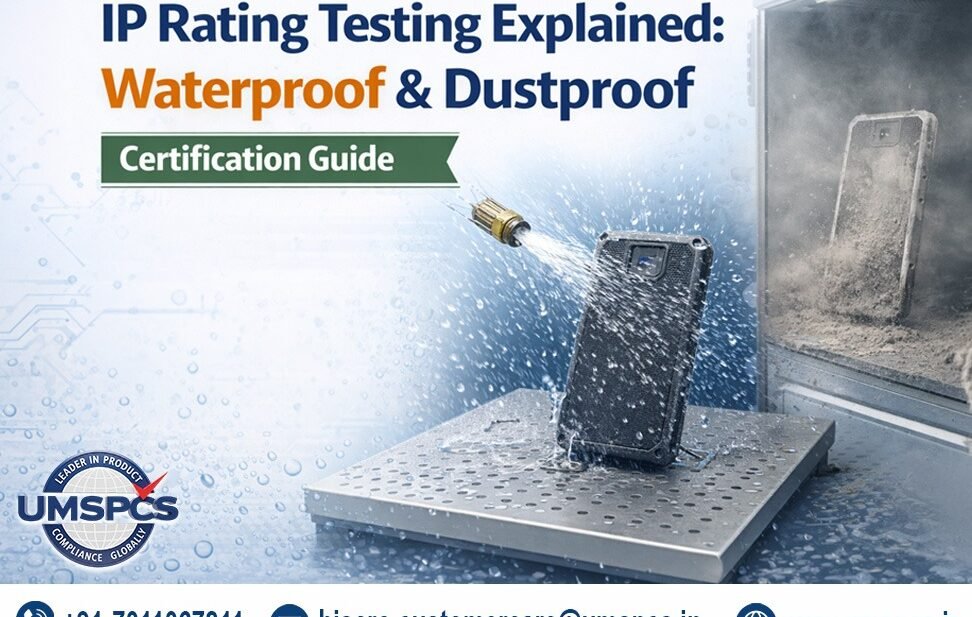
The IP testing procedure is carried out in a controlled environment of a laboratory which uses certain equipment. The procedure varies depending upon the required rating.
Dust Testing (Solid Protection)
- Products are placed in a dust chamber
- Fine dust particles are circulated under controlled conditions
- The enclosure is checked for any dust ingress
Water Testing (Liquid Protection)
Variety of tests are performed depending on the rating which are as follows:
- Drip Test – Simulates rain or dripping water
- Spray Test – Simulates splashing or spraying
- Jet Test – High-pressure water jets applied
- Immersion Test – Product submerged in water for a defined time
Every test has solid global standards which confirms correct and constant compliance.
Industries That Require IP Certification
IP rating testing is largely applicable over several of industries which are as follows:
- Electronics & Consumer Devices (smartphones, earphones, watches)
- Lighting Industry (LED lights, outdoor fixtures)
- Automotive Sector
- Telecommunication Equipment
- Medical Devices
- Industrial Machinery
For example, outdoor lighting systems usually demand IP65 or higher while underwater devices might ask for IP69 Certification.
Common IP Ratings and Their Applications
| IP Rating | Application |
| IP44 | Indoor appliances |
| IP54 | Basic dust and splash protection |
| IP65 | Outdoor lighting |
| IP67 | Mobile phones |
| IP68 | Waterproof devices |
Understanding such ratings assist businesses to select the appropriate level of protection for their products
How to Get IP Rating Certification in India
Receiving IP certification consist of various steps which are as follows:
Product Assessment
Find out the required IP level depending on the usage conditions.
Documentation Preparation
Technical specifications, product design details
Laboratory Testing
testing performed as per the IEC standards
Test Report Generation
Results documented with compliance details
Certification Issuance
Certification provided after successful testing
Role of Expert Compliance Partners
IP rating certification consists of technical expertise, proper documentation and coordination in line with testing laboratories. Several businesses struggle with postponements or mistakes because of a lack of knowledge about standards and procedures.
This is where professional compliance service providers act as an essential component.
In India, UMSPCS with 600+ experience is a trustable firm which helps in regulatory approvals and product certification. In accordance with detailed experience in managing compliance processes where UMSPCS assist businesses in receiving IP rating certification seamlessly and efficiently.
Why Choose UMSPCS?
- Industry Experience: Proven track record in certification and compliance services
- Expert Guidance: Assistance depending upon revised IEC standards
- End-to-End Support: From documentation to final certification
- Accurate Testing Coordination: Liaison with authorized labs
- Pan-India Service Reach
Their expertise confirms that businesses prevent common compliance mistakes and get certification without any unnecessary postpones.
Challenges in IP Rating Certification
Businesses usually face various difficulties during the IP Rating Certification which are as follows:
- Lack of awareness about correct IP rating
- Improper product design leading to test failures
- Documentation errors
- Delays in lab testing
- High cost due to re-testing
Working together with experienced consultants which significantly minimise such risks.
Tips for Successful IP Certification
- select the accurate IP rating depending upon product usage
- Confirming proper sealing and enclosure design
- perform pre-testing checks
- Maintain correct technical documentation
- Work with experienced certification partners
Conclusion
IP Rating Testing is an essential aspect of product quality and safety in today’s competitive market. It not just confirms protection against dust and water but also boosts product reliability and confidence among consumers.
Receiving IP certification is a strategic investment for businesses who are looking to get regulated markets and boost product standards.
In accordance with expert assistance from trusted consultants like UMSPCS who can simplify the certification procedure which confirms compliance and concentrates on high quality delivery products to the market.
Read more also: BIS Registration Consultant in Mumbai
Frequently Asked Questions (FAQs)
1. What does IP rating mean in simple terms?
IP (Ingress Protection) rating defines how well an electronic device is protected against dust and water. It is a standardized classification under IEC 60529 ingress protection standard that helps users understand a product’s durability in different environmental conditions.
2. What is the difference between IP65, IP67, and IP68?
- IP65: Protection against dust and low-pressure water jets
- IP67: Protection against dust and temporary immersion in water
- IP68: Protection against dust and long-term water immersion
Each rating indicates increasing levels of protection depending on the product’s intended use.
3. Is IP rating certification mandatory in India?
IP rating is not always legally mandatory, but it becomes essential for products used in outdoor, industrial, or high-risk environments. Many industries and regulatory approvals require IP-tested products to ensure safety and performance.
4. How is IP testing performed?
IP testing is conducted in certified laboratories using controlled environments. It includes dust chamber testing for solid protection and water exposure tests such as drip, spray, jet, or immersion testing depending on the required rating.
5. Which industries require IP rating certification?
Industries that commonly require IP testing include:
- Consumer electronics
- Automotive
- Telecommunications
- Lighting (especially outdoor LED systems)
- Medical devices
- Industrial equipment
6. How long does IP rating testing take?
The duration depends on the complexity of the product and the required IP level. Typically, testing and certification can take anywhere from a few days to a few weeks, including documentation and report generation.
7. What are the common reasons for IP test failure?
Products may fail IP testing due to:
- Poor sealing or enclosure design
- Incorrect material selection
- Manufacturing defects
- Lack of pre-testing
Proper design and expert guidance can significantly reduce failure risks.
8. Can a product be improved after failing IP testing?
Yes, products can be redesigned or modified after failure. Manufacturers can improve sealing, enclosure strength, or material quality and then undergo re-testing to achieve the desired IP rating.
Read more: BIS Certificate in Bangalore
❓ Ask a Question
Have any doubts? Fill the form below and our team will respond shortly.