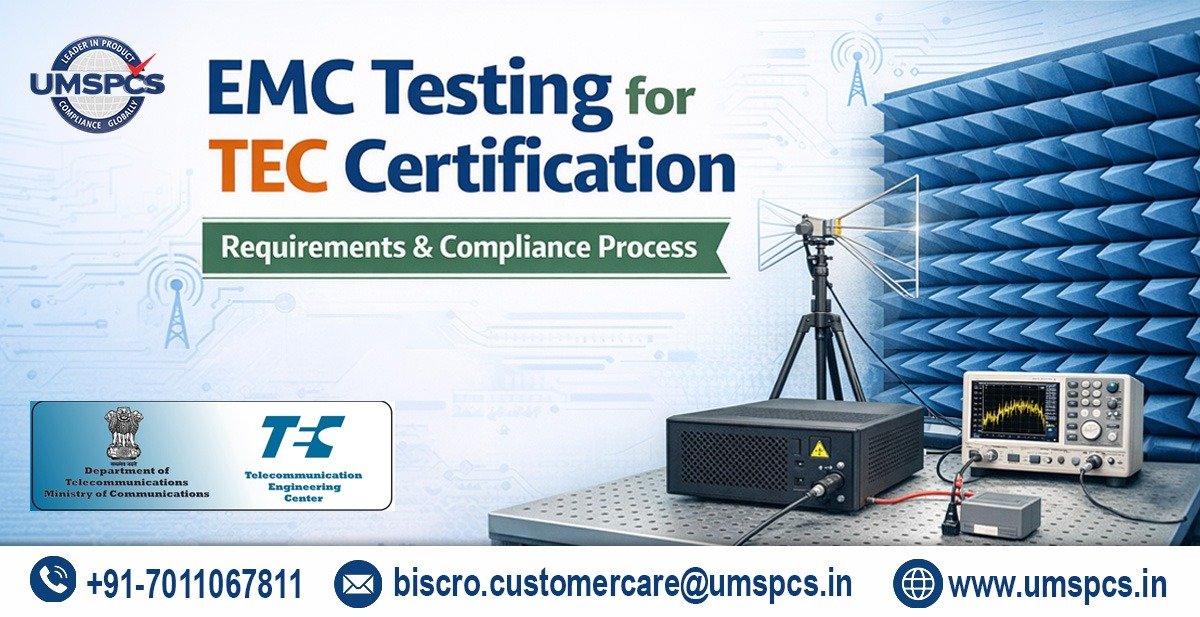
Electromagnetic Compatibility (EMC) testing works as an essential role in confirming that telecom and electronic devices work efficiently without making any interference to other equipment. EMCE testing is a compulsory need under TEC certification which makes it a necessary part of regulatory compliance and market entry.
This blog looks over EMC testing requirements, its importance in TEC Certification and complete compliance procedure in line with how experts assist from UMSPCS which simplifies the journey.
What is TEC Certification?
TEC is a technical body under the Department of telecommunications which is responsible for setting standards and certifying telecom equipment.
Telecom products should go through testing and approval prior to getting sold, imported, or used under the mandatory testing and certification of telecom equipment (MTCTE). Their aim is to confirm the followings:
- Safety of telecom networks
- Protection of end users
- Interoperability across devices
TEC Certification is therefore not only a regulatory formality but a compulsory compliance need.
What is EMC Testing?
EMC testing examines an electronic device which can function properly in its electromagnetic environment without making or affecting it through any interference.
It concentrates on two major aspects which are as follows:
- Emission – The amount of electromagnetic disturbance a device emits
- Immunity – The ability of a device to function correctly in the presence of electromagnetic disturbances
In simple terms. EMC testing confirms that devices can not exist without disrupting each other.
Why EMC Testing is Important for TEC Certification
EMC testing is a core requirement under TEC certification because of the sensitive nature of telecom infrastructure.
1. Prevents Signal Interference
Uncontrolled electromagnetic emissions can disrupt communication systems and degrade network functionality.
2. Ensures Device Stability
Devices should function reliably even in major interference environments.
3. Meets Regulatory Standards
EMC compliance is an essential requirement (ERs) which is specified by the TEC.
4. Enables Market Access
Telecom products are not allowed to get into the Indian market without EMC compliance.
EMC Testing Requirements for TEC Certification
Telecom equipment should align with EMC related essential requirements which are specified by TEC. These consist of various testing parameters which are as follows:
1. Emission Testing
- Radiated Emissions (RE)
- Conducted Emissions (CE)
Such tests confirm that the device does not emit highly electromagnetic noise.
2. Immunity Testing
- Radiated Immunity (RI)
- Conducted Immunity (CI)
Such tests examine whether the devices can withstand electromagnetic disturbances.
3. Electrostatic Discharge (ESD) Testing
Confirms that devices can manage static electricity without any complication faced during manufacturing.
4. Surge and Transient Testing
Verifies resistance to voltage spikes and electrical disturbances.
5. Frequency Range Testing
Cover testing over a wide frequency spectrum to confirm compliance.
Standards Used in EMC Testing
EMC testing gets align with foreign known standards like as follows:
- IEC (International Electrotechnical Commission) standards
- CISPR standards for electromagnetic interference
- Relevant Indian standards aligned with global practices
Such standards specify acceptable limits for emissions and immunity.
Products Covered Under EMC Testing
EMC testing is applicable to a large range of telecom and electronic devices which consist of the followings:
- Mobile phones
- Routers and modems
- Set-top boxes
- Network switches
- Telecom infrastructure equipment
- and more
Every category has defined testing requirements which depend on the usage and performance.
EMC Testing Process for TEC Certification
The EMC compliance procedure consist of various structured steps which are as follows:
Step 1: Identify Applicable Standards
Find out the suitable TEC essential requirements (ERs) for your product.
Step 2: Select an Approved Testing Lab
Testing should be performed in TEC designated or approved labs.
Step 3: Conduct EMC Testing
The product goes through emission, immunity, and environmental testing in controlled lab environments.
Step 4: Test Report Generation
A detailed test outcome is issued through the testing laboratory.
Step 5: Application Submission
Upload reports and documents through the MTCTE portal.
Step 6: Evaluation by TEC
TEC checks the application and compliance.
Step 7: Certification Issuance
Certificate of approval (CoA) is used after getting approved.
Documents Required for EMC Testing & TEC Certification
The certification procedure needs correct documentation which consist of the followings:
- Technical specifications of the product
- Circuit diagrams and block diagrams
- Bill of Materials (BOM)
- Test reports from accredited labs
- Authorization letter (if applicable)
- Company registration documents
Common Challenges in EMC Testing
1. Initial Test Failures
Products usually fail during early testing because of design issues.
2. Design Modifications
Several iterations might be needed to follow EMC limits.
3. Increased Cost and Time
Re testing can postpone timelines and increase charges.
4. Documentation Issues
Incomplete or incorrect paperwork can slow down the approval procedure.
Best Practices for Smooth EMC Compliance
To confirm seamless certification procedure which is as follows:
- Conduct pre-compliance testing during product development
- Design with proper shielding and grounding
- Maintain accurate documentation
- Work with experienced consultants
- Choose accredited testing laboratories
Role of EMC Testing in MTCTE Framework
EMC testing is a compulsory component of Essential Requirements (ERs). MTCTE certification is issued once getting tested or verified compliance successfully.
Testing should be performed in labs approved by BIS only which confirms both national and global standards which are fulfilled. This confirms project reliability and compatibility over telecom industries,
How UMSPCS Supports Your EMC & TEC Certification Journey
Navigating EMC testing and TEC certification can be complex, especially for businesses unfamiliar with regulatory requirements. This is where UMSPCS with 600+ experience plays a vital role as a trusted compliance partner.
Tracing EMC testing and TEC certification is difficult for businesses unfamiliar in line with regulatory
UMSPCS offers the followings:
- Expert guidance on applicable TEC standards and ER requirements
- Coordination with accredited EMC testing laboratories
- Complete documentation and application support
- End-to-end management of the certification process
- Faster approvals with reduced risk of rejection
In accordance with extensive regulatory and is in line with stress free certification procedure.
Read more about: LM-79 & LM-80 Testing for LED Products: Complete Certification
Conclusion
EC testing is an essential requirement for a TEC certificate which confirms the certificate. Each step is in need of technical expertise and regulatory understanding from emission and immunity testing to final certification.
Businesses can get smooth compliance procedures, prevent postpones, and get your products in the Indian market successfully by following best practices and working together in line with experienced professionals like UMSPCS.
Frequently Asked Questions (FAQs)
1. What is EMC testing in TEC certification?
EMC (Electromagnetic Compatibility) testing checks whether a telecom device can operate properly without causing or being affected by electromagnetic interference. It is a mandatory requirement under TEC certification to ensure device safety and performance.
2. Is EMC testing compulsory for TEC certification?
Yes, EMC testing is a mandatory part of the Essential Requirements (ERs) defined under the MTCTE framework. Without successful EMC compliance, a product cannot receive TEC approval.
3. Which products require EMC testing under TEC?
A wide range of telecom and electronic products require EMC testing, including mobile phones, routers, modems, set-top boxes, network switches, and other telecom infrastructure equipment.
4. What are the main types of EMC tests conducted?
The key EMC tests include:
- Emission testing (radiated and conducted)
- Immunity testing (radiated and conducted)
- Electrostatic discharge (ESD) testing
- Surge and transient testing
These tests ensure both low interference and high resistance to disturbances.
5. How long does EMC testing for TEC certification take?
The duration depends on the product complexity and testing scope. Typically, EMC testing may take a few days to a few weeks, including report generation and compliance verification.
6. Can a product fail EMC testing? What happens then?
Yes, products can fail EMC testing if they exceed emission limits or lack immunity. In such cases, design modifications are required, followed by re-testing until compliance is achieved.
7. Which labs are approved for EMC testing?
EMC testing must be conducted in TEC-designated or accredited laboratories, such as NABL or ILAC-recognized labs, to ensure valid and accepted test results.
8. How can UMSPCS help with EMC testing and TEC certification?
UMSPCS provides end-to-end support, including identifying applicable standards, coordinating with approved labs, managing documentation, and handling the MTCTE application process—ensuring faster and hassle-free certification.
❓ Ask a Question
Have any doubts? Fill the form below and our team will respond shortly.