In a competitive and quality driven market where businesses are always looking for ways to build trust, boost efficiency, and grow globally. One among the most effective ways to get this is through ISO certification. It is not just a compliance requirement but also a strategic tool which shows a company commitment to quality, safety and constant improvement.
ISO certification has become essential for businesses over industries from manufacturing to IT services. Regardless of whether you’re a startup or an existing organisation receiving ISO Certification can boost your credibility and functional standards.
What is ISO Certification?
ISO certification is an internationally recognised standard which confirms product and services following certain quality, safety, and efficiency benchmarks. ISO Certifications are introduced by approved certification bodies which assist businesses to get in line with global standards.
Types of ISO Certifications in India
There are various types of ISO certification where every design is to get different aspects of business operation. Some of the certification which are common consist of the followings:
1. ISO 9001 – Quality Management System
This is the most popular ISO standard which concentrates on handling ongoing product quality and improving consumer satisfaction.
2. ISO 14001 – Environmental Management System
This certification confirms that businesses should get aligned with environmentally responsible practices and minimises their ecological impact.
3. ISO 45001 – Occupational Health & Safety
It concentrates on workplace safety and assists organizations which reduces risks in relation to employee health and safety.
4. ISO 27001 – Information Security Management
This standard is essential for businesses who manage sensitive data which confirm proper data protection and cybersecurity measures.
5. ISO 22000 – Food Safety Management
This certification confirms safe management and production of food products which are ideal for food related industries.
Every certification serves a different purpose and businesses select one or several standards depending on their industrial demands.
ISO Certification Process in India
Receiving ISO Certification consists of a structured procedure. It might seem difficult but appropriate guidance can make it seamless and efficient.
Step 1: Identify the Applicable ISO Standard
Select the certification which is in line with your business goals and industrial demands.
Step 2: Gap Analysis
Examine your current processes to find areas which require improvement to follow the ISO standards.
Step 3: Documentation & Implementation
Prepare required documents like policies, procedures and manuals. implementation of essential changes in your business work.
Step 4: Internal Audit
Perform an internal audit to confirm every system which is in line with ISO requirements prior to the final audit.
Step 5: Certification Audit
An external certification body audits your organisation when every needs are fulfilled and ISO Certification is granted.
Step 6: Surveillance & Renewal
ISO certification asks for periodic audits to confirm constant compliance.
Benefits of ISO Certification for Businesses
ISO Certification provides a large range of benefits which go beyond compliance. To transform your business here are the followings ways:
1. Enhanced Credibility and Trust
ISO Certification works as an evidence to your business which gets aligned with global standards as it boosts trust among consumers and stakeholders.
2. Improved Operational Efficiency
Standardised procedure minimises errors, reduces waste, and improves all productivity.
3. Better Market Opportunities
Several government tenders and global clients demand for ISO certification which opens doors to fresh business opportunities.
4. Customer Satisfaction
Ongoing quality and improved service delivery give result to higher customer satisfaction and retention.
5. Risk Management
ISO standards assist in finding and handling issues effectively by confirming business continuity.
6. Global Recognition
ISO Certification makes it simple for businesses to grow into global markets.
Common Challenges in ISO Certification
Businesses usually face various of difficulties during the certification procedure like as follows:
- Lack of awareness about ISO standards
- Complex documentation requirements
- Difficulty in implementing process changes
- Audit preparation issues
In accordance with expert guidance from professionals like UMSPCS where such difficulties can be effectively managed by saving both time and resources.
Why Choose Professional Assistance for ISO Certification?
It mostly becomes time consuming and difficult because of documentation and compliance requirements while businesses can attempt the certification procedure independently. This is where an expert consultant has an essential role.
UMSPCS is a trustable consultancy which assists businesses over India to get ISO certification efficiently. UMSPCS offers complete support in line with solid industry experience and detailed knowledge of regulatory framework which consist of the followings:
- Identifying the right ISO standard
- Documentation and process implementation
- Audit preparation and compliance support
- Liaison with certification bodies
Their expert workforce confirms stress free certification procedures while handling complete compliance in line with international standards.
Read more also: BIS Certificate in Mumbai
Conclusion
ISO Certification is not just a certificate but a commitment to excellence quality, and ongoing improvement. In today’s competitive business environment where it works as an essential component in boosting trust, efficiency and the growth of market reach.
Receiving ISO certification can provide you benefit in a competitive market regardless of whether you’re a minor business or large enterprise. In accordance with appropriate guidance and assistance from experienced consultants like UMSPCS where the certification becomes simpler, efficient and excessively beneficial for long term growth.
Read more about: BIS Certificate in Bangalore
Frequently Asked Questions (FAQs)
- What is ISO certification and why is it important for businesses in India?
ISO certification is an internationally recognized standard that ensures a business follows quality, safety, and efficiency guidelines. It is important because it builds trust, improves operational processes, and enhances business credibility in both domestic and global markets.
- How long does it take to get ISO certification in India?
The time required for ISO certification depends on the size and complexity of the organization. Generally, it can take anywhere from a few weeks to a few months, depending on documentation, implementation, and audit readiness.
- What are the most common types of ISO certifications in India?
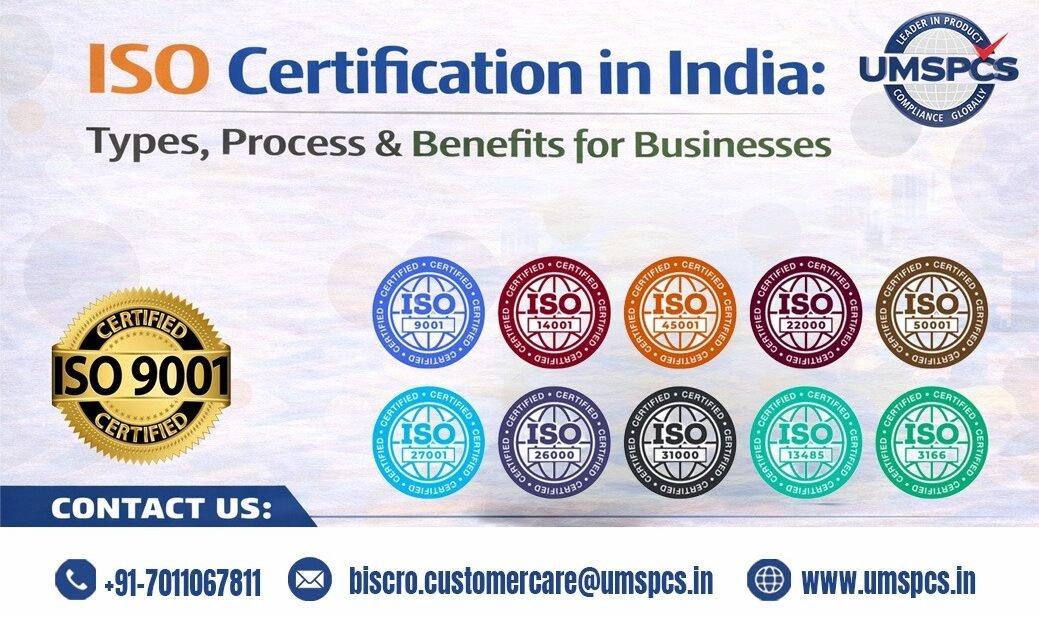
Some of the most common ISO certifications include ISO 9001 (Quality Management), ISO 14001 (Environmental Management), ISO 45001 (Occupational Health & Safety), ISO 27001 (Information Security), and ISO 22000 (Food Safety Management).
- Is ISO certification mandatory for businesses in India?
ISO certification is not mandatory for all businesses. However, it is often required for government tenders, exports, and certain industries where quality and safety compliance are critical.
- What is the cost of ISO certification in India?
The cost of ISO certification varies based on factors such as company size, chosen ISO standard, and consultancy services. Small businesses may incur lower costs, while larger organizations may require a higher investment.
- Can small businesses apply for ISO certification?
Yes, ISO certification is suitable for businesses of all sizes, including startups and small enterprises. It helps small businesses improve their processes and compete effectively in the market.
- What happens after receiving ISO certification?
After certification, businesses must undergo periodic surveillance audits to ensure ongoing compliance with ISO standards. Certifications are typically valid for three years, with regular reviews required.
- Why should businesses hire a consultant for ISO certification?
Hiring a professional consultant simplifies the certification process by assisting with documentation, implementation, and audit preparation. Experts like UMSPCS help ensure faster approval and compliance with minimal errors.
❓ Ask a Question
Have any doubts? Fill the form below and our team will respond shortly.