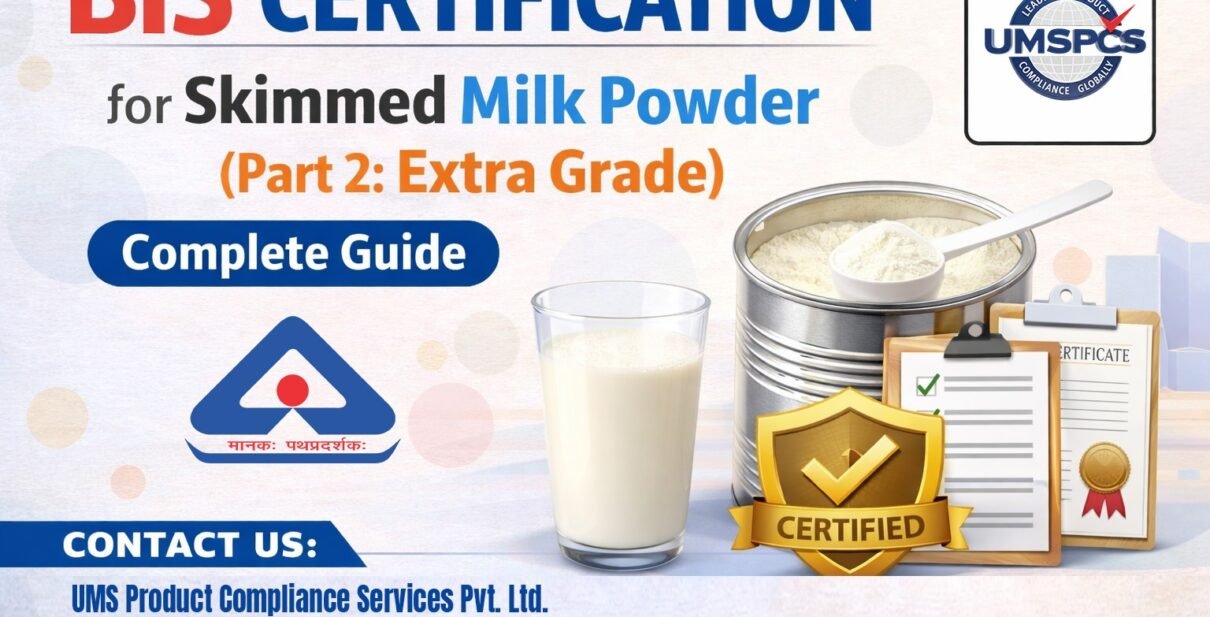
In India’s growing dairy industry where handling product quality, safety, and consistency is highly important for products like skimmed milk powder which is in huge use for food processors, nutrition, and exports. The Bureau of Indian Standards has a rigid guideline under IS 13334 (Part 2):2014 for Skimmed Milk Powder- Extra grade to confirm such standards.
BIS Certification has an essential role in confirming manufacturers to deliver safe, hygienic, and high quality dairy products to consumers. In this blog, we will look over everything that you require to know about BIS Certification for Skimmed Milk Powder (Extra Grade) which consist of its important specifications, process, and how expert consultancy like UMSPCS can assist.
What is Skimmed Milk Powder (Extra Grade)?
Skimmed Milk Powder (SMP) is a dairy product which is obtained by removing fat and water from milk which is usually done through a spray drying procedure. It gives important nutrients like proteins, lactose, and minerals.
In accordance with IS 13334 (Part 2): 2014 for Extra Grade SMP which is a premium quality product that gets aligned with higher standards of purity, solubility, and microbiological safety.
It is in huge use at the followings:
- Dairy products (cheese, ice cream, yogurt)
- Bakery and confectionery
- Infant nutrition and health supplements
- Pharmaceutical formulations
What is BIS Certification for SMP Extra Grade?
BIS Certification confirms that the skimmed milk powder gets aligned with Indian quality and safety standards. Manufacturers can display the ISI mark which shows trust and compliance after getting certified.
Bis Certification for skimmed milk powder extra grade is under the followings:
- IS Standard: IS 13334 (Part 2): 2014
- Scheme: BIS Product Certification Scheme (ISI Mark)
This certification is compulsory for manufacturers who aim to sell or distribute their product into the Indian market.
Key Requirements Under IS 13334 (Part 2): 2014
This standards defines quality parameters which manufacturers should follow are given as follows:
1. Raw Material Quality
- Milk must be free from preservatives, neutralizers, and adulterants.
- It can be sourced from cows, buffaloes, or both.
2. Manufacturing Process
- Typically produced using spray drying.
- Hygienic processing conditions must be maintained.
3. Chemical Composition
The product must comply with limits for:
- Moisture content
- Fat percentage
- Protein levels
- Acidity
Such parameters confirm nutritional value and shelf stability.
4. Microbiological Standards
Rigid limits are specified for the followings:
- Total bacterial count
- Pathogens
- Yeast and mold
This confirms the product is safe to consume for customers.
5. Sensory Characteristics
Extra Grade SMP should have the followings:
- Be creamish-white in color
- Have a clean and pleasant flavor
- Be free from lumps and foreign particles
6. Packaging and Labeling
- Must be packed in airtight, food-grade containers
- Labels should include:
- Product name
- Manufacturer details
- Batch number
- Expiry date
Correct packaging assists in avoiding contamination and secure quality of product.
Why is BIS Certification Important?
1. Ensures Product Quality
BIS certification confirms that the product gets aligned with specified standards for safety, nutrition, and consistency.
2. Builds Consumer Trust
The ISI mark boosts credibility and assists consumers to find reliable products.
3. Legal Compliance
Distribution of non certified products where certification is compulsory give results to fines or bans.
4. Boosts Market Access
Certified products are accepted at both local and global markets.
5. Supports Export Opportunities
BIS certified SMP gets in line with international quality expectations which makes export easier.
BIS Certification Process for SMP Extra Grade
The certification procedure consist of the following steps:
Step 1: Application Submission
Manufacturers should upload an application in line with essential documents to get BIS.
Step 2: Documentation Review
Required documents consist of the followings:
- Manufacturing process details
- Raw material specifications
- Quality control procedures
Step 3: Product Testing
Samples are tested in labs approved by BIS for the followings:
- Chemical properties
- Microbiological safety
- Sensory quality
Step 4: Factory Inspection
BIS officials examined the manufacturing unit to check the followings:
- Hygiene standards
- Equipment
- Production process
Step 5: Grant of License
BIS grants the license to display the ISI mark when every requirement is fulfilled.
Documents Required for BIS Certification
Required documents to receive BIS certification are given below:
- Business registration certificate
- Manufacturing unit details
- Product formulation details
- Test reports from BIS-approved labs
- Quality control system documents
Challenges in BIS Certification
Receiving BIS certification might seem complex because of the followings:
- Strict compliance requirements
- Detailed documentation
- Testing delays
- Regulatory updates
Even minor errors can give result to denials or postponements.
How UMSPCS Can Help You
UMPCS provides complete expert BIS certification services for dairy and food products like skimmed milk powder extra grade.
Why Choose UMSPCS?
- Expert Guidance
- Complete Support
- Affordable solutions
- Faster Processing
Services Offered
- Application filing and documentation
- Coordination with BIS-approved labs
- Factory audit preparation
- Compliance management
- Post-certification support
In accordance with UMSPCS where businesses concentrate on production while experts manage the procedure seamlessly.
Read more also: Top BIS CRS Certification & Registration Consultant in Pune
Importance of Compliance with FSSAI Regulations
Manufacturers should align with Food Safety and Standards Authority of India (FSSAI) regulation to get into the Indian market legally.
The BIS standards gets in line with FSSAI rules for the followings:
- Food safety
- Contaminants and toxins
- Labeling requirements
This confirms complete regulatory compliance for food products in India. Also, you can easily get FSSAI Licence with us.
Market Demand for Skimmed Milk Powder
India is one among the largest producers of milk internationally and there is a huge demand for skimmed milk powder is rising continuously because of the followings:
- Increasing use in processed foods
- Growing health awareness (low-fat products)
- Demand from the pharmaceutical and nutrition sectors
Certified extra grade SMP assists manufacturers to stand out in this competitive market.
Conclusion
BIS Certification for Skimmed Milk Powder (Part 2: Extra Grade) under IS 13334 (Part 2):2014 is necessary for confirming product quality, safety, and regulatory compliance. It not just protects consumers but also boosts brand value and market credibility.
Receiving BIS certification might seem difficult for manufacturers but it becomes seamless with correct guidance. Working together with experienced consultants like UMSPCS which confirms that your certification journey is fast, stress free, and entirely compliant with Indian standards.
In India, Now is the correct time to obtain BIS certification and boost trust among brands when you’re a manufacturer who wants to sell skimmed milk powder.
FAQs for Skimmed Milk Powder Extra Grade
1. Is BIS certification mandatory for Skimmed Milk Powder Extra Grade?
Yes, it is mandatory for manufacturers to comply with IS 13334 (Part 2): 2014.
2. What is the IS standard for SMP Extra Grade?
The applicable standard is IS 13334 (Part 2): 2014.
3. How long does BIS certification take?
It usually takes 30–45 days depending on documentation and testing.
4. What tests are conducted for certification?
Chemical, microbiological, and sensory tests are conducted.
5. Can importers apply for BIS certification?
Yes, importers can apply under the Foreign Manufacturers Certification Scheme (FMCS).
6. What is the validity of BIS certification?
The certification is typically valid for 1–2 years and requires renewal.
7. Why is packaging important in SMP certification?
Proper packaging ensures product safety and prevents contamination.
8. How can UMSPCS help in BIS certification?
UMSPCS provides complete support including documentation, testing coordination, and approval assistance.
❓ Ask a Question
Have any doubts? Fill the form below and our team will respond shortly.