In India’s fastest growing electrical appliance market where energy efficiency has become a major concern for both consumers and the government. The Government of India imposed the BEE Star Rating System which assists in showing energy efficient appliances and minimises overall electricity consumption.
Receiving BEE star rating registration is not only a compliance requirement but also a solid marketing advantage. In this blog, we will demonstrate the complete procedure of BEE star rating registration, its importance, required documents, and how experts like UMSPCS can help you.
What is BEE Star Rating?
The Bureau of Energy Efficient (BEE) is under the Ministry of Power which launched the standards and labelling (S&L) program in 2006. These programs give star ratings from 1 to 5 stars which is for electrical appliances depending upon their energy consumption.
- 1 Star → Lowest efficiency
- 5 Star → Highest efficiency
Higher ratings have lower electricity consumption which assist consumers to save energy bills and assist environmental sustainability.
Objective of BEE Star Labelling
The primary objective of the BEE program is to assist consumers to make informed decisions through comparing the energy performance of appliances. It also wants to minimize energy consumption without affecting their functionality.
Primary goals consist of the followings:
- Promoting energy-efficient appliances
- Reducing national energy demand
- Encouraging manufacturers to adopt efficient technologies
Products Covered Under BEE Registration
| Sl. No. | Product Name | Schedule |
|---|---|---|
| 1 | Frost Free (No-Frost) Refrigerator | Schedule 1 |
| 2 | Tubular Fluorescent Lamps | Schedule 2 |
| 3 | Room Air Conditioners | Schedule 3 |
| 4 | RAC (Cassette, Floor Standing Tower, Ceiling, Corner AC) | Schedule 3(A) |
| 5 | Distribution Transformer | Schedule 4 |
| 6 | Direct Cool Refrigerator | Schedule 5 |
| 7 | Electric Geysers | Schedule 10 |
| 8 | Color TV | Schedule 11 |
| 9 | Variable Capacity AIR Conditioners | Schedule 19 |
| 10 | LED Lamps | Schedule 20 |
PRODUCTS COVERED UNDER VOLUNTARY BEE LABELING
| Sl. No. | Product Name | Schedule |
|---|---|---|
| 1 | INDUCTION MOTORS | Schedule 6 |
| 2 | AGRICULTURAL PUMP SETS | Schedule 7 |
| 3 | CEILING FANS | Schedule 8 |
| 4 | LPG STOVES | Schedule 9 |
| 5 | WASHING MACHINES | Schedule 12 |
| 6 | DIESEL ENGINE DRIVEN MONO-SET PUMPS FOR AGRICULTURAL PURPOSES | Schedule 13 |
| 7 | LAPTOPS/NOTEBOOKS | Schedule 14 |
| 8 | BALLAST (ELECTRONIC/MAGNETIC) | Schedule 15 |
| 9 | OFFICE EQUIPMENTS’S | Schedule 16 |
| 10 | SOLID-STATE INVERTERS | Schedule 17 |
| 11 | DIESEL GENERATOR | Schedule 18 |
| 12 | CHILLERS | Schedule 21 |
| 13 | MICROWAVE OVENS | Schedule 22 |
| 14 | SOLAR WATER HEATERS | schedule 23 |
| 15 | LIGHT COMMERCIAL AIR CONDITIONERS | Schedule 24 |
| 16 | DEEP FREEZERS | Schedule 25 |
| 17 | UHD TELEVISIONS | Schedule 26 |
| 18 | AIR COMPRESSOR | Schedule 27 |
| 19 | HIGH ENERGY Li-BATTERY | schedule 29 |
| 20 | TYRES | schedule 30 |
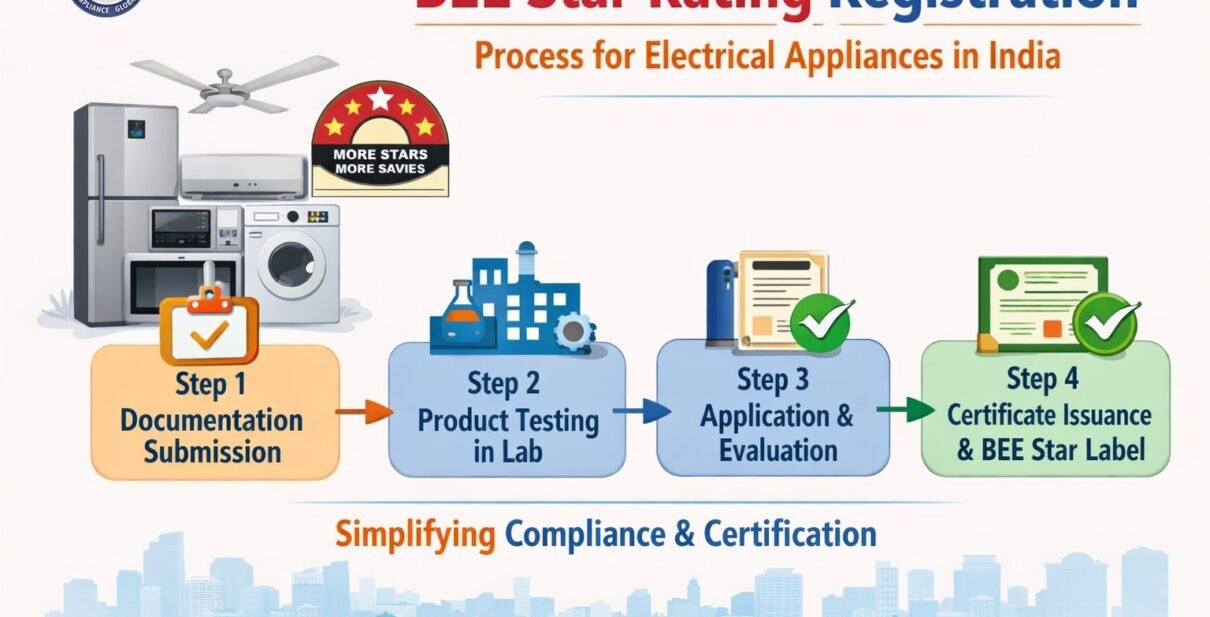
Step-by-Step Process of BEE Star Rating Registration
The BEE registration procedure consists of various structured steps depending upon industry practices and regulatory guidelines, here is a simplified breakdown given below:
Step 1: Identify Applicable Product Category
At first manufacturers should verify whether their product comes under the followings or not:
- Mandatory scheme
- Voluntary scheme
This step is necessary due to compliance requirements differ accordingly.
Step 2: Company / Brand Registration
The applicant, no matter whether it is a manufacturer or importer, is required to register their company on the BEE portal.
This consist of the followings:
- Submission of company incorporation details
- Trademark or brand authorization
- Payment of registration fees
Login credentials are issued for additional application procedures after getting approved.
Step 3: Product Testing in Accredited Lab
Products should get tested in NABL approved or recognised labs prior to applying for model registration.
- Testing determines energy consumption
- It ensures compliance with BEE standards
- Test reports must follow BEE format
This is one among the most essential steps due to the star rating which depends on these results only.
Step 4: Model Registration
Every product should get registered separately once tested successfully.
This step consist of the followings:
- Uploading test reports
- Submitting product specifications
- Providing sample label design
- Paying model registration fees
Every model gets a separate star rating depending on their performance.
Step 5: Documentation Submission
Applicants should upload the following documents:
- Test reports
- Product specifications
- Factory license
- Brand authorization letter
- GST registration
Correct documentation is necessary to prevent postponements or denials.
Step 6: Application Review by BEE
BEE officials examines after the application get submitted:
- Technical data
- Test reports
- Compliance with guidelines
Clarity and accuracy might be requested when any differences are found.
Step 7: Grant of BEE Star Label
Once getting verified successfully:
- BEE issues approval
- Star rating (1 to 5 stars) is assigned
- Manufacturer is allowed to use the BEE label
The label should show on the product prior to selling it in the market.
Documents Required for BEE Registration
Here are the primary documents given as follows:
- Company registration certificate
- Trademark certificate
- Test report from NABL lab
- Product details and specifications
- Authorized signatory documents
- Label design sample
Validity and Renewal
BEE star rating is only valid for a specific time which is also known as labeling cycle.
- Renewal is required after expiry
- Updated standards may apply
- Re-testing may be needed
Failing to comply can result in non-compliance and fines.
Benefits of BEE Star Rating for Businesses
BEE certification provides various of benefits like the followings:
1. Legal Compliance
Compulsory for several appliances prior to selling it in India.
2. Competitive Advantage
Higher-rated products come with more customers
3. Increased Sales
Energy-efficient products are preferred by buyers
4. Brand Trust
Boosts credibility and reliability among market
Challenges in BEE Registration
Manufacturers often face difficulties which are far from its benefits are as follows:
- Complex documentation
- Frequent regulatory updates
- Testing delays
- Application rejection
This is why professional consultancy assistance has become essential.
How UMSPCS Can Help
BEE star rating registration consists of technical knowledge, proper documentation, and regulatory understanding. This is where UMSPCS offers expert assistance.
UMSPCS provides the followings:
- Complete assistance in BEE registration
- Coordination with NABL testing labs
- Documentation and application filing
- Compliance guidance as per latest norms
- Faster approval with minimal errors
UMSPCS confirms seamless and stress-free certification procedures in accordance with experienced professionals.
Read more also: IMEI Registration: Process for Mobile Importers & Manufacturers
Conclusion
In India, BEE star rating registration is an essential certification for electrical appliance manufacturers. It confirms compliance with energy efficiency standards while assisting consumers to make informed decisions.
The procedure needs careful planning and execution from product testing to final permit. It might seem difficult but working together with experienced consultants like UMSPCS can simplify the whole journey.
Receiving BEE certification is not only a requirement but a strategic investment for long term business success when you’re aiming to launch or sell electrical appliances in India.
Read more about: CRS Consultant in Pune
FAQs
1. Is BEE Star Rating mandatory in India?
Yes, for certain appliances like ACs and refrigerators.
2. Who can apply for BEE registration?
Manufacturers, importers, and brand owners.
3. How long does the process take?
Typically 20–45 days depending on testing and approval.
4. Is lab testing compulsory?
Yes, testing in a recognized lab is mandatory.
5. Can one certificate cover multiple models?
No, each model requires separate registration.
6. What is the cost of BEE registration?
It depends on product type, testing, and number of models.
7. What happens if the application is rejected?
Corrections or re-testing may be required.
8. Can consultants help in BEE registration?
Yes, experts like UMSPCS simplify the process and ensure compliance.
❓ Ask a Question
Have any doubts? Fill the form below and our team will respond shortly.