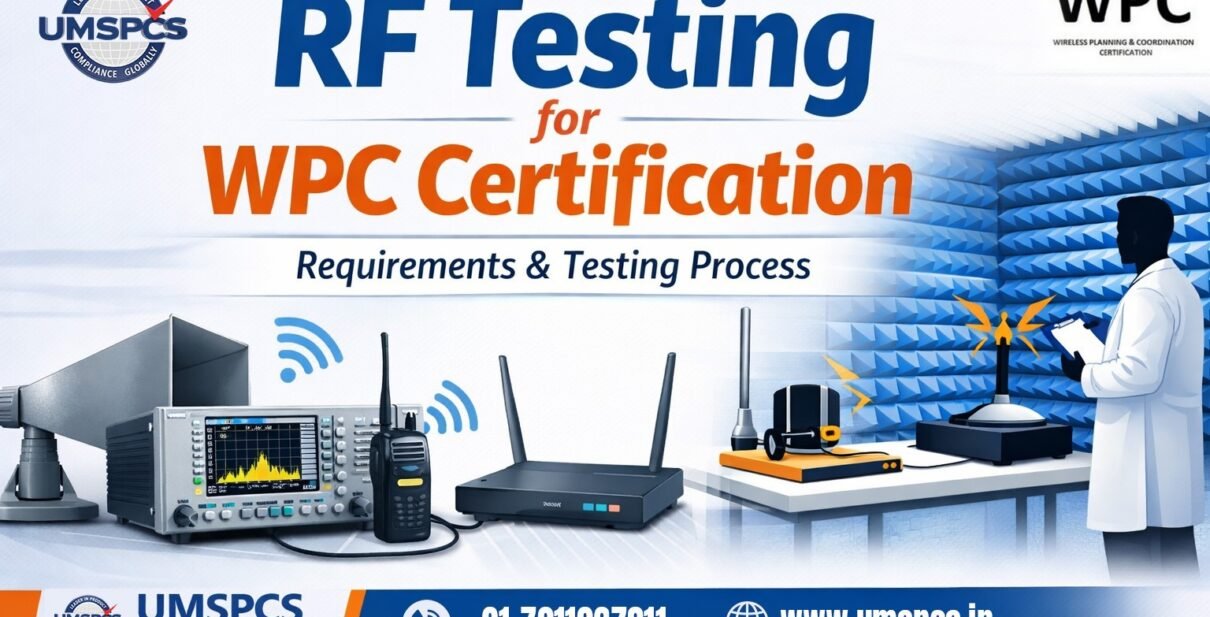
In today’s world where there is a rapid growth of wireless technologies like WiFi, bluetooth, LoT, and smart devices. Regulatory compliance has become necessary in India. One among the most crucial approval for these products is WPC (Wireless Planning and coordination certification which specifies the equipment type approval (ETA).
At the center of this certification lies RF (Radio Frequency) testing which confirms that devices function within frequency ranges which are allowed and do not interfere with licensed communication systems. This blog demonstrates RF testing requirements, its importance, and the complete testing procedure regarding WPC certification.
What is WPC Certification?
WPC certification is issued by the Wireless Planning & Coordination Wing which comes under the Department of Telecommunications (DoT), government of India. It is compulsory for every wireless and RF renewables product prior to importing, selling, or manufacturing products in India.
This certification confirms the followings:
- Devices operate within approved frequency bands
- RF emissions are within permissible limits
- Products do not interfere with critical communication networks
What is RF Testing?
RF (Radio Frequency) testing is a technical evaluation procedure which verifies whether a wireless device gets aligned with spectrum regulations. It checks the transmission characteristics of a device which confirms that it works safely and efficiently.
RF testing is compulsory for the followings:
- Bluetooth devices
- Wi-Fi routers and smart gadgets
- IoT products
- RFID and Zigbee-based equipment
Products can not get WPC ETA approval without having RF testing.
Importance of RF Testing in WPC Certification
RF testing works as a central role in WPC approval because of the following reasons:
1. Ensures Frequency Compliance
Devices should work within de-licensed frequency bands like 2.4 GHz and 5 GHz. Non compliance gives results in denials.
2. Avoid Signal Interference
Tetsing confirms that devices are not interfering with licensed telecom networks which use defense systems, or aviation frequencies.
3. Mandatory for ETA Approval
A valid RF test outcome from an approved lab is one among the most essential required documents for certification.
4. Facilitates Smooth Import Clearance
Products without RF test outcomes usually get stuck at the border which causes postpones and financial losses.
RF Testing Requirements for WPC Certification
Receiving WPC ETA certification requires the followings:
1. Accredited Testing Laboratory
RF testing should get conducted as follows:
- NABL-accredited labs (India)
- ILAC-recognized international labs
This confirms credibility and acceptance by WPC authorities.
2. Key Parameters Tested
Various of technical parameters are examined during the RF testing which are as follows:
- Frequency Range: Confirms operation within permitted bands
- Output Power: Ensures transmission power is within limits
- Bandwidth: Determines signal width
- Modulation Characteristics: Checks signal transmission quality
3. Compliance with NFAP
In India, Devices should get align with the National Frequency Allocation Plan (NFAP) which specifies permissible frequency usage
4. Product Configuration Consistency
The tested product should must get matched by the followings:
- Hardware design
- Antenna type
- RF module
Any change demands for re testing and re certification.
5. Complete RF Test Report
The RF test report should have the followings:
- Test results and graphs
- Spectrum analysis
- Device specifications
- Lab accreditation details
This report is uploaded during the ETA application.
RF Testing Process for WPC Certification
The RF testing procedure consist of various structured steps which are as follows:
Step 1: Product Identification
The first step is to find out whether the product has an RF module and needs WPC ETA approval.
Examples consist of the followings:
- Wireless headphones
- Smart home devices
- IoT modules
Step 2: Selection of Testing Laboratory
Select a recognised NABL or ILAC approved lab to conduct RF testing.
Step 3: Sample Submission
The product sample is delivered to the lab along with the followings:
- Technical specifications
- Circuit diagrams
- User manuals
Step 4: RF Testing Execution
The lab does an detailed testing to measure the followings
- Frequency accuracy
- Power output
- Emission limits
- Bandwidth
Step 5: Generation of RF Test Report
The lab grants a certified RF test outcome which assures compliance in line with Indian regulation once tested.
This is the most essential document for WPC approval.
Step 6: Documentation Preparation
Further documents are made in line with the RF test report which are as follows:
- Product datasheet
- Authorization letter
- Company registration documents
- Declaration of compliance
Step 7: Application Submission
The application is uploaded on the Saral Sanchar portal in line with the followings:
- RF test report
- Technical documents
- Government fees
Step 8: WPC Review and Approval
WPC officials check the application and issue the ETA certificate when every requirement is fulfilled.
Common Challenges in RF Testing
Businesses often face difficulties during RF testing which are given below:
- Incorrect frequency band selection
- Incomplete or invalid RF test reports
- Testing from non-accredited labs
- Mismatch between tested and final product
Such issues can result in postponements or denials of applications.
How UMSPCS Helps in RF Testing & WPC Certification
UMSPCS is a reliable compliance consultancy which supports businesses to get WPC ETA certification in line with a seamless and stress free procedure.
In accordance with extensive industry experience and a solid track record regarding regulatory approvals where UMSPCS offers the followings:
- Expert guidance on RF testing requirements
- Coordination with NABL/ILAC accredited labs
- Accurate documentation preparation
- End-to-end WPC ETA application support
- Fast-track approval assistance
Their workforce confirms that every RF parameters and compliance demands are fulfilled which minimises the possibility of getting rejected or any postponed.
Best Practices for Successful RF Testing
There are best practices to confirm seamless certification which are given below:
- Choose a reputed and accredited testing lab
- Verify frequency band compliance before testing
- Ensure product consistency during testing and submission
- Maintain complete and accurate documentation
- Seek expert consultation for complex cases
Read more also: BIS CRS Certification for Automatic Data Processing Machines
Conclusion
RF testing is an essential step to get WPC certification in India. It confirms that wireless devices work within permitted limits and does not get any interference with necessary communication systems.
Knowing the requirements and getting aligned with a structured testing procedure where businesses can get fast approvals and prevent regulatory issues. Working together with a professional expert consultant like UMSPCS which helps in simplifying the certification journey and assure compliance, accuracy, and efficiency in WPC certification.
Read more also: CRS Consultant in Pune
FAQs (Short)
- Is RF testing mandatory for WPC certification?
Yes, RF testing is compulsory to receive an ETA approval.
- Which labs are approved for RF testing?
NABL-accredited Indian labs or ILAC-recognized international labs.
- What is checked in RF testing?
RF testing checks the Frequency, power, bandwidth, and modulation.
- Can I use an existing RF module test report?
Yes, if the module is already certified and unchanged.
- How long does WPC certification take?
On an average WPC certification usually requires 7–15 working days after submission.
- Is WPC ETA valid for a lifetime?
Yes, unless the product’s RF design changes.
- What happens if RF testing fails?
The product must be modified and re-tested.
- Can UMSPCS help with RF testing?
Yes, they provide complete support from testing to certification approval.
❓ Ask a Question
Have any doubts? Fill the form below and our team will respond shortly.