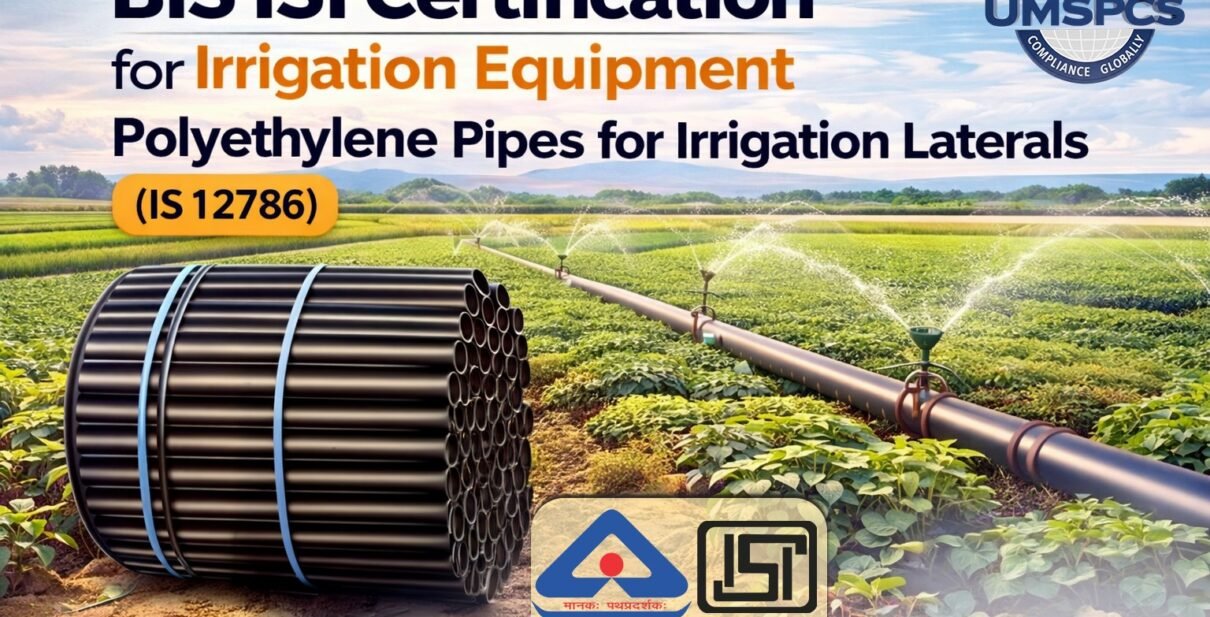
India’s agricultural sector is highly dependent on an efficient irrigation system to confirm optimal crop yield and sustainable water usage. Polyethylene pipes are one among the crucial components of modular irrigation infrastructure which is used for irrigation laterals. Such pipes act as an essential role in directly distributing water to crops in drip and sprinkler systems. Manufacturers should get aligned with the certain requirements under IS 12786 and get BIS ISI certification to keep consistency in quality, safety, and functionality
This blog offers a detailed outline of BIS ISI Certification for polyethylene pipes which are used in irrigation laterals consisting of its significance, scope, procedure, and the role of professional consultancy support.
Understanding IS 12786 Standard Polyethylene Pipes for Irrigation Laterals
IS 12786 is an Indian standard which defines the needs for polyethylene pipes employed in irrigation laterals. Such pipes are usually installed as branch lines which distribute water from the primary pipeline to crops by emitter or sprinklers.
The standard overviews necessary parameters which are as follows:
- Material quality and composition
- Dimensions and tolerances
- Mechanical and physical properties
- Performance under pressure and environmental conditions
Pipes manufactured under this standard are usually available in outer diameter ranging from 12mm to 32mm and are formed to stay in differ agricultural conditions like exposure to sunlight, fertilisers and chemicals.
Importance of BIS ISI Certification Polyethylene Pipes for Irrigation Laterals
BIS ISI Certification Polyethylene Pipes for Irrigation Laterals works as a mark of compliance in line with Indian quality standards. Certification confirms that the product should align with solid technical and safety requirements for irrigation equipment such as polyethylene pipes.
Quality Assurance
ISI Certification gives surety to pipes that are manufactured by using approved raw materials and in accordance to certain specification which confirms durability and long service life.
Reliable Performance
Approved pipes are tested for pressure resistance, tensile strength and environmental durability which give surety to online function in irrigation systems.
Market Acceptance
Products showing the ISI mark are accepted in a huge way for both government and private sectors to boost trust and credibility among consumers and stakeholders.
Regulatory Compliance
In a variety of cases specifically for government tenders and large scale irrigation projects where BIS certification is compulsory.
Risk Mitigation
Compliance in accordance with the BIS standard usually minimises the risk or product failure, leakage, and functional inefficiencies.
Scope of IS 12786 Certification
The scope of IS 12786 covers polyethylene pipes employed in irrigation laterals for agricultural applications.
Key Features Covered:
- Pipe sizes: 12 mm, 16 mm, 20 mm, 25 mm, and 32 mm
- Pressure classifications: Based on operational requirements
- Applications: Drip irrigation, sprinkler systems, and micro-irrigation
The standard also defines the requirements for raw materials which consist of the usage of polyethylene compounds in line with suitable additives like carbon black for UV resistance.
BIS Certification Process for IS 12786
The BIS ISI certification process is carried out under Scheme-I (ISI Mark Scheme) and consists of various stages to confirm compliance.
1. Application Submission
The manufacturer uploads an application along with product details, manufacturing process information, and quality control documentation.
2. Product Testing
Samples are tested in laboratories approved by BIS only for several of parameters, including:
- Dimensional accuracy
- Pressure resistance
- Tensile strength
- Resistance to environmental stress
3. Factory Inspection
BIS officials conduct an inspection of the manufacturing unit to examine the followings:
- Production facilities
- Quality control systems
- Testing infrastructure
4. Grant of License
BIS grants the license to display the ISI mark on the product after getting verified successfully.
5. Ongoing Surveillance
BIS conducts specific inspections and testing to confirm ongoing compliance in line with the standard after certification.
Testing Requirements Under IS 12786
Polyethylene pipes should go through various tests to check their quality and performance. which includes the followings:
- Internal pressure creep rupture test
- Tensile strength test
- Reversion test
- Environmental stress cracking resistance
- Dimensional verification
Such tears are necessary to confirm that the pipes can withstand long term usage under varying agricultural conditions.
Documentation Requirements
Manufacturers are required to upload an comprehensive detailed documentation as part of the certification process which includes the followings:
- Manufacturing process description
- Raw material specifications
- In-house testing reports
- Factory layout and infrastructure details
- Quality control procedures
- Trademark registration (if applicable)
Correct and complete documentation has an essential role in confirming a seamless certification procedure.
Common Challenges in Bis Certification
Receiving BIS ISI certification might be difficult which is specifically for initial applicants. In general, it consists of the followings:
- Understanding detailed BIS guidelines
- Preparing and organizing documentation
- Meeting stringent testing requirements
- Managing delays due to incomplete submissions
- Addressing non-conformities during inspection
Professional guidance can assist to overcome such challenges effectively.
Role of Professional Consultants in BIS Certification
Getting an experienced BIS consultant can considerably simplify the certification procedure. Consultant offers technical and regulatory assistance which confirms that manufacturers should get aligned with every essential requirement efficiently.
Why Choose UMSPCS for BIS ISI Certification?
UMSPCS provides deep bis consultancy services to industry requirements for businesses who want reliable assistance in getting BIS certification.
UMSPCS has made itself a reliable compliance partner by helping manufacturers all across the nation in getting regulatory approvals for several products consisting of irrigation equipment.
Industry Knowledge
The team has an in-depth understanding of BIS standards which consist of IS 12786 by allowing correct guidance throughout the certification process.
Complete Assistance
From initial application filing to coordination with laboratories and managing inspections, UMSPCS provides complete assistance.
Efficient Process Management
The consultancy assists in minimising postpones and confirms on time certification in accordance with a structured approach.
Focus on Compliance
UMSPCS confirms that every technical and documentation requirements are fulfilled which reduces the risk of rejection or rework.
Trusted by Businesses
UMSPCS boost a solid reputation for reliability and professionalism in line with extensive experience in managing certification projects.
Read more about: BIS CRS Certification for Visual Display Units and Video Monitors
Conclusion
BIS ISI certification for polyethylene pipes employed in irrigation lateral under IS 12786 is necessary for confirming product quality, safety and long-term functionality in agricultural applications. It not just improves product credibility but also simplifies access to government projects and competitive markets.
In accordance with expert guidance which make it efficient and manageable while the certification procedure consists of technical and regulatory steps. Manufacturers who want to make a solid presence in the irrigation sectors have to prioritise BIS compliance and have professional assistance to get smooth certification.
FAQs
- What is IS 12786 in BIS certification?
IS 12786 is an Indian Standard that defines the requirements for polyethylene pipes employed in irrigation laterals by confirming quality and performance.
- Is BIS ISI certification mandatory for irrigation pipes?
Yes, BIS ISI certification is compulsory for polyethylene irrigation pipes in various government projects and regulated markets,
- What sizes are covered under IS 12786?
The standard covers pipe sizes usually has a range from 12 mm to 32 mm in outer diameter.
- How long does it take to get BIS ISI certification?
The process usually requires around 4 to 6 weeks which is based on documentation, testing, and inspection timelines.
- What tests are required for IS 12786 certification?
Primary tests consist of pressure resistance, tensile strength, reversion test, and environmental stress cracking resistance.
- Can a small manufacturer apply for BIS certification?
Yes. Both small and large manufacturers are applicable to ensure that they align with BIS requirements and quality standards.
- What is the validity of a BIS ISI license?
The BIS license is usually valid for 1 to 2 years and should get renewed periodically.
- How can a consultant help in BIS certification?
A consultant supports documentation, testing coordination, application filing, and confirms compliance to accelerate approval.
❓ Ask a Question
Have any doubts? Fill the form below and our team will respond shortly.