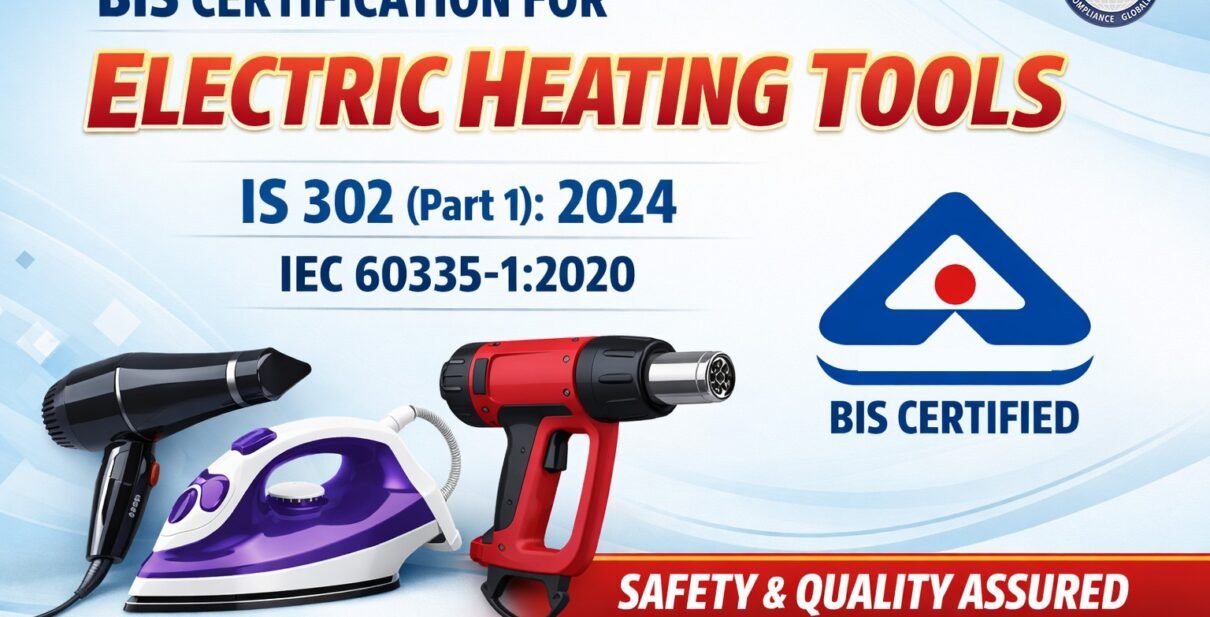
In accordance with the huge use of electric heating tools in households, salons, workshops, and industrial setups, safety and quality have become essential concerns these days. The government of India has imposed the BIS Certification to be compulsory for electric heating tools under IS 302 (Part 1):2024 aligned with IEC 60335-1:2020 to mention these risks.
This certification makes certain that electrical appliances should follow the rigid safety standards and should be safe for consumer’s daily use. Getting familiar with BIS certification is necessary for legal compliance and market access when you’re a manufacturer, importer, or distributor of electric heating tools.
What is BIS Certification for Electric Heating Tools?
The Bureau of Indian Standards (BIS) certification is a conformity assessment which gives surety that products are aligned with Indian safety and quality standards. Certification is grander under the ISI Mark scheme (scheme I) which is for electric heating tools.
In accordance with the latest Quality Control Order (QCO) for electric heating tools which should align with IS 302 (Part 1): 2024, which covers general safety requirements for household and similar electrical appliances.
Businesses are not allowed to manufacture, import, or sell such products in India without having the BIS Certification for electric heating tools.
About IS 302 (Part 1): 2024 / IEC 60335-1:2020
The standard IS 302 (Part 1):2024 is the upgraded version of safety requirements for electrical appliances and is harmonised in accordance with the international standard IEC 60335-1:2020.
Key Highlights:
- Covers general safety requirements for electrical appliances
- Applicable to devices operating up to:
- 250V (single-phase)
- 480V (other appliances)
- Focuses on:
- Protection against electric shock
- Fire hazards
- Mechanical and thermal safety
- Durability and reliability
This upgraded standard replaces the previous IS 301-1:2008 and shows improved safety measures for modular appliances.
Products Covered Under the Standard
Electric heating tools come under a huge category of appliances which are regulated through the BIS. Such consist of the followings:
- Electric soldering irons
- Heat guns
- Electric glue guns
- Heating plates
- Industrial heating tools
Furthermore, several household and commercial appliances such as ovens, boilers, and cooking devices are also under this standard.
Benefits of Bis Certification
There are various benefits to becoming certified according to the appropriate Indian Standard.
Various advantages of getting bis certification in line with the appropriate Indian Standards are as follows:
- Legal permit to sell products in the market
- In accordance with the QCO regulations
- Boosting consumer confidence
- Enhance brand credibility
- Prevent dangers associated with regulations
- Improve the institutional markets
Certified products indicate confirmation with imposed standards of quality and security.
Penalties for Non-Compliance
Getting failed to comply can result to the followings:
- Heavy fines
- Product seizure
- Ban on manufacturing or sales
- Legal action by authorities
This shows that compliance is not only essential but necessary for business to go on.
BIS ISI Certification Process for Electrical Heating Tools
1. Product Evaluation and Standard Identification
With the goal to find the right Indian Standard and certification process suitable for the UPS or inverter model, the product will be assessed.
2. Documentation Preparation
Manufacturers are needed to prepare complete records, like the following:
- The technical details
- representations of circuits
- Specification of the component
- A procedure for quality control
- Descriptions of the manufacturing process
3. Testing at BIS-Recognized Laboratories
In order to verify conformity towards BIS safety and performance standards, samples of the product undergo examination in approved labs.
- Inspection of the Factory
For the purpose to verify that manufacturing procedures and quality control systems correspond to standards, BIS may carry out live inspections.
5. The acceptance & Packaging
The manufacturer receives a license to use the ISI Mark only if the product and factory meet the BIS requirements.
Step 6: Check in and Renewal of previous certification
Certification in BIS is removable. To promise ongoing compliance, sample testing and surveillance inspection should take place constantly. After some time, licenses are meant to get renewed.
Performing this step can be challenging, particularly among foreign producers or those who were getting into the Indian market for the first time
Documents Required for Certification
In general, manufacturers suffer to offer a number of things:
- Papers that are associated by establishing a business.
- Confirmation of location and manufacturing facility.
- Information regarding how the product is constructed.
- Procedure for verifying the quality.
- Data of testing facilities.
- Details about products being tested in labs approved by BIS only.
How UMSPCS Can Assist
UMSPCS provides an indepth BIS consulting and compliance support for producers and importers of electric heating tools. Services that we offer are as follows:
UMSPCS helps with the following:
- Testing of products in BIS-approved labs only.
- Preparing complete paperwork
- Submission of the application online through the BIS portal
- Preparing for factory audits
- Coordinating with BIS and handling the query
- Support in the approval of the license
- Support in renewal, amendment, and monitoring
UMSPCS works with Indian manufacturers, importers, and foreign manufacturers, ensuring faster approvals and zero compliance risks.
Read more about also: Bis Certification for foreign manufacturers
Conclusion
In India, BIS certification for electric heating tools under IS 302 (Part 1): IEC 60335-1:2020 has become an essential requirement for manufacturers and importers. It gives surety of safety enhancing the quality of product and boosts trust among consumers.
Businesses should work proactively to get compliance and prevent penalties in accordance with mandatory enforcement from 2026. Working together with a professional consultant like UMSPCS which simplifies the process and assists you to get certification more efficiently.
Read more also: BIS Certificate in Pune
FAQs
- Is BIS certification mandatory?
Yes, it is compulsory in accordance with QCO for electric heating tools.
- Which standard is applicable?
IS 302 (Part 1): 2024 / IEC 60335-1:2020 is an Indian standard which is applicable for this .
- Under which scheme is it issued?
Under the ISI Mark Scheme (Scheme I) it was issued.
- How long does it take?
On an average, BIS Certification usually requires 4–8 weeks.
- Is factory inspection required?
Yes, factory inspection is required in most of the cases.
❓ Ask a Question
Have any doubts? Fill the form below and our team will respond shortly.