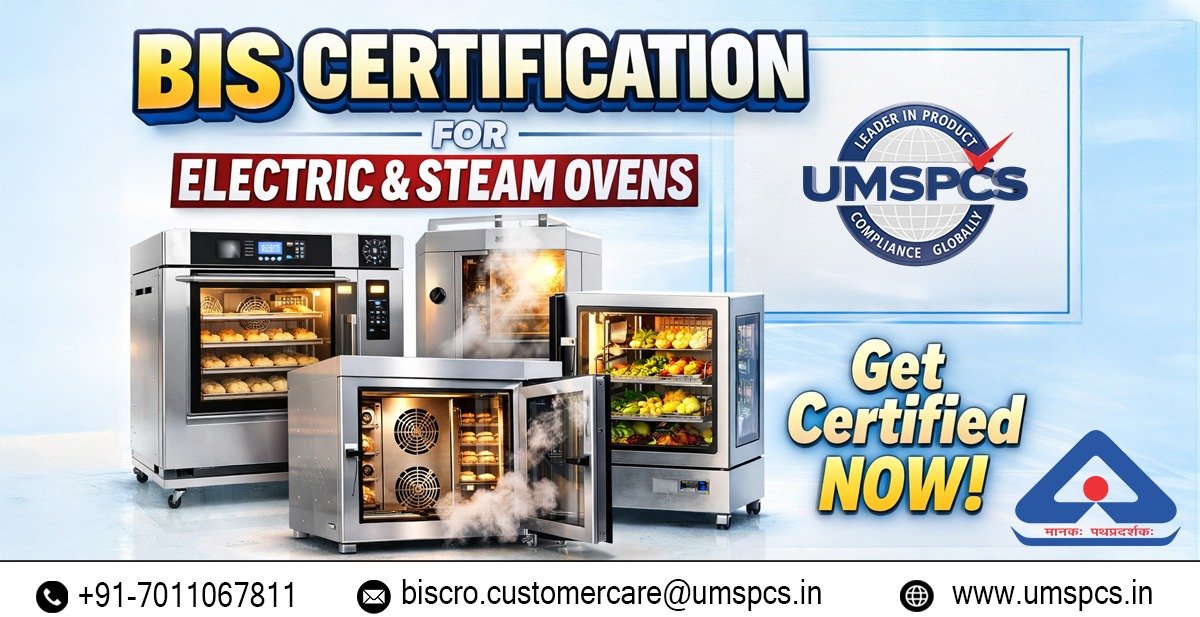
In today’s rapidly growing food and hospitality industry, commercial kitchen appliances such as electric forced convection ovens, steam cookers, and steam convection ovens which work as a primary role. Therefore, giving surety of safety and compliance is equally essential. This is how BIS certification has become compulsory.
Manufacturers and importers should align with solid requirements of safety which is prior to distributing products in India, BIS Certification for Electric Forced Convection Ovens, Steam Cookers and Steam-Convection Ovens under the upgraded standard IS 302 (Part 1):2024 which is aligned with IEC 60335-1:2020.
What is BIS Certification?
The Bureau of Indian Standards (BIS)is in charge of the national authority and holds the responsibility of handling the product quality, safety, and reliability. BIS certification gives security of products that are in line with Indian safety standards and are secure to get utilized by consumers.
BIS certification is usually imposed under the ISI mark scheme (scheme I) or CRS (compulsory Registration Scheme) which is based upon the category of product for electrical appliances.
About IS 302 (Part 1): 2024 / IEC 60335-1:2020
The standard IS 302 (Part 1):2024 is the upgraded version of safety requirements for household and other similar electrical appliances. It is in line with the global standards IEC 60335-1:2020, which gives global safety compliance.
This standard specifies usual safety requirements which are as follows:
- Protection against electric shock
- Thermal safety and overheating prevention
- Mechanical strength and durability
- Fire hazard prevention
- Safe operation under normal and abnormal conditions
The updated version replaces the earlier IS 302-1:2008 and introduces stricter safety norms and modern testing methods.
Products Covered Under This Standard
The scope of this certification consists of commercial kitchen appliances like the followings:
- Electric Forced Convection Ovens
- Steam Cookers
- Steam-Convection Ovens
Such appliances are mostly utilised in the followings:
- Restaurants and hotels
- Catering services
- Commercial kitchens
- Food processing units
In India, Such appliances should align with safety requirements prior to getting manufactured, imported, or solid through the BIS regulations.
Why BIS Certification is Important
1. Consumer Safety
Electric forced convection ovens, steam cookers, and steam convection ovens get direct constant with body and electrical operation. BIS Certification gives protection from electric shock, excess heating, and fire dangers.
2. Legal Compliance
Certification is compulsory in accordance with the QCO. Products are not able to distribute products lawfully in India without having the BIS approval.
3. Market Access
Both local manufacturers and importers should get certification to access the Indian market.
4. Builds Trust
The ISI mark boosts credibility of brand and reassures consumers regarding the quality of product.
5. Standardized Quality
Make certain uniform safety and function all across certified products.
BIS Certification Process for Electric Forced convection ovens, steam cookers and steam convection ovens
The BIS certification procedures gets along with a structured approach in accordance with the ISI scheme which is as follows:
Step 1: Application Submission
Manufacturers must apply through the BIS portal with product and company details.
Step 2: Product Testing
Samples are tested in BIS approved labs to check whether they are complying with IS 302 (Part 1): 2024.
Step 3: Factory Inspection
BIS officials conduct live audits of the facility provided by the manufacturing place to get access to quality control systems.
Step 4: Grant of License
Manufacturers get a BIS license and can show the ISI mark on product after getting approved only.
Step 5: Ongoing Compliance
Ongoing surveillance and testing gives surety that the standards are on point.
Key Updates in IS 302 (Part 1): 2024
The upgraded standard gives various of essential alterations which are as follows:
- Alignment with international IEC safety standards
- Improved testing procedures for modern appliances
- New provisions for battery-operated and advanced devices
- Enhanced moisture resistance and durability testing
- Updated guidelines for power input and current measurement
Such changes want to enhance the safety of products and adapt to every changing technology.
Documents Required for BIS Certification
Manufacturers should provide various documents when applying for the BIS Certification in India.
Primary documents includes the followings:
- Business license of the manufacturer
- Factory registration documents
- Product technical specifications
- Manufacturing process details
- Product test reports from BIS-approved labs
- Quality control manual
- Authorized Indian Representative (AIR) details for foreign manufacturers
- Trademark registration (if applicable)
Correct documentation is necessary for a simple and smooth certification procedure
Challenges Faced by Manufacturers
Several of businesses might seem complex because of the followings :
- Complex documentation requirements
- Technical compliance issues
- Delays in testing and approvals
- Lack of knowledge about BIS procedures
This is how a professional experienced BIS CRS consultant works as a primary role.
How UMSPCS Can Help
Receiving an BIS certification might seem difficult and time consuming procedure specifically for fresh manufacturers or importers. This is where a professional BIS consultant in India like UMSPCS has a primary role to play.
UMSPCS provides complete assistance for BIS certification which consists of the followings:
- Documentation and application filing
- Coordination with BIS-approved testing laboratories
- Assistance in factory inspection and audit preparation
- Guidance on IS standards and compliance
- Support BIS for foreign manufacturers (FMCS)
- Post-certification compliance and renewal
Businesses can give quick approvals and prevent high cost postpones or rejections when you’re under expert guidance.
Conclusion
In India, BIS certification for Electric Forced Convection Ovens, Steam Cookers and Steam-Convection Ovens under IS 302 (Part 1):2024 / IEC 60335-1:2020 which is necessary for giving surety of safety, quality, and legal compliance of electrics.
Manufacturers should work proactively to get compliance demands, since the safety standards now become rigid and more aligned with the international standards. No matter whether you’re a local manufacturer or an importer for whom getting BIS certification is not only compulsory but it’s a strategic step regarding boosting trust among consumers while also expanding rapidly all over the Indian market.
Working together with a reliable consultant like UMSPCS which can simplify the whole procedure and assists you in getting certification efficiently.
Frequently Asked Questions (FAQs)
- Is BIS certification mandatory for electric convection ovens and steam cookers?
Yes. In India, BIS certification is compulsory for manufacturing, importing, or distributing products.
- Which standard applies to these appliances?
This standard should align with IS 302 (Part 1): 2024 / IEC 60335-1:2020.
- What is the validity of BIS certification?
The BIS license is usually valid for 1-2 years while also needing to get renewed before expiration.
- How long does the BIS certification process take?
On an average, BIS certification usually requires 4-8 weeks which is based on testing and documentation.
- Can a consultant help in BIS certification?
Yes. professional consultant like UMSPCS which can make the documentation, testing, and approvals simple.
❓ Ask a Question
Have any doubts? Fill the form below and our team will respond shortly.