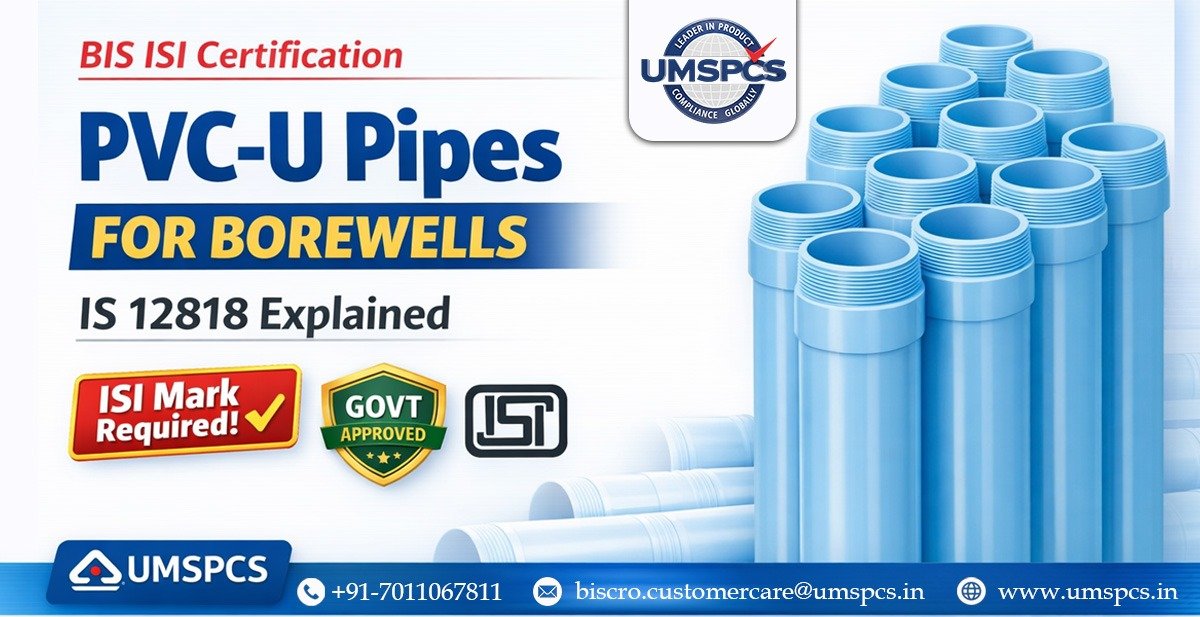
In today’s fast growing infrastructure and water management sector where the demand for high quality piping solutions is increasing continuously. PVC-U screen and casing pipes are one among the most essential components for groundwater extraction systems which are employed in borewells and tubewells. Such pipes are required to get in line with the standard for giving surety of safety, durability, and functionality which is in charge of the Bureau of Indian Standards (BIS) in accordance with IS 12818.
This blog demonstrates everything about BIS ISI Certification for PVC-U screen and casing pipes and its importance, requirements and certification procedure.
What is IS 12818 Standard?
IS 12818:2010 is an Indian Standard that defines the requirements for PVC-U screen and casing pipes which are utilised in bore/tubewells for the supply of water.
This standard consists of the followings:
- Ribbed screen pipes
- Plain screen pipes
- Plain casing pipes
Such pipes are produced in size ranging from 35mm to 400mm nominal diameter and are formed particularly for the groundwater extraction systems.
The standard gives validation that the pipes are utilised in borewells which are solid, safe and capable of long term use without the contamination of water.
Types of PVC-U Screen and Casing Pipes
In accordance with IS 12818, PVC-U are defined into three main categories which are as follows:
1. Ribbed Screen Pipes
- Ribbed Medium Well Screen (RMS)
- Ribbed Deep Well Screen (RDS)
2. Plain Screen Pipes
- Plain Medium Well Screen (PMS)
- Plain Deep Well Screen (PDS)
3. Casing Pipes
- CS Pipe (Shallow wells)
- CM Pipe (Medium wells)
- CD Pipe (Deep wells)
Every type is formed for various depths and groundwater conditions which make sure of the efficient water filtration and support of structure.
Key Requirements Under IS 12818
To receive the BIS ISI certification, manufacturer should get align with various of technical and quality parameters are as follows:
Material Requirements
- Pipes must be made primarily from unplasticized polyvinyl chloride (PVC-U)
- Only approved additives can be used for durability and performance
Dimensional Standards
- Pipes must adhere to specified diameters, thickness, and lengths
- Proper threading must be ensured for secure connections
Testing Requirements
PVC-U pipes must undergo rigorous testing, including:
- Visual appearance test
- Tensile strength test
- Resistance to external blows
- Vicat softening temperature test
- Effect on water (non-toxicity)
Marking Requirements
Each pipe must include:
- Manufacturer’s name or trademark
- Pipe type and size
- ISI mark
Benefits of BIS ISI Certification for PVC-U Screen and Casing Pipes for Bore/Tubewells
1. Legal Requirement
In every aspect wood products distributed domestically in India need to possess BIS Certification for Unplastic polyvinyl chloride (PVC-U) Screen and Casing Pipes which has to conform to the Quality Control Order.
Products which do not have a valid certification may be seized in the market, inspected at ports, or taken off the market, which could lead to fines, penalties, and a lack of market access.
2. Quality Assurance
Consumers and manufacturers have made certain that the appliances for PVC-U screens and casing pipes align to certain quality, safety, and functionality standards due to the ISI Mark and BIS Certification. This is specifically essential in construction, applications, and infrastructure projects where poor quality supplies results in damage for structure and financial loss.
3. Market Status and Competitive Benefit
BIS-certified products come with the ISI mark that is familiar to Indian consumers and businesses. This mark indicates the image of brand, boosts trust among consumers, and provide government tenders, export markets, and large contracts for market which can cause various advantages to your business in several ways,
- Protection Against Substandard Products
Highly rigorous certification standards make certain that unsafe PVC-U screens and casing pipes with poor binding agents or insufficient bonding — frequently seen in less expensive imported or local unapproved products — continue to stay out of the market, improving overall industry quality.
Documents Required for BIS Certification
BIS Certification process usually consists of the following required documents:
- Business registration certificate
- Factory license
- Manufacturing process details
- List of manufacturing equipment
- Quality control documents
- Test reports of raw materials
- Authorized signatory documents
- Product specifications and drawings
Accurate documentation helps in making the certification process smooth.
BIS FMCS Certification for Foreign Manufacturers
Manufacturers should get the BIS Certification for foreign manufacturers if they are selling PVC-U screens and casing pipes outside the nation or importing it into the Indian market.
The Foreign Manufacturers Certification Scheme (FMCS) enables manufacturers from foreign to get the BIS approval and sell their products into the Indian market. This procedure consists of factory audits through BIS officials and product testing in line with the Indian standards.
After the approval, foreign manufacturers are able to use the ISI mark, which gives validation to their products which is in line with the similar standards of quality like those in India.
How UMSPCS Helps in BIS Certification
Companies which require help with certification and sticking to the rules are referred to an experienced consulting firm like UMSPCS, assists companies in India gain the necessary government authorizations and certifications that they require through offering them qualified guidance.
They offer help with:
- ISI and BIS ISI Certification
- BIS Certification in India
- Obtaining BIS Hallmark certification and enrolling an item
- BIS FMCS Certification for manufacturers coming from other countries
- MTCTE Certification and TCE Approval
- WMI Certification
UMSPCS allows manufacturers to recognize the legal requirements and successfully complete their certification procedure quickly by hiring qualified consultants who are familiar with what they are doing.
Conclusion
BIS ISI Certification for PVC-U screen and casing pipes are in line with the IS 12818 is important for giving validation to product’s quality, safety, and reliability in borewell and tubewell applications. It not just provides proof for compliance in line with Indian Standards but also boosts trust among consumers and contractors.
Manufacturers who want to grow in the Indian market should give importance to BIS Certification for getting aligned with regulatory requirements and handling excellence of product. Working together with an experienced consultant like UMSPCS who provides complete assistance to make the certification procedure smooth, efficient, and hassle free.
Read more also: BIS Certification for Heating Liquids
Frequently Asked Questions (FAQs)
- What is IS 12818?
IS 12818 is an Indian Standard which defines the needs for PVC-U screen and casing pipes which are utilised in borewells and tubewells.
- Is BIS ISI Certification mandatory for PVC-U pipes?
Yes. BIS ISI Certification is compulsory in accordance with the applicable Quality Control Order (QCOs) which is for manufacturers who want to market in India.
- How long does it take to get BIS certification?
On an average, BIS Certification usually requires 4-6 weeks which is based on paperwork and testing.
- Can I sell PVC-U pipes without BIS certification?
No. Distributing products without having certification which can give rise to fines, when the product comes under the QCO.
- How can UMSPCS help?
UMSPCS provides complete assistance with preparing documentation, testing, and complete BIS certification who manages and makes the whole certification process faster.
❓ Ask a Question
Have any doubts? Fill the form below and our team will respond shortly.