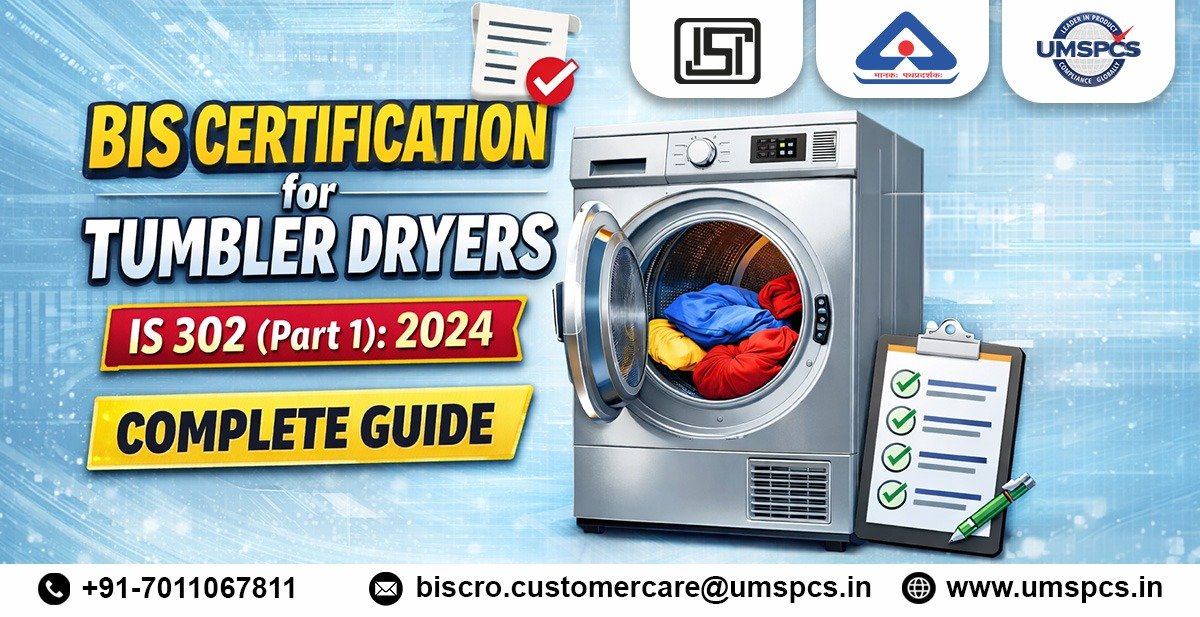
Tumbler dryers are used widely in household and commercial appliances which are made in a way to dry clothes rapidly and efficiently. These are usually used in houses, laundry, hotels, and hospitals. As these appliances consist of electricity and heating components, therefore, standards of safety and functionality are crucial.
The government of India demands BIS Certification for tumbler dryers in accordance with IS 302 (Part 1): 2024 which sets the seal on consumer safety and product quality. Manufacturers and importers should get the ISI certification prior to sell these products into the Indian market.
In this blog, we will look over the BIS Certification process, required documents, fees, timeline, and advantages for Tumbler Dryers in India.
What is BIS Certification for Tumbler Dryers?
The Bureau of Indian Standards (BIS) holds the charge of BIS Certification which is a quality certification to give validation of products that follow the requirements of safety, reliability, and performance.
Tumbler dryers should align with IS 302 (Part 1): 2024 and keep the ISI Mark certificate in accordance with the Safety of Household, Commercial and Similar Electrical Appliances (Quality Control) order. Manufacturers are not able to manufacture, import or sell Tumbler Dryers in India without having the BIS approval from 19 March 2026.
This certification is approved under scheme-I (ISI Mark Scheme) of BIS.
Applicable Standard for Tumbler Dryers
| Product | Tumbler Dryers |
| Indian Standard | IS 302 (Part 1): 2024 |
| International Equivalent | IEC 60335-1:2020 |
| Certification Scheme | ISI Mark Certification |
| Regulating Authority | Bureau of Indian Standards (BIS) |
| Mandatory Date | 19 March 2026 |
The IS 302 (Part 1) standard defines the general safety requirements for household electrical appliances like dryers, kitchen appliances, and cleaning equipment.
Importance of BIS Certification for Tumbler Dryers
Receiving BIS certification in India is compulsory for manufacturers who are into polyethylene water storage tanks. It gives various advantages for both businesses and consumers.
1. Quality Assurance
The BIS ISI certification gives surety that these tanks follow the quality standards stated by the BIS.
2. Safe Water Storage
IS 302 gives assurance to tanks that they are composed of safe materials which make them safe for consumption of water and avoid contamination.
3. Legal Compliance
BIS certification is a must for manufacturers who are trying to legally sell their water tanks into the Indian market.
4. Customer Trust
ISI mark on products boosts trust among consumers as they went through a lot of testing and are approved by the BIS.
5. Business Opportunities
Manufacturers who have BIS ISI certification can safely distribute their products to government projects, builders, and companies.
Key Testing Requirements for Tumbler Dryers
To receive ISI Certification, the product is required to go through various tests in labs which are approved by the BIS.
Some of the important tests include the following:
- Protection against electric shock
- Heating and temperature rise test
- Input power and current test
- Insulation resistance test
- Leakage current test
- Mechanical strength and stability test
- Abnormal operation test
- Durability test
These tests gives surety that the product work safely with normal and abnormal conditions.
Documents Required for BIS Certification
Manufacturers should provide various of documents when applying for the BIS Certification in India.
Primary documents include the followings:
- Business license of the manufacturer
- Factory registration documents
- Product technical specifications
- Manufacturing process details
- Product test reports from BIS-approved labs
- Quality control manual
- Authorized Indian Representative (AIR) details for foreign manufacturers
- Trademark registration (if applicable)
Correct documentation is necessary for a simple and smooth certification procedure.
BIS ISI Certification Process for Tumbler Dryer IS 302 (Part 1):2024
1. Product Evaluation and Standard Identification
With the goal to find the right Indian Standard and certification process suitable for the UPS or inverter model, the product will be assessed.
2. Documentation Preparation
Manufacturers are needed to prepare complete records, like the following:
- The technical details
- representations of circuits
- Specification of the component
- A procedure for quality control
- Descriptions of the manufacturing process
3. Testing at BIS-Recognized Laboratories
In order to verify conformity towards BIS safety and performance standards, samples of the product undergo examination in approved labs.
- Inspection of the Factory
For the purpose to verify that manufacturing procedures and quality control systems correspond to standards, BIS may carry out live inspections.
5. The acceptance & Packaging
The manufacturer receives a license to use the ISI Mark only if the product and factory meet the BIS requirements.
Step 6: Check in and Renewal of previous certification
Certification in BIS is removable. To promise ongoing compliance, sample testing and surveillance inspection should take place constantly. After some time, licenses are meant to get renewed.
Performing this step can be challenging, particularly among foreign producers or those who were getting into the Indian market for the first time
Implementation Timeline Under QCO 2025
To make a smooth process, the government established a progressive start depending on the size of the company.
Dates of compliance:
| Enterprise Type | BIS Compliance Required From |
| General manufacturers (other than MSMEs) | October 1, 2025 |
| Small companies | January 1, 2026 |
| Micro business | April 1, 2026 |
Legal penalties and company reputation can be impacted by neglecting these deadlines.
Penalties for violation of QCO 2025
The Bureau of Indian Standards (BIS) Act of 2016 applies penalties on any individual or organisation that violates the Bis QCO 2025.
Possible consequences include:
- Serious financial consequences.
- Seizure of a product that violates the rules.
- BIS suspension or cancellation licence.
- Legal actions.
- Restrictions on imports and issues with customs clearance.
Not following compliance can impact your company’s reputation.
Timeline for BIS Certification
| Manufacturer Type | Estimated Time |
| Indian Manufacturer | 30–45 days |
| Foreign Manufacturer (FMCS) | 4–6 months |
Prior to exporting their products to India, Foreign companies should get certification through the BIS FMCS Certification which is Foreign Manufacturers Certification Scheme.
BIS Certification Fee Structure
The amount of BIS Certification is based upon the type of product, testing requirements, and location of manufacturing.
| Fee Component | Approx Cost |
| BIS Application Fee | ₹1,000 |
| Testing Charges | ₹25,000 – ₹50,000 |
| Factory Inspection Charges | ₹7,000 – ₹10,000 |
| Annual License Fee | ₹1,000 |
| Marking Fee | As per BIS guidelines |
Note: Actual amount may vary due to product complexity and testing requirements.
Role of a BIS Certification Consultant in India
Getting BIS Certification can be difficult because of documentation, testing process, and regulatory requirements. BIS Certification Consultant in India can assist your businesses to get simpler process.
Professional consultants offers the following:
- Application filing support
- Product testing coordination
- Documentation preparation
- Factory audit assistance
- BIS license approval support
How UMSPCS Can Help
The IS 12701 might seem difficult to get a BIS Certification without getting any expert assistance.
How UMSPCS offers assistance:
- Inspection of product effectiveness under QCO 2025.
- Finding the right Indian standards.
- Preparation and confirmation of documentation.
- Interaction with the BIS and laboratory testing.
- Uploading enquiries and keeping an eye on them.
- Services for MSMEs, importers, and manufacturers for fast approvals
- Minimal chances of rejection or failure.
Our professionals assure that your company is fully compliant, legally secure, and market-ready.
Read more about: BIS CRS Certification for Laptop/Notebook/Tablet
Conclusion
Manufacturers and importers who want to sell their appliances in India should need to get inline with the BIS Certification for Tumbler Dryers under IS 302 (Part 1): 2024 / IEC 60334-1:2020. This certification provides validation to products safety, quality, and regulatory compliance regarding electrical household appliances.
Receiving ISI Certification not just helps in getting aligned with legal requirements but also enhances product credibility and boost trust among consumers. In accordance with BIS Certification Consultant in India, businesses can get the certification and market access smoothly and efficiently.
Frequently Asked Questions (FAQs)
- Is BIS Certification mandatory for Tumbler Dryers in India?
Yes. In accordance with the Quality Control Order, Tumbler Dryers should get BIS Certification prior to selling their products in India.
- Which standard applies to Tumbler Dryers?
IS 302 (Part 1): 2024 is only applicable standard for Tumbler Dryers with IEC 60334-1:2020.
- What is the certification scheme used?
Tumbler Dryers are approved in line with the ISI Mark Scheme (Scheme-1) of BIS
- How long does BIS certification take?
On an average, BIS Certification requires 30-45 days whereas, foreign manufacturers might need 4-6 months.
- Can foreign manufacturers apply for BIS certification?
Yes. Foreign manufacturers can apply for BIS Certification through the BIS FMCS Certification scheme.
❓ Ask a Question
Have any doubts? Fill the form below and our team will respond shortly.