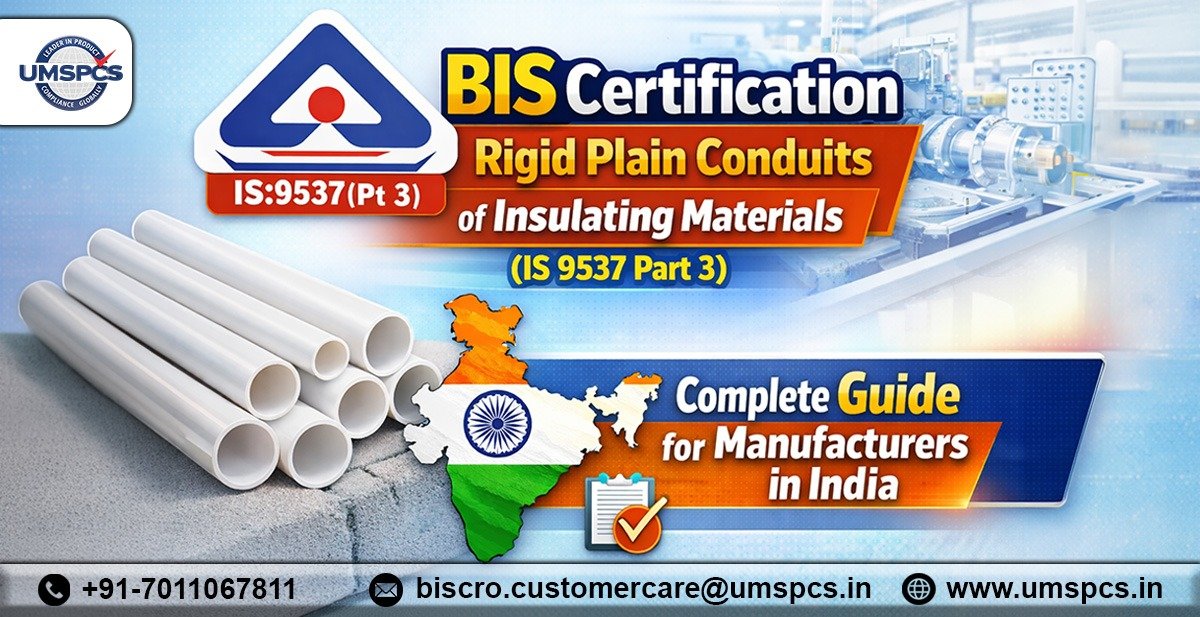
Safety of electrical wiring is a crucial component of contemporary systems. Conduit systems are commonly utilised for maintaining wiring systems secure from destruction caused by the surroundings and machines. The Bureau of Indian Standards (BIS) in India initiates certain standards for the superiority of these kinds of products. BIS Certification for Rigid Plain Conduits of Insulating Materials IS 9537 (Part 3) is an important standard that talks about fixed plain conduits constructed from insulating materials that can be utilised in electrical installations.
Making sure that the conduits satisfy Indian safety and quality standards, the companies that make them must apply for BIS certification and the ISI mark.
What Are Rigid Plain Conduits of Insulating Materials?
Rigid plain conduits are pipes that are not made of metal and serve the purpose of safeguarding and distributing electrical wiring in homes, businesses, and factories. People usually make these conduits out of insulating materials like PVC. Their primary responsibility is to safeguard electrical cables from damage, keep them insulated, and make sure they go where they need to go safely.
People make use of them for a lot of different things, including the following:
- Wiring that is hidden inside walls, ceilings, and floors
- Wiring systems that are open in buildings
- Installing electrical systems in offices, factories, and stores
- Building sites and infrastructure projects
These conduits are a great choice instead of metal conduits in many cases because they don’t rust, are light, and are easy to install.
Overview of IS 9537 (Part 3)
IS 9537 (Part 3) Rigid Plain Conduits of Insulating Material is an Indian Standard that informs you how to test and what you need for rigid plain conduits composed of insulation materials employed in electrical installations.
The standard makes certain that conduits employed in electrical wiring remain secure, long-lasting, and good at insulating.
Key Features of the Standard
The standard involves plenty of significant factors, such as:
- The durability and toughness of the machine
- Resistant to fire and heat
- Properties of electrical insulation
- The amount of thickness of the wall and the accuracy of the dimensions
- Resistance to impact and bending performance
Making certain that electrical installations are safe and reliable, conduits are required to be constructed as round, solid, flame-resistant, and unbreakable pipes.
Classification of Conduits Under IS 9537 (Part 3)
The standard organises conduits into groups based on how much mechanical stress they can handle under various installation settings.
1. Light Mechanical Stress
These conduits are employed in places where there won’t be much external force or damage.
2. Medium Mechanical Stress
Good for building things like homes and offices.
3. Heavy Mechanical Stress
Made for places that might get more mechanical stress or physical damage.
This classification assists construction workers and engineers in choosing the right sort of conduit for different electrical uses.
Important Tests Under IS 9537 (Part 3)
To experience BIS certification, conduit products are required to clear several types of tests in labs that BIS recognises.
Some common tests are:
- Durability test for marking
- Test for the accuracy of dimensions
- The same thickness of the wall
- Test of bending
- Test of compression
- Not being able to handle heat
- Not being able to burn
These tests make sure that the conduits stay safe, structurally sound, and insulated for the whole time they are in use.
BIS Certification for Conduits (ISI Mark)
Under Scheme-I, manufacturers of conduits addressed by IS 9537 (Part 3) should get BIS certification. This lets these individuals put the ISI mark on the goods they sell.
The certification demonstrates that the conduits meet Indian safety standards and are now safe when used in electrical work.
Steps in the Process of Getting BIS Certification
- Sending an application to BIS
- Testing products in BIS-approved labs
- BIS officials check out the factory
- Checking the quality control systems
- Getting a BIS license to use the ISI mark
Manufacturers must follow the Scheme of Inspection and Testing (SIT) and keep the quality of their products high once they are certified.
Importance of BIS Certification
BIS certification is extremely significant for making sure that the electrical infrastructure is secure and dependable. Some important benefits involve the following:
- Makes certain that electrical safety and insulation work as they should
- Make sure that the quality of manufacturing is the same every time.
- Gives workers and customers trust in each other
- Allows Indian companies follow the rules set by the government
- Increases acceptance and trust in the market
Selecting ISI-marked conduits is a good way for builders and electrical contractors to help make certain that the electrical wiring system stays secure and lasts for a long time.
How UMSPCS Helps in BIS Certification
Getting BIS certification may seem difficult because it requires paperwork, testing, and adherence to the rules. Expert consulting services may make this process easier.
For BIS certification in line with the Indian Standards, UMSPCS has experts who can help with this.
UMSPCS offers services that consist of the following:
- Complete guidance for BIS certification
- Submitting & maintaining records
- Interacting with labs approved by BIS only.
- Handling factory inspections
- Help with receiving and renewing licenses after expiry
UMSPCS assists the manufacturers to obtain BIS certification quickly, which also gives validation on the compliance of Indian Standards by professionals with experience in applying the regulations.
Conclusion
Rigid plain intermediaries composed of insulating materials are demonstrated to fulfil rigorous quality and safety requirements set through BIS certification for conduits under IS 9537 (Part 3). These conduits serve as essential in ensuring the safety of electrical work and the effective functioning of electrical installations.
Importers and manufacturers must secure the ISI mark and BIS certification to get the permit to sell products legally in India, which gives validation to the high level of safety. UMSPCS assists you with complete guidance for businesses, which allows you to complete the certification process and obtain compliance with BIS rules.
Frequently Asked Questions (FAQs)
- What is IS 9537 (Part 3)?
IS 9537 (Part 3) is an Indian Standard that specifies the demands required for rigid plain conduits composed of insulating materials that are used in electrical installation.
- Are these conduits required to have BIS certification?
Yes. Manufacturers are required to have BIS certification, including the ISI mark, to legally market conduits in India.
- What materials are used to make insulating conduits?
They are usually composed of PVC and other non-metallic insulating materials.
- Who needs BIS certification for these conduits?
Manufacturers and importers selling conduits in India must obtain BIS certification. Manufacturers and importers require the BIS certification for conduits to distribute.
- How can companies get BIS certification easily?
UMSPCS provides experienced expert assistance for handling the paperwork, testing, and BIS permit.
❓ Ask a Question
Have any doubts? Fill the form below and our team will respond shortly.