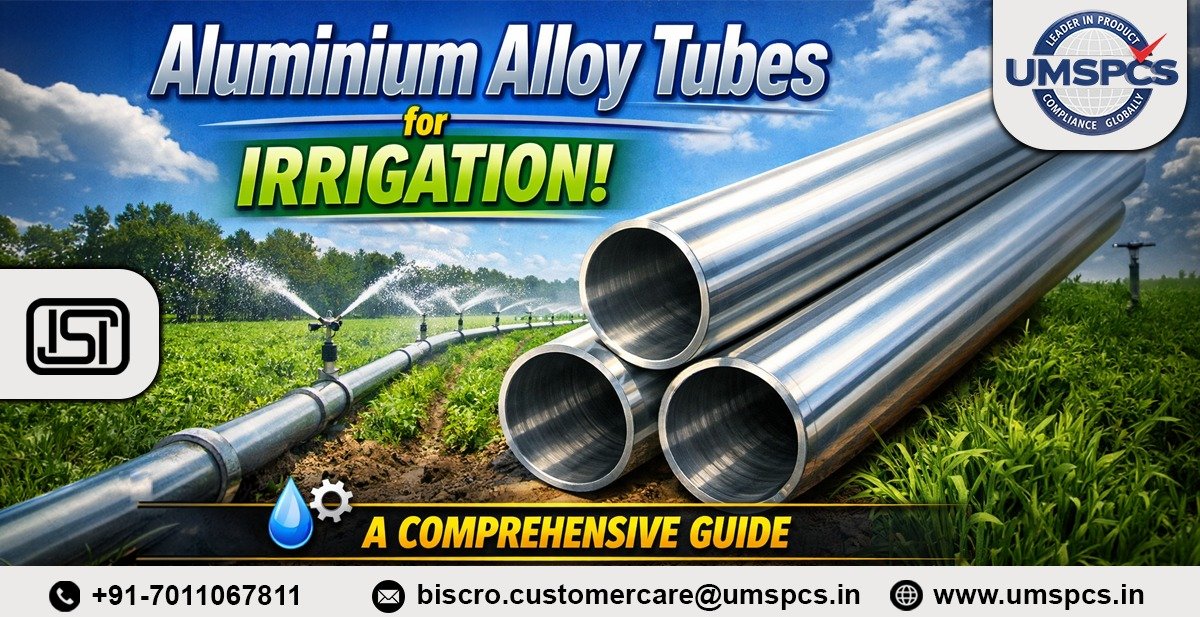
The materials implemented for transporting water throughout fields are evolving in line with agriculture and irrigation systems. One of the most dependable, compact, and resistant to corrosion possibilities for today’s irrigation systems is aluminium alloy tube material. Knowing the various types of aluminium tubes and the regulations that govern these individuals serves as essential for maintaining their durability, functionality, and conformity, regardless of your role as a manufacturer, agricultural professional, or agriculturalist.
In this blog, we look into the features of aluminium alloy tubes used in irrigation, particularly welded and extruded tubes under IS 7092 (Part 2):1987, and show how excellent goods from a reputable vendor like UMSPCS can truly make a difference.
Aluminium Alloy Tubes for Irrigation Purposes –Welded Tubes
Pipes and tubes can be easily found in irrigation systems, which are capable of controlling water supply, alteration in changes, chemical exposure by fertilisers, and environmental shifts may occur. Aluminium alloy tubes possess a variety of benefits,
Lightweight and Easy to Handle
Because aluminium is substantially less heavy compared to steel and other metals, it is more affordable to ship and put into agricultural land and irrigation systems.
Corrosion Resistance
Agricultural settings may seem challenging. Even during wet or chemically processed soil, aluminium’s natural durability against rust and corrosion promises an extended lifespan.
Strength and longevity
Usually in Irrigation systems, Aluminium alloy tubes consist of high tensile strength, which build immune to mechanical stress and pressure variation.
Recyclability
Due to the recyclability of aluminium without any modification in its material qualities, it is environmentally friendly.
Types of Aluminium Alloy Tubes for Irrigation
1. Welded Aluminium Alloy Tubes
For the purpose of generating an immovable tubular structure, aluminium strips are pressed together, and the edges are joined together. These tubes provide:
- The strength that is dependable according to the internal water pressure
- Consistent measurements to make certain correct connector installation
- Performance that is appropriate for pumped and gravity irrigation systems
IS 7092 (Part 1):1992 regulates welded aluminium irrigation tubes in India. In India, it states that the essential IS 7092 (part 1): 1992 holds the regulatory of welded aluminium irrigation tubes which are used for the distribution of water, including tensile strength, chemical composition, dimensional tolerance, testing of mechanics, and surface quality.
2. Aluminium Alloy Tubes IS 7092 (Part 2):1987
Aluminium alloy is compelled to move through a tool during the extrusion manufacturing process, resulting in tubes with uniform thickness and shape. These extruded tubes provide:
- Increased dimensional precision
- Better leak resistance with smooth structures
- Improved efficiency for applications involving the irrigation of high-pressure regions
A comprehensive technical description for formed aluminium alloy irrigation tubes can be obtained in IS 7092 (Part 2):1987. It presents requirements for mechanical characteristics, hydrostatic pressure testing, chemical composition, and tolerances for dimensions that can exceed a nominal measurement of 200 mm.
This norm indicates that extruded tubes will survive difficult field conditions and effectively nourish crops with water throughout the year. Manufacturers and suppliers have to stick to these specifications for the purpose to meeting legal requirements and winning over customers.
Understanding IS 7092 (Part 2):1987 — What It Means for You
Extruded aluminium alloy irrigation tubes are the subject of Indian Standard IS 7092 (Part 2):1987. Its application is well-defined:
Key Quality Parameters
Chemical Composition: For absolute durability and resistance to corrosion, the alloy needs to conform to rigorous chemical limits.
Mechanical Properties: In order to keep mechanical breakdowns from occurring, requirements for tension strength, extension, and flexibility need to be established.
Dimensional Accuracy: In order to make certain that irrigation fittings and pumps operate with the pipes, the diameter on the outside and the wall thickness need to be extremely accurate.
Evaluation necessities: Hydrostatic pressure tests and drift expansion tests indicate that the tube is capable of handling operational stress.
Field Performance Expectations
Tubes which meet this standard are required to:
- maintain an ongoing supply of water and have the capacity to handle internal pressure
- Don’t let chemicals in the soil and water from irrigation break down you.
- Sustain mechanical stress for long periods of time
- Stay away from leaks thanks to better manufacturing controls
Following IS 7092 (Part 2):1987 shows that manufacturers are productive, reliable, and make high-quality products. This gives farmers, irrigation planners, government competitors, and buyers of agricultural equipment confidence.
How Professional Support Simplifies Your BIS Journey
UMS Product Compliance Service (UMSPCS)– Trusted BIS Certification consultant in India. which offers complete guidance by experts from the initial stage to final approval. UMSPCS is a complete regulatory consultancy that assists manufacturers and brands to receive BIS certification as well as other required regulatory approvals by avoiding delays and stress.
What UMSPCS Offers
UMSPCS simplifies the whole ISI Certification Aluminium Alloy Tubes for Irrigation journey by providing complete guidance from product evaluation to the license permit.
UMSPCS Services Include:
- Testing of products in BIS approved labs only.
- Preparing complete paperwork
- Submission of the application online through the BIS portal
- Preparing for factory audits
- Coordinating with BIS and handling the query
- Support in the approval of the license
- Support in renewal, amendment, and monitoring
UMSPCS works with Indian manufacturers and importers.
Read more about also: BIS ISI Certification for Aluminium Alloy Welded Tubes in India
In Conclusion:
Obtaining a suitable aluminium alloy tube affects how well, how long, and how efficiently irrigation systems work. You are able to make smart choices about what to invest in and how to construct things if you know how to differentiate between welded tubes and extruded tubes while adhering to standards like IS 7092 (Part 2):1987.
You are able to get high-quality aluminium alloy tubes from reliable suppliers like UMSPCS. These tubes get aligned by strict performance standards, which helps growers and irrigation experts receive results after the season in a good way.
Frequently Asked Questions:
- What is IS 7092 (Part 1): 1992?
IS 7092 (PART-1):1992 is an Indian Standard for aluminium alloy welded tubes for using the irrigation systems.
- Who issues this standard?
It is implemented by the Bureau of Indian Standards (BIS).
- Is BIS certification mandatory?
Yes. BIS certification is in line with the ISI mark, which is compulsory for the appropriate Quality Control Order.
- What tests are required?
Usually, the required tests are: Hydrostatic, tensile, flattening, and dimensional tests.
- How can UMSPCS help?
UMSPCS supports in preparing documentation, coordinating with tests, and approving the BIS certification.
❓ Ask a Question
Have any doubts? Fill the form below and our team will respond shortly.