Imagine you have planned to ship a lot of toys, air conditioners or electrical appliances to India and then faced uncertainty due to varying compliance requirements and supply chain restrictions. In the past few years, many manufacturers/importers have been in this situation because of the expanding range of Quality Control Orders (QCOs) in India.
In response to these concerns, the Government of India has enacted the Transition Facilitation (Quality Control) Order, 2026, to ensure the quality and safety of products. The new framework seeks to offer a phased transition process for some businesses subject to specific QCOs.
UMSPCS regularly helps Indian and foreign manufacturers to comprehend the regulations of BIS and how it affects their supply chain. This guide provides an explanation of the new order, who it applies to, and how businesses can get ready to comply with the order.
What is Transition Facilitation QCO (Quality Control Order) 2026?
On 25th June 2026, the Ministry of Commerce and Industry, Government of India, issued the “Transition Facilitation QCO (Quality Control Order) 2026” by the Department for Promotion of Industry and Internal Trade (DPIIT).
The order covers certain products that are already subject to some quality control orders and includes a transition mechanism for eligible companies under certain conditions.
Significantly, the Order does not repeal the product quality requirements or BIS obligations. Products covered under the order must continue to comply with applicable Indian standards.
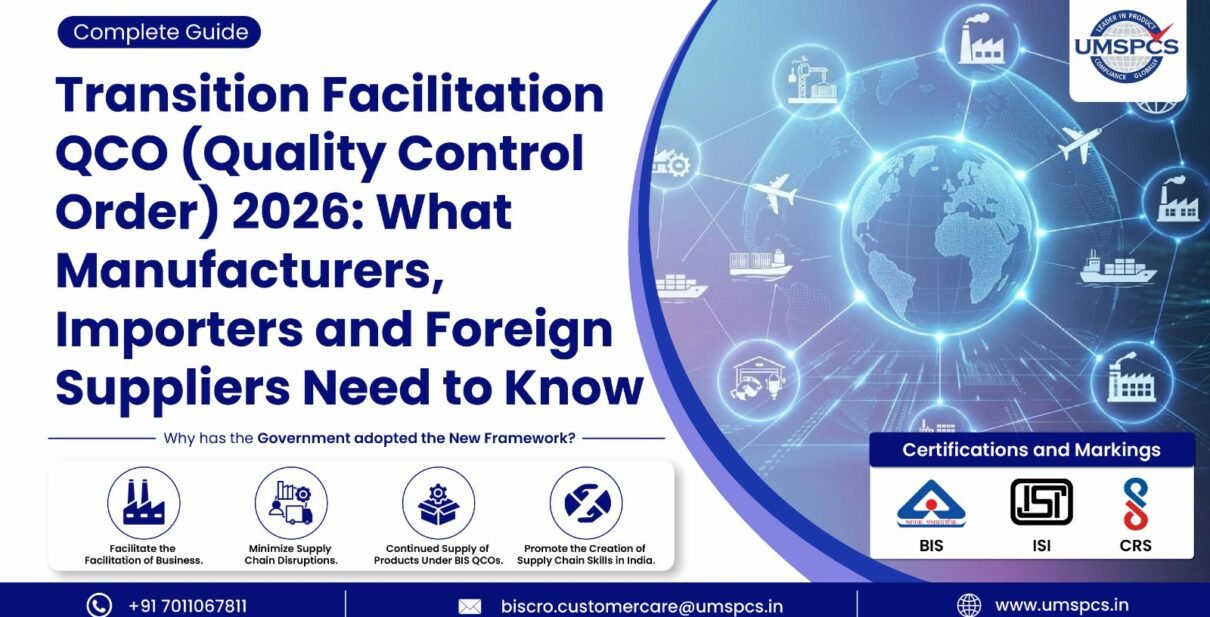
Why has the Government adopted the New Framework?
The Government made this order with the aim of:
- Facilitate the facilitation of business.
- Minimize supply chain disruptions.
- Continued supply of products under BIS QCOs.
- Promote the creation of supply chain skills in India.
- Maintain the quality of products and the safety of consumers.
It is clear from the framework that there are certain industries that will require greater flexibility to fully comply.
Which Products Are Covered Under the Transition Facilitation (Quality Control) Order, 2026?
The following quality control orders are currently under the order:
| S. No. | Quality Control Order | Date of Issue | Date of Implementation |
| 1 | Toys (Quality Control) Order, 2020 | 25.02.2020 | 01.01.2021 |
| 2 | Personal Protective Equipment – Footwear (Quality Control) Order, 2020 | 27.10.2020 | 01.01.2022 |
| 3 | Air Conditioner and Its Related Parts, Hermetic Compressor and Temperature Sensing Controls (Quality Control) Order, 2019 | 05.12.2019 | 01.10.2023 |
| 4 | Footwear made from All Rubber and All Polymeric Material and its Components (Quality Control) Order, 2024 | 27.10.2020 | 01.08.2024 |
| 5 | Footwear made from Leather and Other Materials (Quality Control) Order, 2024 | 27.10.2020 | 01.08.2024 |
| 6 | Electrical Appliance for Domestic Water Heating (Quality Control) Order, 2025 | 11.03.2024 | 01.03.2025 |
| 7 | Electrical Appliance for Domestic Clothes Washing (Quality Control) Order, 2024 | 07.03.2024 | 01.04.2025 |
| 8 | Hinges (Quality Control) Order, 2025 | 12.12.2023 | 01.07.2025 |
| 9 | Furniture (Quality Control) Order, 2025 | 14.02.2025 | 13.02.2026 |
| 10 | Safety of Household, Commercial and Similar Electrical Appliances (Quality Control) Order, 2026 | 20.09.2024 | 01.10.2026 |
Enterprises dealing in these products should be cognisant of the upcoming guidelines from DPIIT.
Does the New Order Replace BIS Certification Requirements?
No, the largest possible confusion is that the Transition Facilitation Order is exempt from BIS certification. This is incorrect.
Products subject to the Order will still:
- Meet applicable Indian standards.
- Follow the BIS standard mark under a valid licence.
- Obey the relevant quality control orders.
- Stay subject to the supervision of the BIS market.
The order is limited to a transition mechanism in certain circumstances.
Who Can Apply Under the Transition Facilitation Order?
An order may allow for permission to be granted to the following:
- This is a part of the Companies Act 2013.
- Applicants are evaluated by the Implementation Committee according to specified requirements.
The permissions that are issued will be conditional as determined by the government.
How will applications be judged?
The Implementation Committee may assess the following:
- Technical abilities and production expertise.
- Quality assurance systems.
- Compliance record and integrity.
- Focus on strengthening capacity building for the supply chain in India.
Adoption of technology and research and development efforts.
The committee is also allowed to accept declarations, certifications, undertakings, and independent assessments from the applicant.
What is an application timeline?
Applicants need to apply under the Order within 24 months from the date of the commencement of the Order.
The government has also stated that there will be specific rules for:
- Application procedures;
- Required documentation;
- Monitoring mechanisms; and
- Compliance requirements.
The order will remain in force for five years, unless extended by the central government.
How Could the Transition Facilitation Order Impact Chinese Manufacturers?
The notification does not mention China; Chinese manufacturers connected in India’s supply chains, particularly to electrical appliances, air conditioners, furniture, and consumer products, could be impacted by the order.
The framework can offer further flexibility to companies experiencing problems in their supply chains. But foreign manufacturers need to be aware of the following:
- The Order does not provide an automatic exemption.
- The requirements of complying with BIS remain in force.
- Conformity with Indian standards is still required for the products.
- Permission may be withheld or revoked if non-compliant.
Compliance planning is still vital for Chinese manufacturers who are providing goods to India, and it will continue to be so in the future. Get to know more about BIS Certification in China.
What does the new order mean for Importers and Brand Owners?
In the case of importers and Indian brand owners, the order could offer the following:
- Improved flexibility in the supply chain.
- Reduced business disruptions.
- Greater regulatory clarity.
But the companies are still held liable for the products brought into the Indian market to meet all the Indian standards and quality control orders.
How UMSPCS Can Help Companies Tackle Emerging BIS & QCO Regulations
Having 6+ years of experience in providing services related to BIS certification, we have been guiding both domestic and international companies in getting certifications for more than 600 products regulated by BIS in different sectors.
Being aware of the problems that arise when companies work with new regulations, QCOs, and compliance issues, we are ready to support them throughout the process to help them:
Get familiar with the applicability of emerging QCO notifications and BIS requirements.
- Analyse the impact on their products and supply chain.
- Plan documentation and compliance measures.
- Navigate through the entire process easily.
- Be aware of recent changes in India’s system of quality and certification.
No matter whether you are a manufacturer, importer, brand owner, or foreign supplier, UMSPCS will be glad to assist you in understanding the implications of the Transition Facilitation (Quality Control) Order, 2026.
Are you in need of professional consultation? Reach out to UMSPCS and get comprehensive support with BIS and QCO regulations.
Conclusion
The Transition Facilitation (Quality Control) Order 2026 is a significant regulation that applies to manufacturers, importers, brand owners, and foreign suppliers in India. While this regulatory structure facilitates a well-planned transition path for products listed under a specific quality control order, it does not mean that BIS certification requirements and compliance with Indian Standards are not important.
Companies working with products subject to this order must pay attention to future guidelines from DPIIT and analyse how the new regulation will affect their business operations.
UMSPCS has been providing BIS certification consultancy services for more than 6 years, helping manufacturers get certified BIS-regulated products. We know all the difficulties that companies may face when working with new legislation, which is why we can help you comprehend the significance of the Transition Facilitation (Quality Control) Order, 2026, analyse your compliance requirements, and successfully navigate India’s QCO legislation.
Latest News – DPIIT Introduces Transition Facilitation Quality Control Order 2026
FAQs
- What is the Transition Facilitation (Quality Control) Order, 2026?
This is an order developed by DPIIT to create a transition facility for products that fall under specified quality control orders.
- Does the order exempt BIS certification?
No. The products have to adhere to Indian Standards and BIS requirements.
- What kind of products have been listed in the order?
The order covers 10 categories of products including toys, footwear, air conditioners, furniture, hinges, and electrical appliances.
- Who can make applications through the Order?
The order enables any company incorporated under the Companies Act, 2013, to apply, provided it passes the Implementation Committee’s assessment.
- For how many years has the Transition Facilitation (Quality Control) Order been effective?
The transition facilitation (quality control) will be in effect for five years unless it is extended by the government.
- What is the effect of the order on Chinese manufacturers?
The Order may provide flexibility for certain supply chains but does not exempt foreign manufacturers from BIS compliance requirements.
❓ Ask a Question
Have any doubts? Fill the form below and our team will respond shortly.