Think about having spent months designing your high-quality LED modules, arranging for distributors and shipping, but finding out after all that your goods are not legal to sell since they do not have the required BIS certification.
The lighting sector in India is growing quickly, owing to various smart infrastructural developments, energy-efficient measures, and the need for sustainable lighting solutions. In order to guarantee product quality and safety, the Bureau of Indian Standards (BIS) has made it compulsory to obtain the BIS Certification for Independent LED Modules under the Compulsory Registration Scheme (CRS).
If you are either an Indian manufacturer or an international exporter interested in selling your LED products in India, then knowing about the BIS CRS Certification process will be of great importance to you.
This blog post will help you understand everything about getting the BIS CRS Certification for Independent LED Modules under IS 16103 (Part 1).
What is BIS Certification for Independent LED Modules?
Registration of BIS Certified Independent LED Modules is a compulsory registration requirement as per the Compulsory Registration Scheme (CRS) from the Bureau of Indian Standards (BIS).
The requirement entails the safety requirements for the LED modules employed in general lighting. The safety requirements seek to offer protection from any danger arising from electrical dangers, overheating, insulation problems, among others.
The manufacturer of the electronic products should be registered with BIS CRS prior to the manufacture, importation, distribution, or sale of the electronic products in India.
From the BIS CRS products list, Independent LED Modules for General Lighting are among the items that require compulsory registration.
What Are Independent LED Modules?
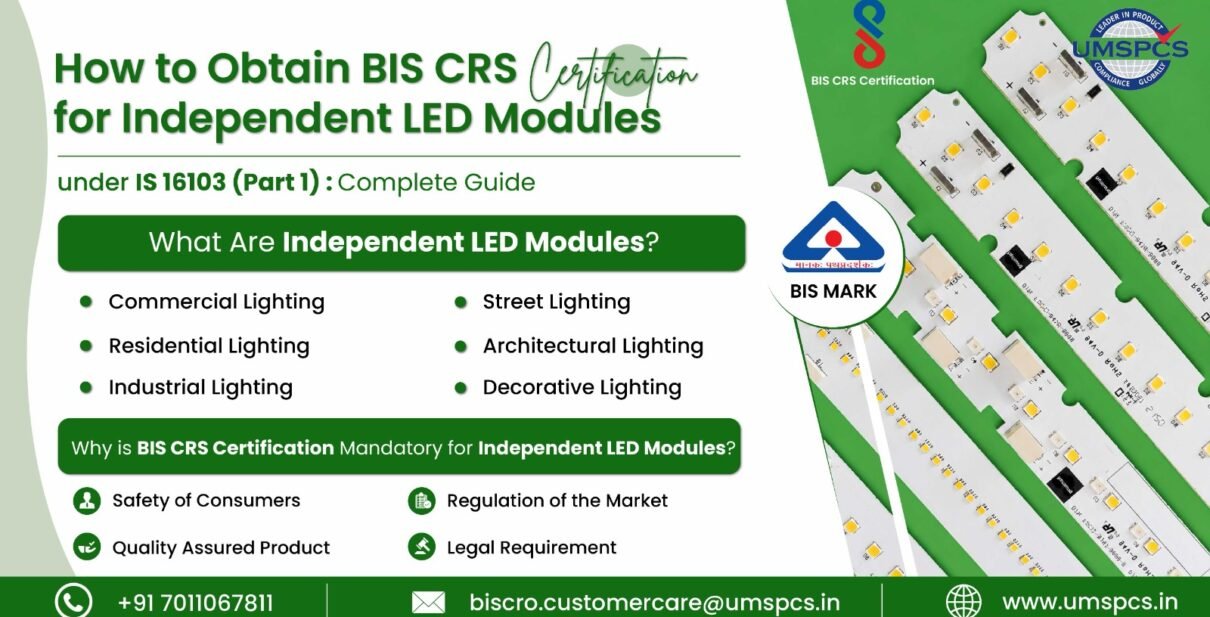
A standalone LED module is a lighting fixture that can work independently from a luminaire and has an LED light source/s along with mechanical, optical and electrical parts.
This kind of modules finds application in:
- Commercial lighting
- Residential lighting
- Industrial lighting
- Street lighting
- Architectural lighting
- Decorative lighting
- Smart lighting
IS 16103 (Part 1) divides LED modules into three classes, namely: Built-in, Standalone and Integral, while standalone modules are separately classified in IS 16103 (Part 1).
Why is BIS CRS Certification Mandatory for Independent LED Modules?
Introduction of the CRS program by the Indian Government ensures that electronic products adhere to certain safety and quality requirements before being launched into the market.
Some of the key goals are as follows:
- Safety of Consumers: It provides protection from electrical shock, fire risk, and overheating.
- Quality Assured Products: The product must comply with safety standards in India.
- Regulation of the Market: It stops inferior products from making their way into the market.
- Legal Requirement: It is mandatory for the importation and distribution in India of covered products.
- Brand Credibility: It builds customer confidence.
Key Safety Requirements Under IS 16103 (Part 1)
The specification emphasises several safety features, such as:
- Electric shock protection
- Insulation resistance
- Dielectric strength
- Thermal management
- Temperature rise restrictions
- Fire and overheating protection
- Mechanical strength
- Proper product identification
- Safe functioning during normal and abnormal operation conditions
These requirements must be proven by conducting tests in BIS-approved labs.
Products Covered Under This Certification
The product certifies:
- Independent LED Modules for General Lighting
- Standalone LED Modules
- LED Arrays
- PCB LED Modules
- General Lighting LED Assemblies
Products covered in the notified category should have an LED Module BIS Certification prior to market entry.
Who Can Apply for BIS Certification?
A BIS license will be issued to the manufacturer. Eligibility for a BIS license for Independent LED modules includes:
Indian Manufacturers
Indian manufacturers whose manufacturing units are situated in India can directly apply for BIS Certification for Independent LED Modules. The BIS license will be issued to the manufacturing unit once the testing and documentation are completed in the BIS CRS certification for electronic products scheme.
Foreign Manufacturers
Foreign manufacturers wishing to export their products to India. In case of BIS certification for foreign manufacturers, it is mandatory to appoint an Authorised Indian Representative (AIR).
Eligibility Requirements for BIS Certification
Before an application is made, certain criteria must be satisfied as follows:
- Manufacturing Plant: There must be a valid manufacturing plant.
- Product: The product must satisfy IS 16103 (Part 1).
- BIS Testing: Testing must be carried out at an approved BIS lab.
- Technical & Manufacturing Information: There should be complete technical & manufacturing information available.
- Authorised Indian Representative: Necessary for overseas manufacturers.
Applicable Tests for Independent LED Modules
Tests form an important step in the BIS CRS registration process. These tests usually comprise the following:
- Safety tests
- Insulation resistance tests
- Dielectric strength tests
- Temperature rise test
- Strength test
- Endurance tests
- Marking checks
- Protection from electric shock
- Thermal safety tests
- Abnormal operation tests
The test report forms the main basis for CRS registration approval by BIS.
Documents Required for BIS Certification
Manufacturers require:
- Business Registration Certificate – Showing proof of business registration
- Technical Details and Specifications – Showing complete information about the product
- Testing Reports – Test reports issued by laboratories recognised by BIS indicating the compliance
- Trademark Certificate – Showing proof of trademark, if any
- Authorisation Letter – Authorising signatory or authorised representative
- AIR Documents – Required if the manufacturer is foreign to authorise an Authorised Indian Representative.
Accurate documentation significantly reduces approval delays.
Step-by-Step BIS CRS Registration Process for Independent LED Modules
Getting BIS Certification for independent LED modules requires technical evaluation, testing, documentation, and other regulatory activities. UMSPCS offers complete assistance to make your BIS certification process hassle-free.
1. Product Profiling & IS Standards Selection
The first task is to analyse the technical specifications of your product and then identify the right Indian Standard for your product.
We help you in the assessment of your product to find out the appropriate standard and requirements for certification.
The proper selection of the standard helps avoid:
- Improper classification of the product
- Delays in the test phase
- Inadequate compliance with the requirements
- Application refusal by BIS
2. Test Process & Laboratory Assistance
Tests are mandatory for BIS CRS registration. UMSPCS helps you coordinate the product tests in BIS-approved laboratories.
The services include:
- Test planning
- Sample submission
- Lab correspondence
- Compliance checking
- Test report management
Thus, we ensure that the product complies with the safety requirements of IS 16103 (Part 1).
3. Documentation & Application Preparation
BIS registration involves comprehensive technical and legal documentation as part of the process. Our team ensures all the required documentation is created and reviewed for full compliance.
Documentation preparation service includes:
- Technical specifications
- Product photographs
- Circuit diagrams
- User manuals
- Manufacturing and Quality Control Documents
- Declarations and Affidavits
- AIR Documentation for foreign Manufacturers
All documentation is prepared according to the guidelines of BIS CRS to reduce the possibility of any objection or delays.
4. Submission of Application and BIS Coordinating Process
After completion of testing and documentation, the application is filed using the BIS CRS portal.
UMSPCS handles:
- Online application filing
- Filing regulatory submission
- Coordinating with BIS authorities
- Query handling and response to queries
Our proactive efforts ensure the timely resolution of the observations that might come from the reviewing authority.
5. Awarding of BIS Registration and R-Number
On successful evaluation and approval, BIS issues the registration certificate and R number to the product.
Following the approval, the manufacturer receives:
- BIS CRS Registration Certificate
- BIS R Number
- Right to use the BIS Standard Mark
Registration is usually valid for two years and enables the product to be manufactured, imported, marketed and sold legally in India.
6. Marking & Labelling Compliance Support
Product marking is an essential requirement in the BIS CRS scheme.
UMSPCS facilitates manufacturers with:
- Appropriate use of the BIS Standard Mark
- R-number marking requirements
- Labelling requirements of products
- Marking of packaging & cartons
This will ensure compliance with market inspections and regulations.
7. Renewal, Model Additions and Continuous Compliance Assistance
Our service does not stop there; UMSPCS offers continuous compliance assistance to ensure that you continue your BIS registration.
Our after certification services include:
- Support for renewal of BIS CRS
- Adding new models
- Support for updates in the regulation
- BIS Surveillance
- Management of compliance with revised standards
This will allow companies to remain compliant without having to divert their attention from their core activities.
Cost of BIS Certification for Independent LED Modules
Final cost of certification will depend upon the following factors:
- Number of models
- Complexity of the product
- Test requirements
- Location of manufacturer
- Readiness of documents
| Category | Total Cost (Excluding GST) |
| Indian Manufacturer | ₹55,000 + GST |
| Overseas Client | ₹90,000 + GST |
The certification period mainly depends on the testing and documentation period. Periods may differ depending upon product complexity and regulatory questions. It is normally 20-30 working days.
Common Challenges Faced by Manufacturers
Most candidates face delays because of:
- Incorrect Product Classification
- Insufficient Documentation
- Testing Failure
- Technical Non-Compliance
- BIS Queries Delay
- Delay in AIR Appointments
- Inaccurate Model Grouping
And without professional guidance, these can considerably prolong the approval process. Also can get more information about BIS Certification Consultant in Gujarat.
Why Choose UMSPCS for BIS Certification?
UMSPCS has over 6 years of experience as compliance consultants, along with 600+ certified projects, making us a reliable choice for BIS certification in India. Our consultants have the expertise to offer complete assistance in the BIS certification for independent LED modules.
Our Areas of Expertise Include:
- Complete assistance in BIS CRS registration
- Documentation and preparation of necessary documents
- Coordination with BIS-recognised laboratories
- Compliance queries resolution
- AIR assistance for foreign manufacturers
- Certification maintenance and other regulatory services
- Assistance for both domestic and international manufacturers
As experienced consultants in product compliance and certifications, we help our clients get approval fast and avoid regulatory issues.
Conclusion
Opportunities in the Indian Lighting Market abound, but compliance is the starting point to enter this market successfully.
BIS Certification for Independent LED Modules to IS 16103 (Part 1) is a mandatory requirement for all those who wish to manufacture, import or sell such products in India. From testing and documentation to obtaining approval for registration, the procedure involves both technical knowledge and compliance requirements.
UMSPCS makes it easy by providing you with professional help in every aspect of the certification process.
Looking for BIS Certification of Independent LED Modules?
Connect with UMSPCS today for professional help with BIS CRS certification of electronic products, BIS certification of foreign companies and all other aspects of BIS certification in India.
Connect with us today and get your product into the Indian market.
Read more about Galvanised Steel Barbed Wire BIS Certification under IS 278
FAQs
- Does BIS Certification for Independent LED Modules have to be Mandatory in India?
Yes, the Independent LED Modules for General Lighting come under the BIS Compulsory Registration Scheme and need mandatory certification prior to marketing or importation in India.
- What standard do independent LED Modules follow?
The applicable standard for this product type is IS 16103 (Part 1), which specifies the safety requirements of LED Modules used in general lighting applications.
- Can foreign manufacturers apply for BIS Certification?
Yes, the foreign manufacturers can apply via an Authorised Indian Representative (AIR).
- How much time will it take to register under BIS CRS?
In general, it takes about 20 – 30 working days to complete the whole procedure.
- What will happen if independent LED modules are marketed without BIS Certification?
Penalties and regulatory actions can be expected from the government authorities.
- What documents will you need for BIS Certification?
Documents like the company registration certificates, product specifications, testing reports, factory details and AIR documents (if applicable) will be needed.
- How much will it cost me for BIS Certification for LED modules?
The price will depend on the number of product models, testing required and government fees, among others.
❓ Ask a Question
Have any doubts? Fill the form below and our team will respond shortly.