
Best bis consultants in delhi

DPIIT Introduces Transition Facilitation (Quality Control Order), 2026: A Major Compliance Relief for Selected Industries

DPIIT Introduces Transition Facilitation 2026

DPIIT Introduces Transition Facilitation (Quality Control Order), 2026: A Major Compliance Relief for Selected Industries

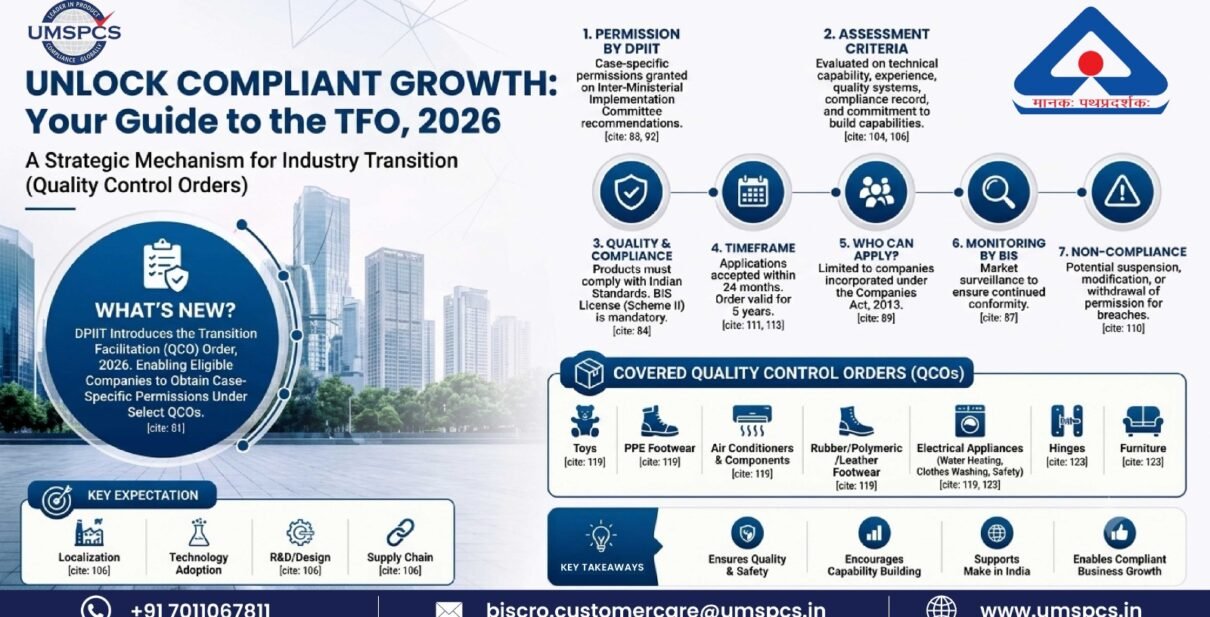
It is hereby noted that the Government of India made the Transition Facilitation (Quality Control) Order, 2026 by the Department for Promotion of Industry and Internal Trade (DPIIT), Ministry of Commerce and Industry, in the Official Gazette dated 25th June, 2026.

The above development in the regulatory framework is in the background of the BIS Act, 2016, and the underlying principle thereof is to support the transition of the industry and ensure quality control.

By implementing a streamlined procedure through which selected enterprises can obtain relevant approvals issued by DPIIT to be able to continue manufacturing certain products covered under specific Quality Control Orders, provided the products meet Indian Standards and undergo risk assessment and regulatory control.

Background: Strengthening Quality Standards While Facilitating Compliance

These have contributed to better quality control and better protection for consumers, but the industries have been experiencing problems with:

  • Issues related to the supply chain.
  • Timelines of product certification
  • Vendor qualifying criteria
  • Manufacturing adjustment period
  • The adaptation and localisation of technology.
  • The products in the scope of application are subject to BIS licensing.

Considering these practical challenges, the DPIIT has issued the Transition Facilitation (Quality Control) Order 2026 to create an enabling and controlled environment to facilitate compliance transition.

Key Objective of the Order

The main objective of the order is to provide a smooth transition for companies processing goods under certain Quality Control Orders (QCO) to ensure that there is:

Why This Notification Matters for Chinese Manufacturers

India continues to be one of the leading growing import markets for Chinese exporters within many product categories.However, the list of mandatory BIS certification and QCO has grown considerably in recent years with respect to the number of products. Those products that used to be allowed into the Indian market without BIS certification are now falling within the scope of Indian Standards requirements.
The Government Order is the regulatory instrument that is designed to help the transition take place without compromising the quality and safety standards. The Order makes three important points:

Not Relenting on BIS Requirements

The notification does not exempt from or reduce the obligation for BIS certification. All those products covered under relevant QCOs have to meet Indian Standards. It does not imply that manufacturers can look at the Order as an indication that they are not to comply with the BIS requirements.

Increased Accountability in the Supply Chain

The Government has made it clear that:
  • Traceability in the supply chain is required
  • Traceability of products
  • Quality control mechanisms
  • Manufacturing controls
  • Compliance with the regulations
  • It means that Chinese manufacturers providing goods to Indian importers will need to be more compliant and provide documentation

    Greater Regulatory Scrutiny

    This notification empowers the concerned BIS and Government agencies for continued compliance with the Indian Standards and for market surveillance. This implies that all manufacturers will have to brace for increased post-market surveillance requirements for goods shipped to India.

    Key Provisions of the Transition Facilitation (Quality Control) Order, 2026

    The Transition Facilitation (Quality Control) Order, 2026 provides for a system that would assist businesses to transition into compliance with the increasing Quality Control Orders (QCO) of India without compromising on product quality and regulatory control.

    Short Title and Commencement

    The Government has promulgated the Transition Facilitation (Quality Control) Order, 2026, and it entered into force with effect from the date of its publication in the Official Gazette. This Order is a transitional regulatory framework that is being introduced to help companies transition into the growing Quality Compliance Order (QCO) regime in India while ensuring quality compliance.

    Application

    This Order shall apply to such product(s) as are specified in the Quality Control Orders appended to the said notification. It is important for business enterprises involved in dealing with these specified products to determine if they fall within the scope of these QCOs first.

    Compulsory Use of Standard Mark

    The Order does not compromise on the existing quality standards. The products falling within the purview of the applicable QCOs need to continue complying with the respective Indian Standards and also carry a valid BIS Standard Mark under Scheme-II of the BIS (Conformity Assessment) Regulations, 2018. BIS would continue to perform market surveillance for the purpose of checking compliance and quality of the product.

    Granting of Permission

    The permissions could be granted by the DPIIT to such eligible companies incorporated under the Companies Act, 2013, based on a risk assessment carried out by an Implementation Committee consisting of representatives of DPIIT, BIS, DGFT, Department of Consumer Affairs and Department of Commerce. The Committee would assess the applicants on the basis of their technical competence, industry experience, quality assurance system, compliance record, supply chain controls and their commitment towards the development of manufacturing, technology, research and localisation activities in India.

    Application and Other Modalities

    Applications may be made up to 24 months from the date of the commencement of the Order. The Department will come out with guidelines in detail with regard to the procedure for applications, documentation, compliance, monitoring, and other operational aspects.

    Duration and Saving

    This Order shall remain in force for five years from the date of its commencement except as otherwise provided by the Central Government. Permits issued under this Order shall continue to be in force for the duration thereof even after the cancellation of this Order, unless revoked or amended.

    Interpretation

    Any doubt as to the meaning or application of the provisions of the Transition Facilitation (Quality Control) Order, 2026 shall be settled by the DPIIT. This clause takes care of the interpretation of the provisions and also helps businesses to get a clear view regarding the authority for settling regulatory doubts.

    Schedule of Quality Control Orders Covered Under the Transition Facilitation (Quality Control) Order, 2026

    S. No.Quality Control OrderDate of IssueDate of Implementation
    1Toys (Quality Control) Order, 202025.02.202001.01.2021
    2Personal Protective Equipment – Footwear (Quality Control) Order, 202027.10.202001.01.2022
    3Air Conditioner and Its Related Parts, Hermetic Compressor and Temperature Sensing Controls (Quality Control) Order, 201905.12.201901.10.2023
    4Footwear made from All Rubber and All Polymeric Material and its Components (Quality Control) Order, 202427.10.202001.08.2024
    5Footwear made from Leather and Other Materials (Quality Control) Order, 202427.10.202001.08.2024
    6Electrical Appliance for Domestic Water Heating (Quality Control) Order, 202511.03.202401.03.2025
    7Electrical Appliance for Domestic Clothes Washing (Quality Control) Order, 202407.03.202401.04.2025
    8Hinges (Quality Control) Order, 202512.12.202301.07.2025
    9Furniture (Quality Control) Order, 202514.02.202513.02.2026
    10Safety of Household, Commercial and Similar Electrical Appliances (Quality Control) Order, 202620.09.202401.10.2026

    Impact Analysis for Chinese Exporters

    The Transition Facilitation (Quality Control) Order, 2026 provides for a system that would assist businesses to transition into compliance with the increasing Quality Control Orders (QCO) of India without compromising on product quality and regulatory control.

    Toys Manufacturers

    China is still among the biggest manufacturing centres for toys in the world and supplies many toys to India.
    It should be ensured by the manufacturers exporting toys that:
  • BIS compliance is followed
  • Product testing is carried out in accordance with Indian standards
  • Factory compliance criteria are met
  • Technical documentation is maintained With the introduction of the new Order, India has reiterated its emphasis on product safety and quality assessment
  • Footwear Manufacturers

    Chinese footwear manufacturers who export:
  • Safety footwear
  • Industrial footwear
  • Rubber footwear
  • Polymeric footwear
  • Leather footwear
  • should strictly adhere to the BIS compliance criteria.

    Air Conditioner & Component Manufacturers

    The air conditioning industry is now one of the most highly regulated sectors within the Indian QCO regime.
    Chinese manufacturers making:
  • Air conditioners
  • Compressors
  • Temperature sensing controllers
  • HVAC components
  • must remain vigilant regarding issues related to certifications and testing.

    Furniture Manufacturers

    Mandatory furniture compliance based on BIS standards will come into effect in February 2026. There is great potential, in addition to a compliance challenge, for Chinese exporters in this industry sector.
    Manufacturing companies should start getting ready by:
  • Looking at relevant Indian standards
  • Determining testing requirements
  • Checking certification time frames
  • Checking for compliance gaps
  • Such readiness will avoid any risk of shipment delays or market entry problems.

    Electrical Appliance Manufacturers

    Manufacturers of:
  • Washing machines
  • Water heaters
  • Household electrical appliances
  • Commercial electrical equipment
  • are expected to have more compliance challenges within India’s QCO regime. The new Order clearly indicates the government's intentions in this regard.

    What Manufacturers Should Do Immediately

    UMSPCS suggests the following steps for manufacturers, importers, brand owners and authorised representatives:

    Conduct a Product Mapping Exercise

    Identify all products exported to India that fall within:
  • Current QCOs
  • Future QCOs
  • BIS certification requirements
  • Many manufacturers find that the products that were not covered by regulations are now covered by them.

    Assess BIS Certification status

    Check whether existing certifications are:
  • Still valid?
  • Product specific?
  • Factory specific?
  • Are they up-to-date?
  • Manufacturers must also check if any changes in the product necessitate further approvals.

    Improve technical documentation

    Keep record of:
  • Test reports
  • Product specifications
  • Manufacturing process
  • Quality manual
  • Traceability data
  • Factory audit reports
  • This documentation might play an increasing role in compliance checking and market surveillance activities.

    Improve supply chain management

    The notification explicitly mentions the need for improving supply-chain quality assurance. Improvements should be made on:
  • Raw material control
  • Supplier qualification systems
  • Production process
  • Quality inspections
  • Corrective actions
  • Prepare for market surveillance

    BIS will perform market surveillance activities to check the conformity of the products. Manufacturers must make sure that products in the Indian market match their certified specifications. Any non-conformity could result in regulatory action, product recall, cancellation of permissions or other measures.

    How UMSPCS Can Support You

    UMSPCS is committed to guiding manufacturers, importers, exporters, and brand owners through India’s regulations.

    We have 6+ years of industry experience and have over 600+ compliance projects. We offer specialised assistance in BIS Certification, QCO Compliance, testing, documentation, and market access for hassle-free compliance in India.

    The services offered by us are as follows:

    • Assistance in BIS Certification
    • Assistance in FMCS Certification
    • CRS Registration
    • QCO Compliance
    • Technical Documentation Review
    • Product Testing
    • Regulatory Gap Analysis
    • Development of Compliance Strategy
    • Import Compliance Guidance
    • Market Access Guidance

    Our experts stay up-to-date with any regulatory developments and offer professional guidance towards compliance.

    Conclusion


    The Transition Facilitation (Quality Control) Order, 2026, is an essential regulatory measure that tries to achieve a balance between the need for industry transitions and India's concern with quality, safety, and standardisation.

    Organisations falling under the various BIS QCOs must be aware of the effects of the new regulation and must take measures accordingly.

    UMSPCS would like to advise all organisations to keep a watch on future DPIIT and BIS notifications and get any professional help whenever required for smooth operations and compliance.

    Help Required in QCO Compliance?

    Contact UMSPCS for a free compliance assessment today and help your organisation gain seamless access to the Indian market.

    Frequently Asked Questions (FAQs)

    A Quality Control Order is a governmental regulation requiring mandatory BIS certification for certain products prior to their production, importation, and sale in India.

    These include such products as furniture, hinges, household laundry machines, and some household and commercial electrical appliances.

    Yes, all foreign producers shall have the respective BIS certification before shipping such products to India.

    They have to fulfil all BIS certification requirements in order to prevent any shipment problems.

    There might be issues such as shipment detention, rejection of shipment, penalties, and restrictions on sales in India.

    This period of time varies depending on the product category, test procedure, and preparedness of documentation.

    As early as possible, before the enforcement of the relevant requirement.

    ❓ Ask a Question

    Have any doubts? Fill the form below and our team will respond shortly.
    Service & blog Page Form
    ISO Badge
    Contact Page Form