Picture the building of a high-rise building, bridge or industrial structure out of substandard quality reinforcement steel. The results may be devastating, ranging from structural lack of integrity, safety risks, project delays, to legal issues. This is due to the requirement of BIS certification for High Strength Deformed Steel Bars and Wires for Concrete Reinforcement, which is covered by IS1786 by the Government of India.
Achieving BIS Certification for High Strength Deformed Steel goes beyond an obligation for manufacturers; it serves as a vote of confidence regarding quality, safety and credibility in the market. Indian Manufacturers from other countries will need to adhere to IS 1786 along with its certification. BIS ISI Certification for Indian Manufacturers is a way of getting into the Indian Market, whereas BIS Certification for Foreign Manufacturers is a path to reach the Indian Market.
This comprehensive guide explains all aspects of BIS ISI Registration in India for High Strength Deformed Steel bars and Wires, such as applicability of Standards, Testing requirements, Documentation, Time limit and process of BIS ISI Registration made easy by UMSPCS.
Is BIS Certification Mandatory for High Strength Deformed Steel?
Wires and high-strength deformed steel bars, which fall under the IS 1786 mandatory BIS-certified steel framework, come under BIS mandatory certification framework. Indian manufacturers have to get a BIS licence for these Items of Scheme-I before they can sell such Products in India, and must have the ISI Mark.
If not, procedures are used:
- As per the law, products can’t be sold legally in India
- There is a risk of manufacturers being regulated
- Gov projects/public refining agencies may refuse goods
- Cases of being held up for importation
Why BIS Certification for High Strength Deformed Steel is Important
- Regulatory Compliance: Certification helps to make sure that the product is compliant with quality and safety standards in India.
- Market Access: Manufacturers can legally distribute and market products all throughout India once their product is BIS-approved.
- Quality Assurance: This is to ensure that the item meets certain physical, mechanical and chemical requirements as stipulated.
- Customer Confidence: ISI mark builds the confidence of the customers, builders, contractors and infrastructure companies.
- Public works projects: There are many projects in the public sector (infrastructure), and they require BIS-certified reinforcement steel products.
- Competitive advantage: The manufacturer who is certified instils credibility with the non-certified manufacturer.
Products Covered Under IS 1786:2008
The standard covers:
- High-strength Deformed steel bars
- These are also known as Thermos Mechanically Treated (TMT) Bars
- Reinforcement Steel Wires
- Steel bars that can be welded together
- All of the reinforcement steel will be delivered in straight lengths
- Reinforcement Steel – Coiled
These products are extensively used in:
- Residential buildings
- Commercial complexes
- Bridges
- Metro projects
- Flyovers
- Industrial facilities
- Dams
- Infrastructure projects
IS 1786 Standards guarantee that reinforcing steel has the necessary tensile strength, ductility, weldability, and bond strength with concrete.
Testing Requirements Under IS 1786
Product testing and quality control are important aspects of BIS’s attention.
Typical tests include:
- The mechanical tests include Tensile Strength Test, Yield/Proof Stress Test and Percentage Elongation Test.
- For the physical tests, the following are all nominal checks: Nominal Size Verification, Effective Cross-sectional area and Mass Verification.
- Re-bend Test: Use a Bend Test to conduct bend tests.
- Metal Tests: Carbon content, Sulphur content, Phosphorus content, Carbon Equivalent.
- Surface and Rib Characteristics: These methods are used to evaluate the patterning of the surface and rib, and to carry out a surface defect inspection.
- The bond strength between the coating and the base metal was measured using the pull-out test.
These tests are conducted to build up to adherence with the performance and safety criteria laid down in IS 1786. Also get more information about BIS Certification Services for Foreign Manufacturers.
Documents Required for BIS ISI Registration in India
Typically, the documents needed will consist of:
- Information about the manufacturing unit and the product segment (baseline information)
- Document to prove the manufacturing unit is occupied, for example, ownership/lease deed of the manufacturing unit, utility bill, etc
- Trademark Registration Certificate (annexed in case of using the brand name and registered trademark)
- Manufacturing licence / statutory approvals (where relevant – such as pollution)
- About approvals, control and industry-specific (see text)
- Product drawings/design schematics
- Installed manufacturing capacity
- Provide a list of materials used and their specification
- Details of the class on manufacturing machinery and equipment will be provided during the Fall semester
- Production/Testing plan, the layout of the factory, Storage areas, etc., are provided in the layout plan of the factory
- A detailed process flow of manufacturing is given
- Filled with the in-house test equipment and calibration information
- Describe the information on the quality control staff
- Factory organisational chart
The importance of this point of documentation accuracy cannot be emphasised enough as the tilling of documents is often incomplete, resulting in delays and enquiries to BIS.
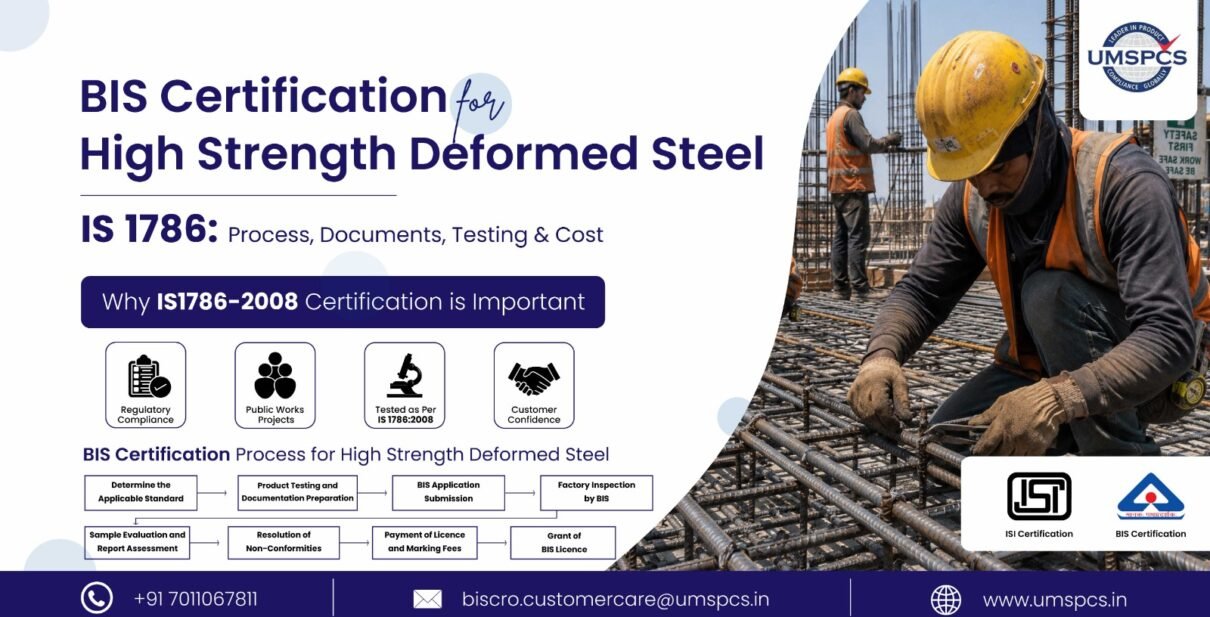
BIS Certification Process for High Strength Deformed Steel
Step 1: Determine the Applicable Standard
To begin with, it needs to be determined which Indian standard corresponds to the product. In the case of High Strength Deformed Steel Bars and Wires for Concrete Reinforcement, the manufacturers have to fulfil the requirements set out by IS 1786.
For this stage of their manufacturing process, manufacturers should:
- Check the relevant requirements of BIS.
- Make sure the products’ specifications are compatible with those specified in IS-1786.
- Evaluate manufacturing capacity, and quality assurance.
- Complete any changes required to meet the requirements
Step 2: Product Testing and Documentation Preparation
The product has to be tested in a BIS-recognised laboratory and have an NABL accreditation number to ensure it complies with the requirements set out in IS 1786.
During this phase:
- Samples of the product are sent in for testing
- Technical documentation is most accurately prepared
- Information about manufacturing and quality control is gathered
- Information about applications is organised
Step 3: BIS Application Submission
After testing and documentation are completed, an application for certification is made to BIS with supporting documents.
Typically, the submission comprises:
- Test reports
- Data on the factory and manufacturing
- Technical documents
- Prescribed government fees
At this stage, the application is subject to a review by BIS.
Step 4: Factory Inspection by BIS
An inspection of the manufacturing facility is made by the officials of BIS to assess compliance of the manufacturing facility with the requirements for their certificate.
The inspection will normally include an examination of:
- Manufacturing processes
- Production infrastructure
- Quality control systems
- In-house testing facilities
Samples of the product may also be collected during the inspection to be run as independent testing.
Step 5: Sample Evaluation and Report Assessment
All the samples collected are tested according to the requirements of IS 1786. The laboratory directly takes the test results to the lab for technical evaluation and verification to BIS.
Step 6: Resolution of Non-Conformities
During the testing or factory inspection, if any discrepancies are found, BIS may ask for some actions or corrections.
Manufacturers will be required to:
- Implement corrective measures
- Submit revised documents
- Identified compliance gaps (AEPs) and addressed them
- Demonstrate compliance with the relevant Standards
Step 7: Payment of Licence and Marking Fees
Upon successful evaluation, the manufacturers have to pay the relevant BIS fees, such as:
- Licence fee
- Marking fee
- There may be other prescribed charges (if applicable)
Step 8: Grant of BIS Licence
BIS issues a certification licence on successful completion of testing/inspection and issuance of required documents (depending on the registration terms) and on the payment of the fee.
The manufacturer gets the authority to print the ISI Mark on the product, which is certified as meeting the IS 1786, BIS Quality requirement, thus asserting a level of compliance with ISI/ BIS.
BIS Certification Cost for High Strength Deformed Steel
The cost will depend on the following:
- Product variants
- Number of units in the manufacturing industry
- Testing requirements
- Factory inspection expenses
- Consultant support requirements
- Foreign manufacturer audits
| Particulars | Estimated Cost (INR) |
| Application Fees (BIS) | ₹1,000 |
| Testing Charges (Lab Fees) | ₹15000 – ₹2,50,000 |
| Factory Inspection Charges | ₹7000 |
| Annual License Fees | ₹1,000 |
| Marking Fees (ISI Mark Usage) | As per BIS norms (based on production) |
| Consultancy Charges (UMSPCS) | ₹ 50000 |
Each manufacturing process is unique, and it is typically advised to do a detailed cost assessment prior to the application.
BIS Certification Timeline
The process for certification may take longer based on the time needed to complete all tests, prepare all documents and schedule all inspections.
The average is 30-40 working days. Applicants who are foreign manufacturers may take longer, as additional time may be needed for overseas inspections.
Common Challenges Faced by Manufacturers
Here are some of the challenges applicants are facing:
- It is very common to make mistakes in a technical document, thereby causing BIS inquiries.
- Testing Failures: If there are any chemical or mechanical failures, certification may be postponed.
- Poor Factory Control: BIS needs well-established quality management and factory test practices.
- Delayed Approval: Inadequate coordination may cause delays in approval times.
- Foreign manufacturers often encounter problems with AIR appointments, factory audits and communications with the regs at FMCS.
Having professional guidance to avoid these issues and to speed up their approvals.
Why Choose UMSPCS for BIS Certification for High Strength Deformed Steel?
UMSPCS is a reputed regulatory compliance consultant with regard to the manufacturers located in India and around the globe. We have successfully been able to support hundreds of bis certification projects in various industries with our team, which has experienced 600+ Successful Compliance Projects.
- Complete Documentation Support
- Testing Coordination
- Factory Audit Assistance
- No distinction is made between Indian & Foreign Manufacturers
- Faster Approvals
Conclusion
The need for Quality certified construction material is gradually increasing in the infrastructure and Real Estate sectors in India. Getting BIS Certification for High Strength Deformed Steel plate IS 1786 is of paramount importance to ensure regulatory compliance, market acceptance and customers’ confidence.
Regardless of whether you are looking to register your products as BIS ISI certified in India, expand your product range and introduce new products to existing markets, or as a manufacturer from abroad, it can make a significant difference in terms of making the product registration process more manageable.
Looking for a BIS Certification Consultant?
To get BIS Certification for high strength deformed steel bars and wires in India, end-to-end assistance, contact UMSPCS today.
Read more also: BIS Certification for Viscose Staple Fibres (IS 17266:2019)
FAQs
- Is BIS Certification for High Strength Deformed Steel Mandatory in India?
Yes, BIS Certification and ISI Marking are mandatory for the marketing of High Strength Deformed Steel Bars and Wires that fall under IS 1786.
- In accordance with which Indian Standard shall the certification of high strength deformed steel be done?
In accordance with Indian Standard IS 1786: 2008 on Concrete Reinforcing Bars & Wires of High Strength Deformed Steel.
- Is there any facility for foreign producers to get their BIS Certification in India?
Yes, provision exists for foreign manufacturers to obtain approval by way of the Foreign Manufacturers Certification Scheme (FMCS).
- How long is the BIS ISI Registration Valid for products that come under IS-1786?
The course of certification usually varies between 6 and 12 weeks, depending upon the testing schedule, documentation, and inspection period.
- What tests are necessary for BIS Certification for High Strength Deformed Steel?
There are several tests including tensile strength, elongation, yield strength, bend and re-bend test, pull out test, chemical analysis and dimensioning.
❓ Ask a Question
Have any doubts? Fill the form below and our team will respond shortly.