
- July 10, 2026
- by umspcs
- Blog, Latest Notifications, News & Updates
- 425 Views
- 0 Comments
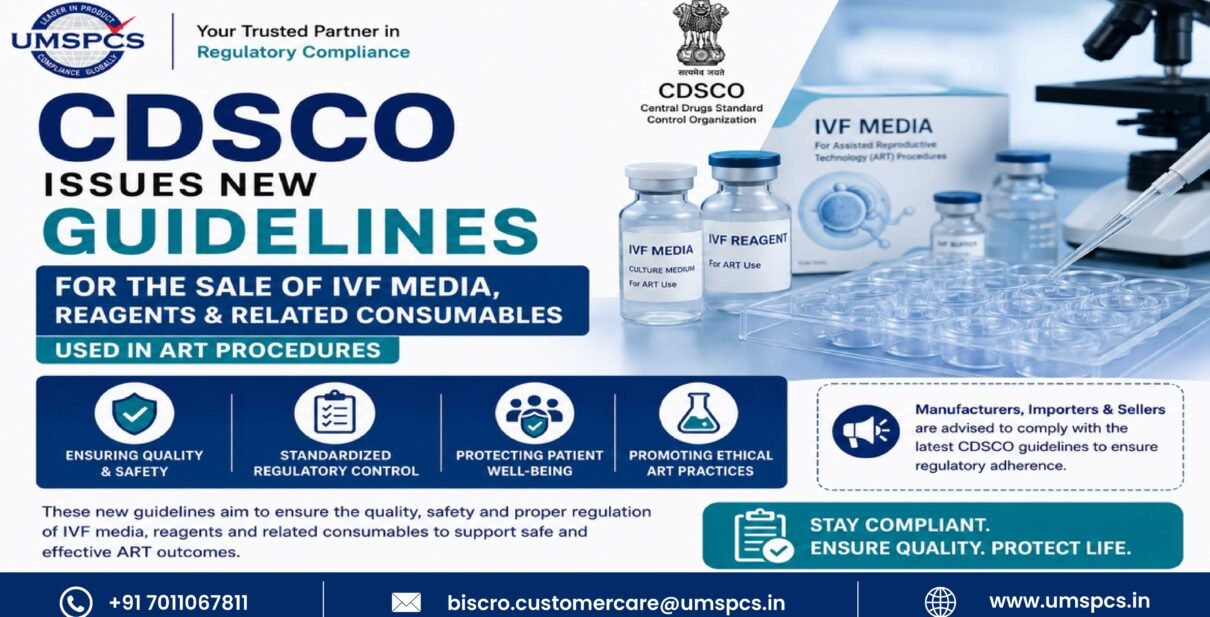
CDSCO Issues New Guidelines for the Sale of IVF Media, Reagents & Related Consumables Used in ART Procedures
Recently, the Central Drugs Standard Control Organisation (CDSCO) issued a circular bearing the number CDSCO/L&R/04/MDD/2026-27 referring to certain requirements in terms of compliance in respect of sales of in vitro fertilisation (IVF) media, reagents and other consumables used in the process of assisted reproductive technology (ART). The Medical Devices Division, Directorate General of Health Services, Ministry of Health & Family Welfare, has released the circular.
These products are governed by the Medical Devices Rules, 2017, and are governed by the relevant licence for their manufacture/import under the circular. Most importantly, CDSCO issues new guidelines and instructs all stakeholders to make sure that these products are only provided to ART clinics and ART banks registered under the Assisted Reproductive Technology (Regulation) Act, 2021, and the Surrogacy (Regulation) Act, 2021.
The IVF product manufacturers, importers, distributors, and suppliers should be aware of these new requirements to keep their business running smoothly and comply with regulatory requirements.
Why Has CDSCO Issued This Circular?
Certain IVF media and related consumables were being provided to institutes and medical centres that were not registered under the ART (Regulation) Act, 2021, posing a threat to public health and ethical use of reproduction, CDSCO noted.
To improve the regulatory control, the stakeholders are advised to sell and supply such products to ART clinics and ART banks, which are registered under the applicable regulations only.
IVF Products Covered Under the Circular
| Product Category | Regulatory Status |
|---|---|
IVF Media |
Regulated under Medical Devices Rules, 2017 |
IVF Reagents |
Regulated Medical Device |
Cryopreservation Media |
Covered under the Circular |
Embryology Media |
Applicable |
Related Consumables used in ART Procedures |
Covered under the Circular |
They are used-only products used in ART procedures and subject to the provisions of the Medical Devices Rules 2017.
Major Compliance Requirements Introduced by CDSCO
1. Supply Only to Registered ART Centres
2. Adherence to Medical Devices Rules 2017
3. Strengthened Patient Safety
4. Ethical Healthcare Practices
CDSCO Approval Process
Step 1: Product Classification –
Step 2: Application Submission –
Step 3: Documentation Review –
Step 4: Inspection (If Applicable) -
Step 5: Grant of Approval –
Documentation Required for CDSCO Approvals
- Application Form (as per CDSCO format)
- Device Master File (DMF) or Drug Master File
- Free Sale Certificate
- ISO 13485 or GMP Certificates
- Clinical evaluation or performance data
- Product labeling and IFU
- Power of Attorney (for importers)
- Manufacturing license
- Charge payment receipt for CDSCO registration
- Fees for CDSCO Registration
- CDSCO registration fees depend on:
- Product category
- Risk classification
- Domestic or imported status
Types of CDSCO License Required
- Import license (Form MD-14 / MD-15) - Needed for the delivery of medical devices.
- Manufacturing License (Form MD-5 / MD-9) – Required for manufacturers who are dealing with drugs and medical devices within India.
- Loan License- For businesses that use the facilities of another licensed manufacturer to produce in India.
- Wholesale License - Required for manufacturers who produce or sell in bulk quantities of drugs and specific medical products.
- Retail License - Needs to be implemented for the purpose of selling drugs and medical devices directly to customers.
- Registration Certificate for Cosmetics – It’s required to import cosmetics into India.
Classification of Medical Devices in India
- Class A (Low Risk): Basic tools and dressings for surgery
- Class B (Minor to Medium Risk): Suction devices and needles
- Class C (Medium to High Risk): Breathing machines and infusion devices
- Class D (High Risk): Implantable equipment and cardiac valves
Timeline of the Regulation
| Date | Regulatory Development |
|---|---|
2021 |
The Assisted Reproductive Technology (Regulation) Act, 2021, was enacted. |
2021 |
Surrogacy (Regulation) Act, 2021, was enacted |
23-Jun-26 |
CDSCO issued the circular restricting the supply of IVF media, reagents, and related consumables |
Current |
Stakeholders should ensure supply only to registered ART clinics and ART banks. |
What Manufacturers Should Avoid in Common Compliance Mistakes
- Confirm ART clinics' and ART banks' registration with customers.
- Make sure that products are made or imported under an appropriate medical device licence.
- Keep good sales and distribution records.
- Examine internal supply verification compliance.
- Update and train sales and distribution staff on the changes in CDSCO regulations.
What Will Happen If Businesses Refuse To Comply?
Non-compliance may also lead to the following:
- Supply chain disruptions.
- Regulatory investigations.
- Increased compliance obligations.
- Coping with the dangers to patient safety.
- Manufacturers and distributors' reputational damage.
Therefore, it is imperative that businesses make sure that only IVF products are supplied via authorised channels.
Common Compliance Mistakes to Avoid
- Offering products without checking ART registration.
- Poor record-keeping of customers.
- Failure to keep records of distribution.
- Failure to be aware of the latest requirements of CDSCO.
- Putting on the back burner internal compliance reviews.
How UMSPCS Can Help
UMS Product Compliance Services Pvt. Ltd. (UMSPCS) helps medical device manufacturers, importers, and medical device enterprises to understand and follow CDSCO regulations.
Our services include:
- Medical device regulatory consultation.
- Assistance with medical device licences.
- Product applicability assessment.
- Documentation preparation/review.
- Regulatory compliance support.
- Import compliance assistance.
- Advisory services by the CDSCO from end-to-end.
UMSPCS has 6+ years of experience in the regulatory field and has completed a successful portfolio of 600+ compliance projects in India to help businesses manage their changing medical device regulations with effective efficiency.
Conclusion
The manufacturers, importers, distributors and suppliers should check their supply chain and ensure 100% compliance with the Medical Devices Rules, 2017; the ART (Regulation) Act, 2021; and the latest directions of CDSCO. Businesses will be able to operate normally while the safe use of reproductive health is maintained when timely action is taken.
Looking for medical device compliance assistance with CDSCO issues new guidelines
Please reach out to UMSPCS today and help your IVF products meet the updated standards of the CDSCO and the medical device rules.
Frequently Asked Questions (FAQs)
On 23 June 2026, CDSCO issued a circular to limit the sale of IVF media, reagents, and other IVF-related consumables to ART clinics and ART banks.
Yes, IVF media, IVF reagents, IVF cryopreservation media, and IVF consumables are considered medical devices in the Medical Devices Rules, 2017.
Only ART clinics and ART banks registered under the ART (Regulation) Act, 2021, and the Surrogacy (Regulation) Act, 2021, should be supplied with these products.
Yes, it is necessary that all the manufacturers or importers hold the requisite licence under the Medical Devices Rules 2017.
This circular was issued with the motive to prevent the supply of IVF products to unregistered clinics.
Medical device licensing, documentation, regulatory compliance, and CDSCO approval assistance are offered by UMSPCS end-to-end.
❓ Ask a Question
Have any doubts? Fill the form below and our team will respond shortly.