Consider a customer using an ATM at night, wanting to withdraw cash in a fast and safe manner. In a few seconds, the machine will scan the card, validate the details, communicate with the banking server, and provide cash to the customer. However, this straightforward procedure is supported by a highly complex electronic system designed to perform in a safe and reliable way.
In order to maintain the safety and quality of the electronic products present in the Indian market, there are some standards laid down by the Bureau of Indian Standards (BIS) of India, which these products should have. One such product is the Automatic Teller Cash Dispensing Machine, for which BIS Certification for Automatic Teller Cash Dispensing Machines IS 13252 (Part 1) : 2010 is required before any sales, import, or distribution in India.
If you are an Indian Manufacturer of ATM machines, a Global ATM Manufacturer, an importer, a banking equipment supplier, or an OEM Brand Owner, learning the requirements of BIS CRS Certification for Electronic Manufacturers will definitely help you to get rid of the legal hassles while entering the market.
This complete Blog explains all about BIS Certification in India – Eligibility criteria, Applicable Standards, Testing process, Documentation, Costing, Timeline, Challenges, and Compliance Services.
Understanding BIS CRS Certification for ATM Machines
The Bureau of Indian Standards (BIS) is the National Standards Body in India that prepares standards regarding the quality and safety of products through several certification programs.
Among the major certifications for electronic products, one of the most prominent is the Compulsory Registration Scheme (CRS) that has been adopted as a result of efforts made by the Ministry of Electronics & Information Technology (MeitY).
As per CRS, manufacturers must ensure that the notified electronic and IT products meet all necessary Indian Standards before they can enter the Indian market.
The main objectives of CRS are as follows:
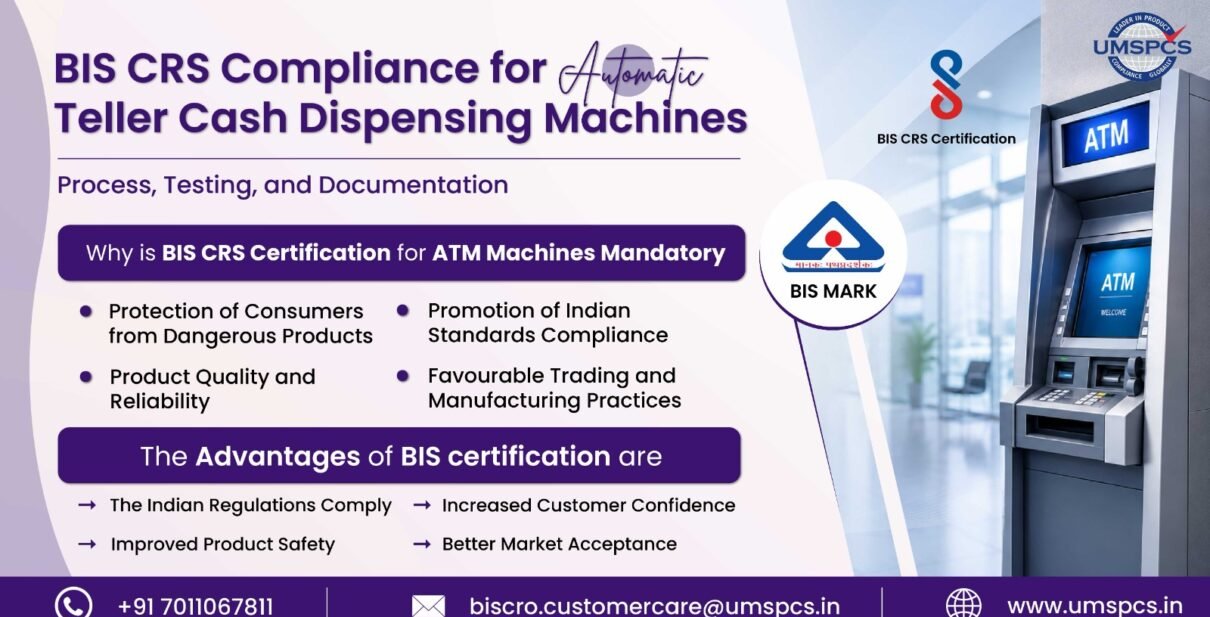
- Protection of consumers from dangerous products
- Product quality and reliability
- Prevention of the entry of sub-standard electronic products into the market
- Promotion of Indian standards compliance
- Favourable trading and manufacturing practices
In this regard, manufacturers must ensure BIS Certification for Automatic Teller Cash Dispensing Machines IS 13252 (Part 1) : 2010.
What Are Automatic Teller Cash Dispensing Machines?
Automated Teller Machines are self-help devices used for conducting banking transactions without requiring any help from bank employees.
The components found in an Automated Teller Machine include:
- Cash Dispensing Unit
- Card Reader
- PIN Entry Device
- Display Unit
- Communication System
- Power Supply System
- Security Devices
Considering the electronic composition and consumer involvement of ATM systems, it is imperative to ensure compliance with the regulations.
Why BIS Certification for Automatic Teller Cash Dispensing Machines Matters
Most companies treat certification as merely a legal requirement. On the contrary, BIS certification provides some strategic benefits to businesses.
1. Legal Entry into the Market
The goods covered under CRS can only be imported, distributed, and sold in India after being registered with BIS.
2. Higher Product Credibility
It establishes that the product complies with safety regulations in India and instils confidence in banks, financial institutions, and procuring organisations
3. Minimisation of Business Risks
It eliminates risks associated with product recalls, penalties for non-compliance, and import restrictions.
4. Competitive Edge
Certified products enjoy a competitive edge in bidding and other procurement procedures.
5. Safety Guarantee to Consumers
It assures the consumers that the products comply with safety standards set by regulatory agencies.
Products Covered Under BIS Certification
Scope typically includes:
- Automatic Teller Machines (ATMs)
- Cash Dispensing Machines (CDMs)
- Banking self-service terminals
- Electronic cash processing systems
- Financial transaction terminals
- Automated banking kiosks
- Electronics for banking applications notified under CRS
A thorough applicability evaluation is essential prior to starting the certification procedure.
Applicable Standards for ATM Machines IS 13252 (Part 1) : 2010
The relevant Indian Standard is based on the product group and CRS notification applicable at the time of certification.
ATM machines generally fall within the scope of:
- Information Technology Equipment Safety
- Electronic Equipment Safety
- Power Supply Safety Requirements
- Functional Safety Requirements
Manufacturers should ascertain the relevant standards and notifications before starting the process of compliance.
Who Needs BIS Certification?
The following organisations may be required to obtain certification:
1. Indian Manufacturer
Indian manufacturers with their manufacturing plant in India can register for BIS certification for Indian manufacturers. They can do so to ensure that their products conform to the relevant Indian standards and can be marketed in the country.
2. Foreign Manufacturer
Foreign manufacturers who intend to export their products to India need to get the relevant BIS certification for foreign manufacturers before coming into the Indian market. In this way, their imported goods can be regulated according to Indian regulations.
3. Importer & Brand Owner
Firms importing products with their brand name in India might need BIS compliance for their products being marketed in India. They usually arrange for certification processes by coordinating with the manufacturer.
4. OEM Manufacturer
Original Equipment Manufacturers (OEMs) manufacturing products for other brands can seek BIS certification for their manufacturing plant and products, allowing their clients to market their compliant products in India.
Key Compliance Requirements Before Filing
The following are the key issues that need to be addressed by manufacturers:
- Design Conformity to the Product: The design of the product must comply with the standards set in India.
- Quality Management Systems: There needs to be a system in place to make sure the manufacturing process is consistent and ensures product quality.
- Safety Considerations: There should be consideration for electrical and mechanical safety.
- Labelling and Marking of the Product: This is necessary prior to launching the product commercially.
- Technical Documentation Readiness: Accurate records should be maintained throughout the certification process.
Testing Requirements for Automatic Teller Cash Dispensing Machines
Testing forms the basis for the entire certification process. All tests have to be done in laboratories approved by BIS.
- Electrical Safety Tests
- Mechanical Safety Tests
- Temperature Rise Tests
- Power Supply Tests
- Environmental Tests
- Functional Tests
Documents Required for BIS Certification for Automatic Teller Cash Dispensing Machines
The documentation part of the procedure is one of the most time-consuming.
- Business Registration Certificate: Proof of business registration/legal incorporation of the firm
- Product Description and Specifications: Technical specifications of the product
- Test Report: Generated by laboratories accredited by BIS to check for compliance
- Trademark Registration Certificate: Proof of trademark registration (where applicable)
- Authorisation Letter: For authorised representative
- AIR Documents: Required for foreign manufacturers who appoint an AIR
Step-by-Step BIS CRS Registration Process for ATM Machines IS 13252 (Part 1) : 2010
Step 1: Product Profiling & Standard Identification
The product is evaluated to determine the relevant Indian Standard (IS code) under BIS CRS. Appropriate standard determination is essential in preventing classification mistakes, testing problems, and application rejections.
Step 2: Product Testing
Testing of the product samples is done in laboratories that have been accredited by BIS. The steps involved include testing arrangement, compliance checking, and receipt of test reports.
Step 3: Preparation of the Documents
All the documentation that is needed is prepared as per the BIS CRS requirement.
Step 4: Application Filing & BIS Processing
The application is made through the BIS CRS portal, and all BIS queries are sorted out to facilitate the approval process.
Step 5: BIS Registration Approval
Upon acceptance of the application, BIS issues the CRS Registration Certificate and the R-Number for the product.
Step 6: Marking & Labelling Compliance
The product is then marked using the BIS Standard Mark and the R-Number as per BIS labelling rules.
Step 7: Renewal & Compliance Services
Services offered include product renewal registration, new model addition, surveillance services, and BIS regulatory changes.
Cost of BIS Certification for Automatic Teller Cash Dispensing Machines
The cost of certification is dependent on many different factors.
- Testing Costs
- Government Cost
- Documentation Cost
- Consultant Cost
- AIR Cost
| Category | Total Cost (Excluding GST) |
| Indian Manufacturer | ₹55,000 + GST |
| Overseas Client | ₹90,000 + GST |
The total certification cost will vary depending on product complexity and project needs. This whole procedure will take about 20 – 30 working days.
Common Challenges Faced by Manufacturers
Many of the delays in certification are due to preventable errors.
- Error in Classification of the Product
- Inadequate Documentation
- Invalid Test Report
- BIS Technical Questions
- Coordinating with Foreign Manufacturers
- Changes in the Design of the Product
Why Choose UMSPCS for BIS CRS Certification?
At UMSPCS, we offer full compliance management all in one place, assisting manufacturers in dealing with complicated regulatory requirements in a hassle-free manner. We have over 600+ product compliance experiences behind us.
We offer full assistance in the bis certification process, starting from product applicability determination, documentation preparation, testing arrangement, application filing, and even issuing certificates.
- Documentation Assistance
- Testing Arrangement
- Queries Resolution
- Assistance to Foreign Manufacturers
- Multi-Certification Assistance
How UMSPCS Helps Manufacturers Achieve Faster Approvals
The following process is involved:
- Applicability study
- Standardization
- Documentation
- Coordination with the laboratory
- Application
- BIS query management
- Monitoring of compliance
- Support after certification
This greatly minimises the risks of certification and approval.
Conclusion
As the banking systems of India continue to progress, the compliance regulations for the use of electronic banking equipment become more stringent by the day. Securing BIS Certification for Automatic Teller Cash Dispensing Machine IS 13252 (Part 1) is not just another paperwork but a business requirement now.
No matter whether you manufacture in India or want BIS CRS certification for electronics manufacturers outside India, advance preparation will save you a lot of effort, cost, and problems.
Get Professional BIS CRS Compliance Consultancy from UMSPCS
UMSPCS can be contacted today for a no-obligation consultation for BIS CRS compliance. We can fast-track your path to BIS certification with our expertise in handling over 600+ product compliance projects.
Read more about BIS Certification for Carbon Steel Cast Billet Ingots under IS 2831
FAQs
- Should ATMs with cash dispensers be required to be BIS-certified in India?
Yes, there is a need to secure BIS registration of the products covered under the CRS notifications prior to sale, import or distribution of the products in India.
- Are foreign ATM manufacturers eligible to get BIS certification?
Yes, foreign manufacturers can get BIS registration with the help of an Authorised Indian Representative (AIR).
- What is the time required to obtain BIS CRS certification?
This process typically takes 20 – 30 working days, depending on the readiness of the testing and documentation.
- In which lab can BIS testing be performed?
Testing should be undertaken in BIS-recognised laboratories, where appropriate, approved for the respective product category.
- What happens if the ATM machines are imported without BIS certification?
Restrictions can be imposed on the products through customs seizure, fines, or regulations.
- Can there be more than one model of an ATM machine in one certificate?
This will depend on the nature of the similarity of the products.
- What are the advantages of BIS certification?
The cost will be dependent on the complexity of the product and its testing requirements.
❓ Ask a Question
Have any doubts? Fill the form below and our team will respond shortly.