- June 13, 2026
- by umspcs
- Blog, News & Updates
- 420 Views
- 0 Comments
With changing times, it becomes imperative to be aware of the notifications that keep coming out now and then from the Government. One such amendment in any notification could have major repercussions on imports, compliance issues, and so forth.
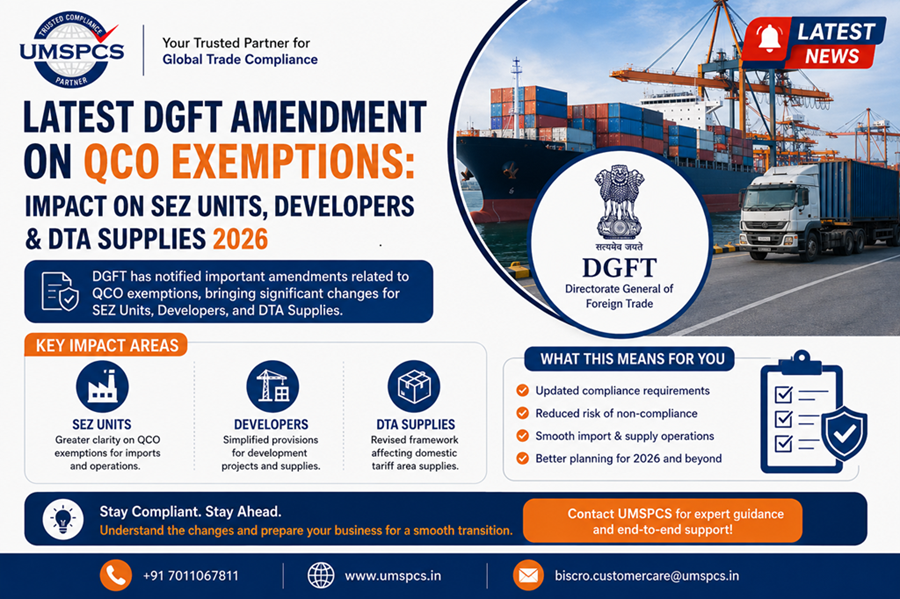
To clarify the issue pertaining to QCOs and/or BIS certificates for SEZs, Notification No. 20/2026-27 dated 2 June 2026 came into effect.
According to the notification, Para 2.03(A)(iii) of Foreign Trade Policy (FTP) 2023 was amended, and QCO exemptions were brought in line with provisions of SEZ Act, 2005 and SEZ Rules, 2006. While the new notification provides a greater scope of operation to SEZ units and developers, there is also a certain compliance requirement that needs to be fulfilled for goods to enter the DTA.
This blog will provide details about the changes, their importance, and the actions required to be taken by the businesses.
Understanding DGFT and Its Regulatory Role
What Are BIS Quality Control Orders (QCOs)?
BIS Quality Control Order (QCO) are the mandatory rules made by different ministries as per the provisions of the BIS Act, 2016. These are aimed at ensuring that all the products marketed, imported, manufactured, or circulated in India conform to the relevant quality and safety standards.
In order to be eligible for marketing in India, a product needs to meet the relevant IS standard and receive the requisite BIS Certification.
The basic objectives of QCOs include:
- Consumer safety and protection
- Preventing inferior-quality imports
- Product quality assurance
- Product standardization
- Improving the quality ecosystem of India
What is an SEZ and its Benefits?
Special Economic Zone means any economic zone formed for the purpose of promoting exports, industries, foreign investments, and a good business environment.
There are various benefits provided to the units/developers of SEZs, which include:
- Free imports
- Simpler customs procedures
- Lesser regulatory compliance
- Incentives for exports
- Flexibility in operations
What Was the Earlier Position?
The exemption was normally only applicable for inputs needed for export purposes, thus leading to uncertainties about:
- Imports of capital goods
- Import of machinery
- Import of spare parts
- Import of consumables
- Import of goods for infrastructure development
- Imports made by SEZ developers
DGFT Notification No. 20/2026-27: What Has Changed?
- Raw materials
- Components
- Consumables
- Capital goods
- Equipment
- Permissible other goods needed for authorised operations
- Spares
A Critical Condition Businesses Must Not Ignore
- Quality Control Order Applicability Criteria (QCO)
- Compulsory BIS Certification Requirements
- Product-wise Approval Criteria
- Any other laws/regulations that may be applicable
The Core Principle Behind the Amendment
Goods used within the Special Economic Zone (SEZ)
Goods entering the Domestic Tariff Area (DTA)
Impact on the SEZ Units
Streamlined Importing Procedures
Lowered Complying Pressure
Better Production Planning
Regulatory Clarification
Impact on SEZ Developers
- Development of infrastructure
- Development of industrial parks
- Development of utility projects
- Construction work
- Upgradation of facilities
Impact on DTA Supplies
- Assess the QCO applicability beforehand
- Determine the necessity of BIS certification early on
- Consider product standards prior to market entry
- Plan the certification timeline ahead of time
- Shipping problems
- Customs complications
- Compliance expenses
- Access problems
Industries Most Likely to Be Affected
- Electronic Products Manufacturing
- Steel and Metal Product Manufacturing
- Chemical and Petrochemical Industries
- Equipment for Renewable Energy Generation
- Engineering Products
- Industrial Machinery
- Automotive Parts Manufacturing
- Medical Devices
- Building Materials Manufacturing
- Consumer Goods
Compliance Challenges Businesses May Still Face
However, the clarification has not made things easier for companies that still face the following issues related to their compliance:
- Identification of Relevant QCOs: Several items fall under certain Quality Control Orders issued by various ministries.
- Evaluation of BIS Certification Criteria: Companies need to determine whether the goods require BIS certification or not.
- Future Movement of DTAs: Items brought into the country through an exemption clause might find themselves sold on the Indian market in the future.
- Documentation of Operations: Proper documentation is essential to show that the company conducts its activities through an approved SEZ.
- Increasing Scope of QCOs: QCOs now cover more and more fields.
How UMSPCS Helps Businesses Navigate BIS and QCO Compliance
- Assessment of QCO Applicability
- BIS Certification Consultancy
- Identification of IS Standards
- Evaluation of Product Compliance
- Preparation of Documentation
- Filing of BIS Applications
- Answering Regulatory Queries
- Compliance Assistance for SEZs
- DTA Clearance Advisory
Conclusion
Frequently Asked Questions (FAQs)
Not necessarily, this exemption would apply only when such goods are used for authorised activities within the SEZ. The BIS certification might still become necessary when the goods are allowed to clear in the Domestic Tariff Area.
The following categories of goods are subject to this amendment: raw materials, consumables, spare parts, equipment, capital goods, and other permissible goods which may be used for authorised activities in SEZ.
As soon as goods are released into the Domestic Tariff Area, all relevant QCO and BIS certification requirements should be met by the importer.
Yes, the provision includes SEZ developers, apart from SEZ units.
UMSPCS offers end-to-end solutions including product evaluation, QCO applicability assessment, BIS Certification, documentation, filing and compliance strategy.
❓ Ask a Question
Have any doubts? Fill the form below and our team will respond shortly.