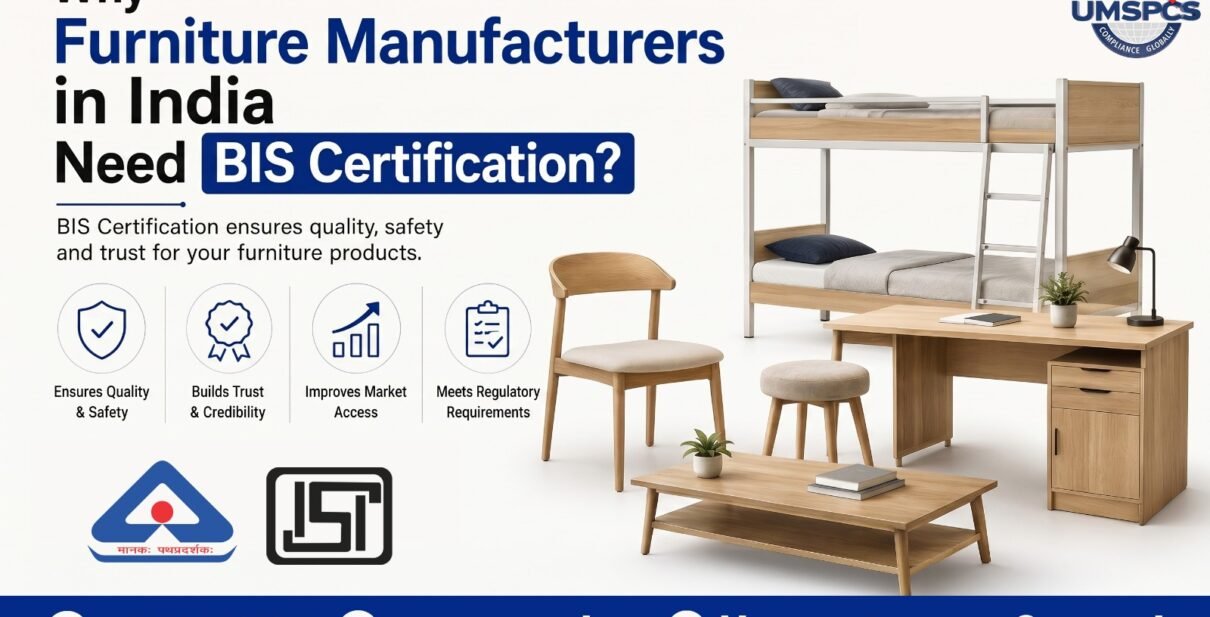
As an industry-leading consultancy, UMSPCS is an industry leader consultancy firm committed to assisting the manufacturers in navigating the changing regulatory environment in India. The BIS has made the furniture industry a quality-driven industry with the introduction of the Furniture (Quality Control) Order (QCO) in 2026.
It is no longer an option for any manufacturer/importer to get a BIS certificate for furniture products, but a statutory and business requirement. In this guide, we’ll give you a step-by-step, simple explanation of why you should get this certification and how to go about it.
Understanding the Legal Mandate: The Furniture QCO 2026
The Ministry of Commerce and Industry (DPIIT) has prescribed certain categories of furniture products to be mandatory for getting BIS ISI Mark for Furniture. Non-compliant products are not allowed to be produced or imported into Indian territory as of 13th February 2026.
The Scope of Mandatory Certification
The QCO is in the process of covering six major categories as per specific Indian Standards (IS). Where your product relates to these, you have to get the BIS Certification:
| Product Category | Indian Standard (IS) | Key Focus Areas |
| Work Chairs | IS 17631:2022 | Ergonomics, stability, and load-bearing for office use. |
| General Purpose Chairs & Stools | IS 17632:2022 | Structural safety for domestic and commercial seating. |
| Tables and Desks | IS 17633:2022 | Surface quality, durability of joints, and stability. |
| Storage Units | IS 17634:2022 | Safety of drawers, shelves, and locking mechanisms. |
| Beds | IS 17635:2022 | Strength of frames and mattress support systems. |
| Bunk Beds | IS 17636:2022 | Height safety, ladder strength, and entrapment prevention. |
Why Do Furniture Manufacturers Need BIS Certification?
We see BIS certification at UMSPCS as a tool to be used, not a barrier to be overcome. Why it is so crucial:
A. Legal Authorization & Zero Risk
The absence of the ISI Mark on furniture is against the BIS Act, 2016. This may result in financial penalties, seizure of production batches and even production plants. You will be able to have the certificate and your business will be “law abiding” and protected from legal raids.
B. Market Expansion & Consumer Trust
BIS ISI Mark for Furniture is the best quality mark seen by the Indian consumers. It assures the purchaser of the safety and durability of the product. In addition, most Tier-1 retailers and e-commerce giants don’t accept any furniture that isn’t certified.
C. Access to Government Tenders
The Government of India is the biggest customer of furniture for schools, offices and hospitals. The government has announced that only vendors with a valid BIS certificate for furniture will be allowed to submit tenders under the ‘Make in India’ and ‘Vocal for Local’ initiatives.
D. Global Competitiveness
Certification helps to ensure the quality of your manufacturing process meets international standards. This will not only enhance your internal production efficiency, but also help you get ready for export markets that require high quality assurance.
BIS FMCS Certification for Furniture (For Foreign Manufacturers)
You are an Out Of Country manufacturer? To gain access to the market of India, manufacturers of products have to get BIS FMCS Certification for Furniture (Foreign Manufacturers Certification Scheme).
The following is a list of some of the key requirements for FMCS:
- Authorized Indian Representative (AIR): Any foreign company has to appoint a company or a person in India as its liaison with BIS.
- Survey with Factory Inspection: BIS inspection officers will visit your overseas factory for a physical inspection.
- Sample Testing: Samples have to be sent to India for testing in the lab approved by BIS.
If not BIS FMCS Certified, your shipments will be deposited at the Indian customs resulting in huge losses and damage to your brand.
The Bis Certification for Furniture Process: Step-by-Step
There are a few technical steps to certification. Although it might sound intimidating, a professional BIS Consultant in India such as UMSPCS can help make the entire plan easy.
Step 1: Align Manufacturing Unit with Applicable Indian Standard
State the particular Indian Standard (for example IS 17631 for chairs, IS 17635 for beds). We assist you in upgrading the production processes, as well as establishing the necessary laboratory for the necessary regular tests and calibration work within your premises.
Step 2: Application Filing & Documentation
Preparation of the document is required by BIS Certificate for furniture (factory layouts, machinery list and quality control manual). All technical files are audit ready to avoid delays.
Step 3: Application Submission
Formal application to be filed in BIS Manak Online. This stage involves statutory fees payments and liaison with the appropriate BIS Branch Office.
Step 4: Product Testing & Lab Report (LTR)
Furniture sampling and testing carried out at a BIS recognized, NABL accredited lab. Products are subjected to exhaustive testing (load, stability and durability) to produce the required Lab Test Report.
Step 5: BIS Factory Inspection
A BIS official visits the plant to check the quality of raw materials, production process, skill of technical staff, and correctness of your in-house lab. Samples are sealed during this visit for independent verification.
Step 6: Non-Conformity (NC) Closures
Testing and inspection may reveal gaps, which we help to address with corrective actions and to provide the evidence to BIS for closure.
Step 7: Grant of License
Once payment of the marking fees has been made and the critical information has been verified successful, BIS issues the license. Thereafter, the ISI Mark can be legally used. The procedure usually takes 30 – 40 working days.
Document Required BIS Certificate for Furniture
Documentation is the key to a successful application. Each of the papers is worth a letter grade and this can result in rejection if missed. This is the checklist that is kept by UMSPCS:
Administrative Documents:
- Provision of Proof of Entity: Incorporation Certificate / Partnership Deed / MSME/Udyam Registration.
- Premises Proof: Factory License, Lease deed, or ownership papers.
- GST Registration: A copy of GST certificate.
- Trademark Copy: If you are using a particular brand name.
Technical Documents:
- A factory layout is a diagram of the production process that indicates the placement of the machines.
- List of Machinery: Information about all the manufacturing equipment.
- List of Testing Equipment: Calibration certificates for your lab equipment.
- Product Drawings: These are the detailed drawings of the furniture models.
- Quality Control Plan: Manual that shows you how to check for defects at each step.
BIS Certification – Costing & Timeline for Furniture Manufacturers
The entire BIS ISI certification for furniture manufacturers takes approximately 30 – 40 working days. But it can be different for different products depending on its complexity, availability of laboratory facilities and quick response from BIS authorities.
BIS ISI certification cost varies from product to product, testing needs and production volume. This is a basic list of costs you can expect:
- Application Fees – The government charges an application fee directly to BIS on submission of application.
- Lab Testing Charges – These will depend on the test(s) you need and your product type. Simple products can be less expensive, whereas complex industrial products can take a long time to test.
- Factory Inspection Charges – These charges are imposed if BIS inspectors come to your manufacturing unit to review your processes and quality systems.
- Annual License Fees – A one-time annual fee to be paid to BIS, to maintain your ISI certification and its validity.
- Marking fees – calculated according to production volume norms of BIS.
- UMSPCS Consultancy Fee – All inclusive support which includes documentation, lab coordination, portal filling, handling queries, assistance for audits.
Challenges and the Role of a BIS Consultant in India
There are technical challenges on the path to certification:
- Time-consuming Complex Paperwork: The Manak Online portal and technical manuals are complicated and time-consuming to manage.
- If a chair fails a load test, then the entire application can be delayed.
- Audit Readiness: Professional training is required for the factory to be “audit-ready.”
This is where a BIS Consultant in India comes in handy. You are a technical partner of UMSPCS who will set up labs, help prepare your documentation and coordinate with BIS officials to make the process easy and rejection free.
Conclusion
The 2026 Furniture QCO deadlines are already here! Delaying your BIS Certification could mean a complete halt in your sales and production. If you are a domestic product to find an ISI Mark or an international brand to obtain BIS Certification for Furniture, UMSPCS is there to help you.
UMSPCS is a trusted name in the field of BIS Certification consultancy with a successful track of 600+ projects. ISI mark standards are available in full and comprehensive support and you don’t have to worry about the technical burden ourselves. We take care of all the details so your certification process is flawless, quick and successful.
Our expert consultants make sure your documents are perfect, your factory complete.
Read more also: How to get Trusted BIS Registration Consultant Delhi
FAQs- BIS Certification for Furniture
- My furniture uses imported components; do I still need the ISI Mark?
Yes, the final product that is sold in India has to be certified. But, the 2026 Amendment provides for import of limited non-BIS components (200 units) for R&D purposes in case of the applicant or licensee.
- Is there any relief for small-scale carpenters or MSEs?
Yes, the deadline is extended for the micro and Small Enterprises (MSEs) till August 14, 2026. This gives much smaller units time to replace machinery and establish the necessary testing laboratories in house.
- Can I sell my old stock that doesn’t have the BIS logo?
Yes, selling pre-implementation stock up to 12 months after the 2026 enforcement date will be allowed where a self-declaration is made to BIS that the stock is manufactured or imported prior to the date of enforcement.
- What if my product design is unique and doesn’t fit a standard?
The 6 major standards (IS 17631 – 17636) cover most of the commercial items. If your design is very specialized, it may be possible to determine if it is considered “Specialized Furniture” or if it requires a specific technical deviation with the help of UMSPCS.
- Are “Ready-to-Assemble” (RTA) furniture kits exempt?
No, BIS standards are applicable to complete units. The final assembled kit is tested to ensure it complies with safety and stability requirements.
- We manufacture only for export; do we need BIS certification?
No, products for “exclusive” export are not exempt. But, documentation and self-declaration are to be kept in strict order so that these goods don’t get into the Indian domestic market.
- What are the most common reasons for application rejection?
Some of the challenges faced are incomplete documentation, inability during the independent Product Testing (e.g., structural failure) or an under-equipped in-house laboratory during BIS Factory Inspection.
- Is the BIS license valid forever once granted?
The license is issued for 1 or 2 years at first. After this, it needs to be renewed at regular intervals. The BIS ISI Mark for Furniture is ensured through a continuous compliance mechanism by conducting surprise market surveillance and periodic factory audits.
❓ Ask a Question
Have any doubts? Fill the form below and our team will respond shortly.