In the fast-evolving landscape of renewable energy and electric mobility, where the heart of the revolution depends on storage batteries. Regardless of whether they are powering a smartphone, an electric vehicle (EV) or a massive solar grid, the reliability of such batteries is supreme. The government of India by the Bureau of Indian Standards (BIS), made this Compulsory Registration Scheme (CRS), which is mandatory to confirm this reliability and safeguard consumers from poor products.
In this blog, we will demonstrate in detail the world of BIS CRS Certification for storage batteries, find out why it is non-negotiable for manufacturers, and highlight how consultancy experts like UMSPCS make this difficult regulatory journey into a straightforward journey.
What is BIS CRS Certification?
The Bureau of Indian Standards (BIS) holds the charge of CRS under Scheme II of the BIS Regulations, 2018. This includes regular factory inspection where the CRS depends on self-declaration of conformity, which is not like the traditional “ISI Mark”. Manufacturers should test their products in labs approved by BIS and register in line with the Bureau of Indian Standards prior to launching their products in the Indian market.
This certification is a legal requirement under the Electronics and Information Technology Goods Order for storage batteries used in portable applications, solar power systems, and electric vehicles
Why is BIS CRS Mandatory for Storage Batteries?
Storage batteries specifically Lithium-ion (Li-ion) and Nickel-based systems which carry inherent risks. Improper design or poor manufacturing can give result to the followings:
- Thermal Runaway: Leading to fires or explosions.
- Chemical Leaks: Posing environmental and health hazards.
- Performance Failure: Resulting in economic loss for the consumer.
The BIS CRS Certification for Storage Batteries confirms that each battery should be sold in India in line with solid safety and performance parameters which boost trust in the “Make in India” initiative and international trade.
Relevant Standards for Storage Batteries
Manufacturers should find out the suitable Indian Standard (IS) which applies to their product. The most common standard for storage batteries consists of the following:
1. IS 16046 (Part 1 & 2):2018
This is the key standard for secondary cells and batteries which have alkaline or other non-acid electrolytes.
- Part 1: Focuses on Nickel systems.
- Part 2: Focuses on Lithium systems. It covers safety requirements for portable applications, confirming the cells/batteries can withstand mechanical stress, thermal abuse, and electrical imbalances.
2. IS 16270
This standard is applicable to secondary cells and batteries for Solar Photovoltaic (SPV) systems. It gives surety that batteries used in solar projects can manage the certain charge- discharge cycles usual of renewable energy storage.
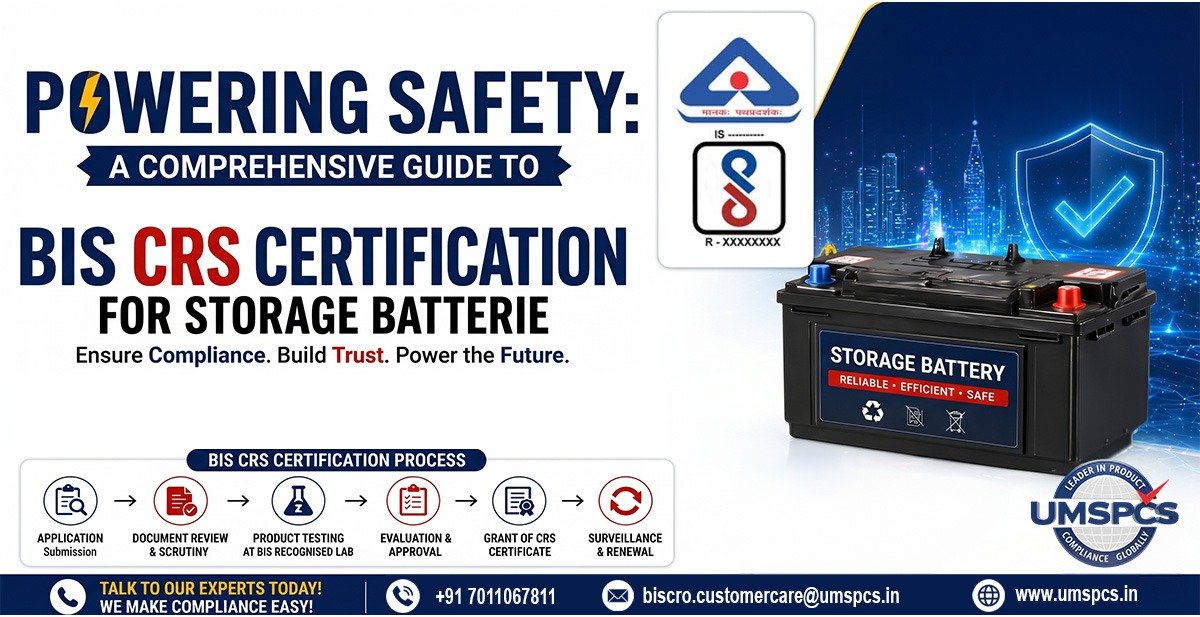
BIS CRS Certification for Storage Batteries Process: Step-by-Step
Tracing the BIS portal can be disconcerting. Here is a simplified procedure given below:
Product Classification:
Find out the correct IS standard and define the “Lead Model” and “Series Models.” BIS allows integration series where similar models can make a group under one registration to save charges.
Testing in Recognised Labs:
Samples should get delivered to a lab approved by BIS in India. The lab tests the following:
- Battery against parameters like vibration
- Mechanical shock
- External short circuit
- Overcharge
- Forced discharge
Online Application:
An online application is submitted on the BIS CRS portal after the test reports come which are usually valid for 90 days.
Appointment of AIR (For Foreign Manufacturers):
The company must hire an Authorised Indian Representative (AIR) which works as a local point of contact when the manufacturing unit is based outside India.
Scrutiny and Grant of Registration:
BIS officials check the test outcomes and documentation. They issue a Registration Number which allows the manufacturers to display the standard mark when fulfilled.
Read more: How to Get BIS ISI Mark Certificate in India
How UMSPCS Helps to Obtain BIS CRS Certification for Storage Batteries
For several manufacturers there are technicalities of “series formation” or the logistics of sample testing are major blockages. This is where UMSPCS comes into effect.
UMSPCS is a prime regulatory consultancy specialising in BIS, WPC, TEC, and BEE certifications. Their role is critical between difficult government mandates and industrial functionalities.
How UMSPCS Simplifies the Journey:
- Complete Documentation: From preparing the application to handling the AIR services for international brands.
- Lab Coordination: They give surety that samples are tested appropriately and outcomes are made within 90 day validity window.
- Technical Guidance: Assisting manufacturers to know IS 16046 to confirm that their products get passed by preventing high costs in retests.
- After Certification Compliance: BIS certification isn’t a “one-and-done” deal; it asks for renewals and occasional updates when standards change. UMSPCS handles the lifecycle of the certification.
Challenges and Pitfalls to Avoid During BIS CRS Registration
- Wrong Series Formation: When your group models are not similar this will make BIS to reject the application which results in loss of time and money.
- Incomplete Documentation: Complications with the Trademark Authorisation Letter or the AIR agreement are common cause for postpones.
- Delay in Testing: Lab slots could get restricted. Proactive scheduling is necessary to get aligned with product launch deadlines.
Conclusion: The Future is Charged
As India walks towards its aim of becoming a global hub for EV manufacturing and renewable energy, the importance of BIS CRS Certification for storage batteries will only expand. It is not only a regulatory difficulty which is a confirmation to quality and safety.
By working together with experts like UMSPCS, manufacturers are able to trace the regulatory maze in line with ease which confirms that their product reaches the market faster and in line with the undisputed seal of Indian Standards. Compliance is your easy access to get into India’s consumers’ hearts and homes, regardless of whether you’re a local startup or global giant.
Read more also: BIS Consultant in Noida: Bis Certification Guide for Businesses
Frequently Asked Questions (FAQs)
- Is BIS CRS mandatory for all storage batteries?
Yes, for specific chemistries. It is legally required for Lithium-ion, Nickel-Cadmium, and Nickel-Metal Hydride batteries used in portable electronics, Solar PV systems (under IS 16270), and Electric Vehicles (EVs). Selling these without the “Standard Mark” is a legal offense in India.
- What are the primary standards I should know?
IS 16046 (Part 2):2018: For Lithium-ion systems (Portable apps).
- IS 16270:2023: For Solar Photovoltaic (SPV) storage systems.
- New 2026 Update: BIS now mandates Rated Capacity Verification via the LIMS portal to ensure label claims match actual performance.
- How long does the certification last?
The registration is valid for 2 years. You must apply for renewal at least 3 months before expiry to avoid customs clearance issues.
- Do I need to test products in India?
Yes. All testing must be done in a BIS-recognized lab within India. Test reports from international labs (like UL or CE) are not accepted for the CRS application.
- What is the role of an AIR for foreign brands?
Foreign manufacturers must appoint an Authorised Indian Representative (AIR). The AIR serves as the legal liaison between the brand and the Bureau of Standards.
- Can I group multiple models under one license?
Yes, through Series Formation. You can test one “Lead Model” and include similar models in the same registration, provided they share the same chemistry, voltage, and construction.
- How long does the process take?
Typically, 20 to 30 working days. This includes 10–15 days for lab testing and another 10–15 days for BIS officer scrutiny and grant of the R-number.
- Why use a consultant like UMS PCS?
Navigating the portal, managing lab logistics, and ensuring correct “Series Formation” is technical. UMSPCS acts as an expert guide, handling everything from sample submission to AIR services, ensuring you don’t face rejections due to paperwork errors.
❓ Ask a Question
Have any doubts? Fill the form below and our team will respond shortly.