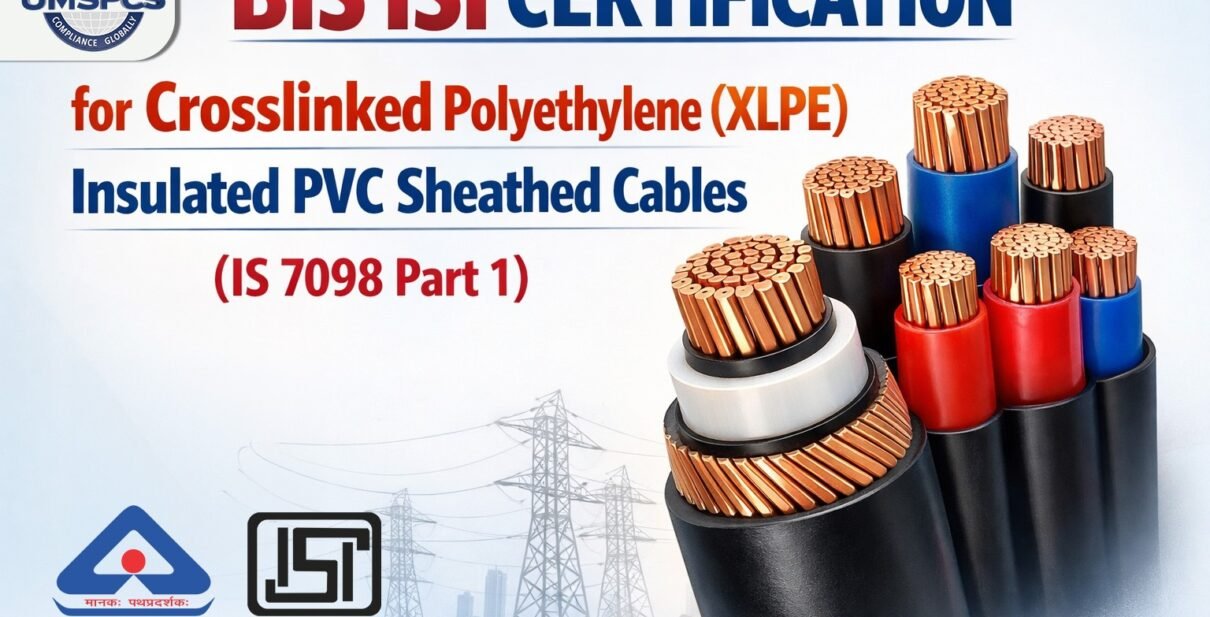
In today’s modular electrical system, the reliability and safety of cables works as an essential component in avoiding failures, accidents, and energy losses. Crosslinked Polyethylene (XLPE) insulated PVC sheathed cables are mostly employed in residential, commercial, and industrial installation because of their excellence functioning. To confirm such cables are aligned with the required safety and quality benchmark also certification from the Bureau of Indian Standards is compulsory.
Compliance in accordance with IS 7098 (Part 1) asked to get the ISI mark for cables functioning at voltages up to 1100V which assures that the product is in line with the Indian safety standards.
Understanding IS 7098 (Part 1): Scope and Technical Requirements
IS 7098 (Part 1) specifies the demands for scope and technical need which are as follows:
- XLPE insulated PVC sheathed cables
- Working voltage up to 1100 volts
- Armoured and unarmoured cables
- Single-core and multi-core configurations
Such cables are usually employed in power distribution systems where durability, heat resistance, and insulation strength is necessary. XLPE insulation provides certain benefits over conventional materials which consist of higher thermal capacity and enhanced electrical properties.
Such cables are preferred for their ability to function consistently under high load conditions and resist environmental stress like moisture, chemicals and mechanical wear.
Importance of BIS ISI Certification for XLPE Cables
Manufacturers working with electrical cables should align with BIS regulations prior to selling them into the Indian market. BIS ISI Certification for XLPE Cables under IS 7098 (Part 1) is not only a procedural demand but it confirms that the product is safe for long term use.
Key Benefits:
1. Regulatory Compliance
Selling non certified cables will result in fines, product bans or lawsuits.
2. Assured Product Safety
The certification checks if the cable can withstand electrical stress, temperature variations, and environmental conditions.
3. Standardized Quality
ISI marked products get aligned with uniform manufacturing and testing standards which confirms consistency.
4. Increased Market Credibility
Certified products are referred by the government body, contractors, and large organization which boost their credibility among the market.
5. Reduced Risk of Failures
Excellent quality of certified cables assists in avoiding short circuits, fire dangers, and system breakdowns.
Testing Requirements for ISI Certification
The product should go through various tests which are in labs approved by BIS only to receive BIS certification. Such tests are formed to stimulate real world functioning conditions and inspect the cable’s operations on time.
Major Tests Include:
- Conductor resistance test
- High voltage test
- Insulation resistance test
- Tensile strength and elongation test
- Heat shock and thermal ageing test
- Cold bend and impact test
- Armour resistance test
Every such test confirms that the cable should meet the rigid function benchmarks and can work safely in demanding environments.
BIS ISI Certification Process
The isi certification procedure consists of various stages each of which concentrates on checking the quality of product and manufacturing practices as given below:
Step 1: Application Submission
Manufacturers should upload comprehensive detail about the product consisting of the design and technical specifications.
Step 2: Product Testing
Samples are delivered to labs which are BIS approved for testing in accordance with IS 7098 (Part 1).
Step 3: Factory Inspection
BIS authority does a live inspection to check manufacturing capabilities, quality control measures, and testing facilities.
Step 4: Evaluation and Review
Every document like test reports and inspection findings to check for compliance.
Step 5: Grant of License
The manufacturers get the ISI license and can use the ISI mark on the product after getting approved.
Documentation Required
Appropriate documentation works as an essential role in the certification procedure. Manufacturers should confirm that every uploaded document is correct and complete.
Required Documents:
- Business registration certificate
- Manufacturing process details
- Product specifications and design drawings
- Test reports from approved laboratories
- Quality control procedures
- Factory layout and machinery details
Incomplete or incorrect documentation is one among the most common reasons for postpones during approval.
Challenges in Obtaining BIS Certification
Manufacturers usually encounter practical complexities through the well-defined procedure which is given below:
- Understanding technical clauses of IS 7098 (Part 1)
- Preparing for factory inspections
- Coordinating with testing laboratories
- Managing extensive documentation
- Delays due to compliance gaps
Mentioning such challenges need both technical understanding and should be known with regulatory procedures.
How UMSPCS Supports BIS ISI Certification
Professional guidance can make a certain change for businesses aiming to simplify the certification procedure. UMSPCS gives complete assistance for BIS ISI Certification procedures in every variety of industry.
The workforce gives practical assistance at each stage from initial documentation to the final approval in line with an extensive experience in handling certification projects for receiving the BIS ISI certification.
Key Support Areas:
- Preparation and verification of documentation
- Coordination with BIS-recognized laboratories
- Assistance during factory inspections
- Application filing and follow-up with authorities
- Guidance on maintaining ongoing compliance
The certification procedure has become more efficient and consumes less time by confirming accuracy and readiness at every step.
Read more: Drug License Registration in India: Process, Types & Documents
Practical Importance of ISI Certified XLPE Cables
In real world applications where the use of certified cables has a direct impact on system functionality and safety. Infrastructure projects, industrial setups, and residential developments depend mostly on ongoing electrical functions.
Non complaint cables might give results to excessive heat, insulation failure, or even fire dangers. Whereas, certified cables go through solid testing which confirms durability and reliability under different conditions.
Thai is particularly essential in sectors like construction, power distribution, and manufacturing where electrical risks can cause certain losses.
Read more also: BIS Registration for Electronic Products in Noida
Conclusion
BIS ISI Certification for crosslinked Polyethylene insulated PVS sheathed cables under IS 7098 (Part 1) is necessary to confirm product safety, regulatory compliance and long term functionality.
As per the requirement for reliable electrical infrastructure which continues to expand where manufacturers should prioritise certification to follow industry standards and boost trust in the market.
Working together with experienced professionals like UMSPCS which simplifies the journey and assists to get on time approval while the certification procedure consists of technical evaluation.
FAQs
1. Is BIS certification mandatory for XLPE cables?
Yes, BIS certification under IS 7098 (Part 1) is compulsory for cables up to 1100V in India.
2. How long does the certification process take?
The process usually requires 4 to 8 weeks which is based on testing and documentation.
3. Can small manufacturers apply for ISI certification?
Yes, manufacturers of every size are applicable to align with the BIS requirements.
4. What happens if cables are sold without certification?
If you’re selling in India without having the certification will give rise to penalties, product bans, or legal action.
5. Is factory inspection compulsory?
Yes, BIS conducts factory inspections to verify manufacturing and quality control systems.
❓ Ask a Question
Have any doubts? Fill the form below and our team will respond shortly.