Microwave ovens have become one of the most commonly used kitchen appliances in homes, offices, and commercial kitchens. They provide quick and convenient cooking, reheating, and defrosting of food using microwave radiation. However, because microwave ovens operate using electrical power and electromagnetic waves, ensuring their safety and quality is extremely important.
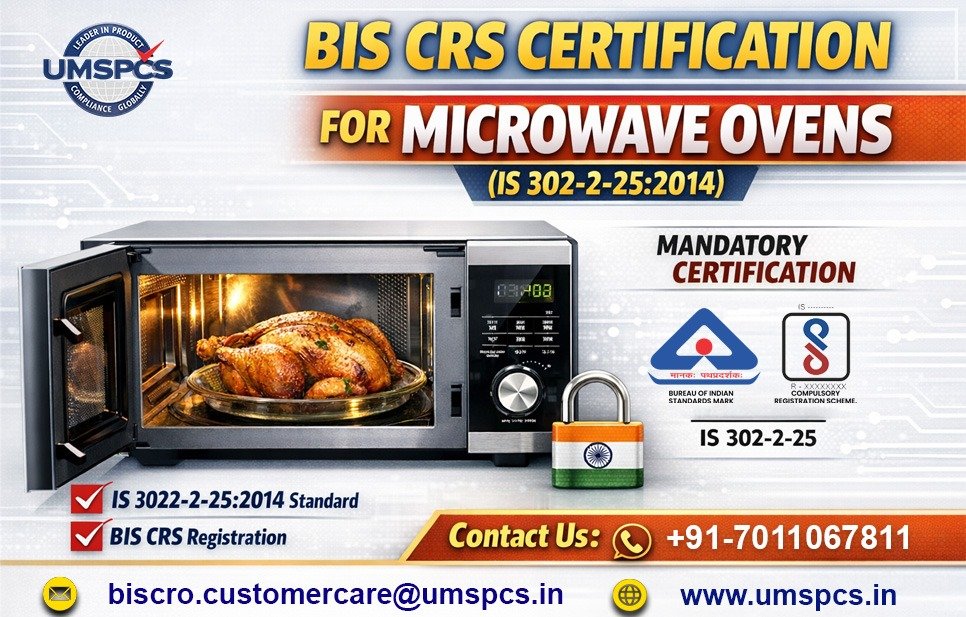
The Government of India made this a compulsory certification to regulate the security and functionality of these applications in accordance with the Compulsory Registration Scheme (CRS) which is in charge of the Bureau of Indian Standards (BIS). Microwave ovens should get in line with the Indian Standards IS 302-2-25:2014, prior to manufacturing, importing or selling it in India.
In this blog, we will explain the BIS CRS Certification for Microwave Ovens, its requirements, process, documents, and how expert CRS Consultants like UMSPCS can assist businesses in obtaining certification smoothly.
What is BIS CRS Certification for Microwave Ovens?
The Government of India has imposed the CRS Certification, which is a compulsory compliance requirement for certain electronic and electrical products. Manufacturers should register their products in alignment with BIS, which gives surety that they follow up with Indian standards prior to distributing them in India with this scheme.
CRS registration is required for products which include Microwave ovens under the electronic and IT goods order.
The suitable standard for microwave ovens is IS 302-2-25:2014, which defines the requirements of safety and combination of microwave appliances.
After getting passed through the testing and approval process, manufacturers get BIS registration number which can be shown as the BIS standard mark on the product.
Overview of Standard IS 302-2-25:2014
The standard which is IS 302-2-25:2024 keeps an eye on the safety of household microwave ovens and similar electrical appliances.
It consists of appliances which work at a rated voltage of 250 volts or less and has microwave ovens employed in homes, hotels, and similar environments.
Key Safety Requirements Under the Standard
The standard gives validation that the microwave oven is in line with the rigid safety and performance requirements, like as follows:
- Protection against electric shock
- Microwave radiation leakage limits
- Thermal safety and overheating protection
- Mechanical strength and durability
- Fire hazard protection
- Safe operation under normal and abnormal conditions
For instance, microwave ovens should get that radiation leakage which should not go over the defined limits, to prevent the consumer from exposure.
Such requirements provide assistance in safeguarding consumers and to check the reliability of microwave ovens which are offered to sale in India.
Benefits for BIS CRS Registration
By getting registered as a BIS CRS registration for electronics can provide you variety of benefits:
- Receiving a legal authorization for marketing electronics in India can be beneficial.
- Easy access through the borders.
- Boost consumer confidence and safety.
- Improve the brand credibility.
- Prevents you from penalties, seizures, and recalls.
Documents Required for CRS Registration
Documents required for CRS registration are as follows:
- Business license of manufacturer
- ISO Certificate (if available)
- Product test report from BIS-recognized lab
- Product specifications and photographs
- Trademark registration (if applicable)
- Authorization letter for AIR (for foreign manufacturers)
- Factory address proof and company documents
Correctness of documentation can help in accelerating your CRS Certification process.
BIS CRS Registration Process (Step by Step)
1. Product Identification and Standard Mapping
figuring out the relevant Indian Standard (IS) for your product is the very first step. Every type of electronic product is linked with a particular standard. Rejection or significant delays can arise from incorrect identification.
2. Testing at BIS-Recognized Laboratory
The product demands to be examined in an Indian laboratory approved by the BIS. Testing confirms conformity to the relevant Indian Standard.
Important points:
- On average, testing takes one to three weeks.
- Test results are good for ninety days.
- The final production model and the sample being examined must match.
3. Documentation Preparation
Following testing, the candidate needs to collect and prepare the following documents:
- Details of the manufacturer’s business registration
- Manufacturing details and the address of the factory
- Report on product testing
- Authorization letter or trademark certificate
- Details of the product label and markings
- affidavits and undertakings
To deal with BIS, foreign manufacturers are required to identify an Authorized Indian Representative (AIR). Read more also: BIS-ISI Certificate for Foreign Manufacture
4. Online Application Submission
The BIS online portal is implemented to submit the CRS application under Scheme II. Pay government fees, submit documentation, complete details of the product, and it provides inspectional application to the applicant.
With proper accuracy, you can prevent queries that might arise by any differences between the test reports and documents.
5. BIS Scrutiny and Query Resolution
BIS officials review the application and may raise technical or documentation-related queries. To keep the application’s progress, responses should be accurate and on time.
6. Approval of the CRS Registration
For approval, BIS offers a separate R-number to the CRS Registration certificate.
Commonly valid for two years, the registration needs to be renewed before then.
Timeline and Validity of CRS Certification
On an average, CRS registration usually requires the time:
20 to 30 working days, depending on testing, documentation, and approval.
Validity
- Usually the CSR registration is valid for 2 years.
- It can get renewed prior to the expiry date.
Role of a CRS Consultant
For CRS certification, you have to abide by strict regulations, test what you sell, and write technical manuals. This is the reason why a lot of businesses like to hire qualified CRS Consultants.
A professional CRS Consultant provides assistance with the following tasks:
- Finding the right BIS standards
- Setting up product testing in labs that have been authorized by BIS
- Getting ready and looking over paperwork
- Submitting the application on the BIS portal
- Answering questions from BIS and meeting compliance requirements
Working with experienced CRS Consultants greatly lowers the chance of your application being denied or delayed.
How UMSPCS Supports BIS CRS Registration
UMSPCS is a professional, experienced compliance consultancy which provides complete support for BIS CRS Registration for electronics in India.
UMSPCS supports companies using:
- Finding out correct identification and product classification.
- Conducting test in BIS approved laboratories.
- Complete documentation preparations
- Online submission of applications
- Submitting applications through online mode.
- Processing the queries of BIS
- Help in model diversity and renewal of the classification.
Working with manufacturers at both local and global level, ensures fast approval and helps in avoiding delays.
Conclusion
Microwave ovens are widely used appliances that must meet strict safety standards before reaching consumers. The BIS CRS Certification for microwave ovens under IS 302-2-25:2014 ensures that these products are safe, reliable, and compliant with Indian regulations.
Manufacturers and importers must obtain CRS Registration before selling microwave ovens in India. This certification not only ensures regulatory compliance but also builds consumer trust and improves brand credibility.
Working with experienced Bis Consultants like UMSPCS can simplify the entire process—from testing to certification—helping businesses obtain approval quickly and efficiently.
Read more also: BIS Certification for Warming Plates and Appliances
FAQs- CRS Certification mandatory for microwave ovens
- Is BIS CRS Certification mandatory for microwave ovens in India?
Yes. microwave ovens should get the CRS certification under 302-2-25:2014 prior to get sold in India.
- Who can apply for CRS Registration?
The manufacturer of the products is required to apply for the CRS registration.
- How long does CRS certification take?
On an average, CRS certification usually requires 20-30 working days, which is based on the testing and paperwork.
- What is the validity of CRS Certification?
CRS certification is usually valid for two years and can get renewed once expired.
- Can foreign manufacturers apply for CRS Certification?
Yes. Foreign manufacturers can apply for CRS certification but they need to hire an Authorised Indian Representative (AIR) first.
❓ Ask a Question
Have any doubts? Fill the form below and our team will respond shortly.