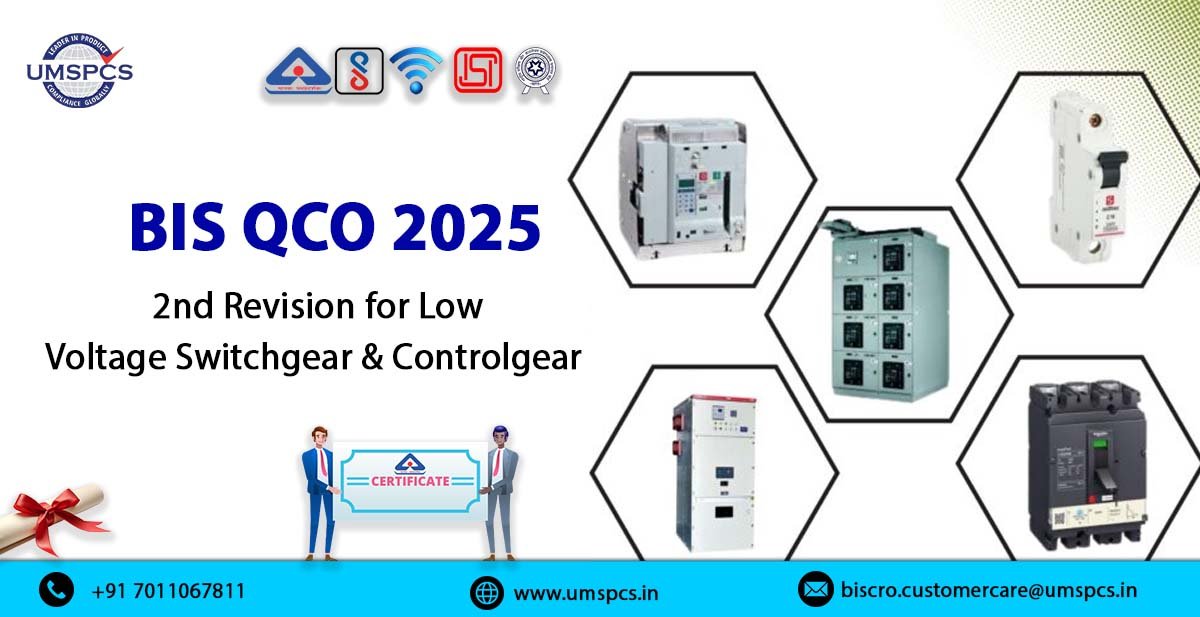
The BIS QCO 2025 has released the 2nd Revision for Low-Voltage Switchgear and Controlgear, which extends the list of electrical equipment categories that must undergo mandatory quality control. With this measure, manufacturers, importers, and suppliers in India are required to ensure safety, reliability, and compliance with international standards.
As per the revision, the products such as motor controllers, contactors, soft starters, and semiconductor motor starters need to be certified and approved as per IS/IEC 60947-4-2:2020 and other applicable standards. The changes have been made to reference local and international manufacturers and highlight the need for BIS Certification for Electronics and FMCS Certification India for the equipment that is imported.
Key Product Categories Under the 2nd Revision
1. Low-Voltage Switchgear BIS Certification: To ensure safety from short circuit, overload, and other similar electrical hazards, all switchgears that are operating at low-voltage levels should be in accordance with BIS standards.
- Controlgear Compliance India: Impulse contactors, disconnectors, and other controlgear equipment must now conform to Indian standards for their performance and reliability.
- Semiconductor Motor Starters Certification: Device containing semiconductor elements in the starter circuit shall meet the requirements of BIS under IS/IEC 60947-4-2:2020 so as to guarantee high efficiency and safe operation in industrial installations.
- Motor Controller BIS Standards: The QCO also includes motor controllers that tightly follow BIS testing and documentation requirements.
- Soft Starters BIS Approval: Soft starters that are commonly used for current reduction at the start of motors will be allowed into the market only after BIS approval.
Importance of Compliance
In order to sell products in India legally, manufacturers and importers are required to obtain a BIS Electronics Certification or FMCS India Certification. If a company fails to comply with the regulations, it can face a fine, have its products recalled, or be prohibited from selling them. By using the services of UMSPCS Compliance, companies can easily obtain their certification as they will be able to meet all the requirements of the regulations and safety standards in an efficient way.
The BIS QCO 2025 is also a directive that requires compliance with the most recent changes of the IS/IEC 60947-4-2:2020 standard. This is aimed at ensuring that both types of devices, electromechanical as well as semiconductors, meet the performance, endurance, and safety criteria set forth. As the application of industrial electronics in automation is on the rise, compliance with these standards is very important to manufacturers as well as to the ultimate users.
Role of UMSPCS in Compliance
Conformity Services is a leader in compliance consultancy, that enables enterprises to be compliant with BIS QCO full standards. The main activities of this corporation include:
- Provision of instruction on Low-Voltage Switchgear BIS Certification and Controlgear Compliance India
- Support in Semiconductor Motor Starters Certification and Soft Starters BIS Approval
- Making sure that products are in line with Motor Controller BIS Standards and IS/IEC 60947-4-2:2020
- Offering service in FMCS Certification India and BIS Certification for Electronics
As a result of a partnership with UMSPCS, producers and importers will be able to efficiently manage the intricate BIS QCO framework, minimize compliance risks and have a quick market entry.
Summary: BIS QCO 2025 2nd Revision introduces tighter oversight for the regulation of low-voltage switchgear, controlgear, motor controllers, semiconductor motor starters, and soft starters. Accomplishing conformity using UMSPCS measures is a guarantee for the safety, performance, and legal market access in India.
BIS QCO Application Process for Low-Voltage Switchgear & Controlgear
Guide for Indian & Foreign Manufacturers
Following the implementation of BIS QCO for Low-Voltage Switchgear and Controlgear under IS/IEC 60947-4-2:2020 (2nd Revision), manufacturers are required to hold a mandatory BIS certificate to be allowed to manufacture, import or sell these products in India. This condition is valid for Indian manufacturers as well as for foreign manufacturers who export to India.
As compliance consultants, we see a clear and single process flow for both, which is expressed as follows.
Step 1: QCO Applicability & Product Classification
Manufacturers should initially ascertain if their products-semiconductor motor controllers, motor starters, soft starters, and related control gear of any rating-are covered by the QCO. It is necessary that each model and each variant be accurately classified.
Consultant insight: The wrong identification of the scope is the most frequent reason for rejection or delay.
Step 2: Applicable Indian Standard & Gap Analysis
The standard that is necessary to be followed is IS/IEC 60947-4-2:2020. The manufacturers are advised to compare their product, its parts, safety features, and performance parameters with those given in the standard.
In the case of foreign manufacturers, compliance with the Indian deviations from the IEC version should be guaranteed.
Step 3: Product Testing in BIS-Recognized Laboratories
Testing of product samples that sufficiently represent the product line should be carried out in BIS-recognized laboratories as per the standard. Test activities usually cover electrical performance, thermal behaviour, overload protection, short-circuit capacity, and functional safety.
Consultant insight: Pre-testing verification stages are instrumental in averting testing failures and expensive retesting.
Step 4: BIS Application Submission
Applications are made through the BIS Manak Online Portal:
- Indian manufacturers file an application under the ISI Certification Scheme
- Foreign manufacturers file an application under the FMCS (Foreign Manufacturers Certification Scheme) and are required to appoint an Authorized Indian Representative (AIR)
Confidential technical dossiers, test reports, manufacturing process details, and quality-control plans are among the necessary documents.
Step 5: Factory Inspection & Audit
BIS performs a factory inspection to ascertain the truth of:
- The producing facilities
- The quality management systems
- The laboratory and testing capabilities of the plant
- The stability of production
In the case of a foreign manufacturer, the BIS officials might be there for an inspection overseas
Step 6: Issue of BIS ISI License
Following a successful testing and inspection, BIS issues the ISI License which is the authorization to use the ISI Mark on products that are in conformity.
It is only after this approval that products can be made, brought in, or sold in India under the QCO.
Step 7: Post-Certification Surveillance & Compliance
Manufacturers must maintain compliance through:
- Regular surveillance audits
- Ongoing quality control
- Retesting when required
- Updating certification for product changes or new models
Step 7: Post-Certification Surveillance & Compliance
Manufacturers are obliged to continue meeting the requirements through:
- regular surveillance audits
- continuous quality control
- retesting if necessary
- certification upgrading for product changes or new models
How UMSPCS Supports You
UMS Product Compliance Services Pvt. Ltd. (UMSPCS) is a one-stop solution provider for end-to-end BIS QCO support for Indian and foreign manufacturers. They take care of everything, right from the determination of the applicability of the certification to the post-certification compliance, thus lowering the risk and ensuring continuous access to the market.
Documents Required for BIS QCO Certification
Low-Voltage Switchgear & Controlgear – Indian & Foreign Manufacturers
The set of documents listed below is mandatory to file an application for BIS ISI certification under the QCO applicable to Low-Voltage Switchgear & Controlgear as per IS/IEC 60947-4-2:2020:
- Product technical specification and datasheet
- Declaration of compliance with the Indian Standard
- Test reports from a laboratory recognized by BIS
- Manufacturing process flow & quality control plan
- Details of the in-house test facility (if available)
- Raw material/component details and supplier list
- Product drawings, nameplate & marking details
- Factory layout and manufacturing infrastructure details
- Quality manuals/procedure documents
Additional for Foreign Manufacturers (FMCS):
- Authorization of Authorized Indian Representative (AIR)
- Details of the overseas factory and address proof
- Undertaking for compliance with BIS Act & QCO
Conclusion
The BIS QCO 2025 (2nd Revision) for Low-Voltage Switchgear & Controlgear is a vital regulatory change that the manufacturers and importers must not ignore. The compliance with IS/IEC 60947-4-2:2020 is mandatory, and hence the emphasis is on safety, reliability, and standardization of the products with worldwide standards. Thus, it is quite imperative for Indian manufacturing industries as well as foreign firms to secure the BIS ISI or FMCS certification within the stipulated period so as to have a smooth run in the market and avoid getting fined.
Granting certification comprises several technical and procedural stipulations—testing, documentation, and factory audits. Nevertheless, the correct conformity approach is what counts. As soon as you set out on this path, you will not only avert the risk of your work being delayed or rejected, but also, I believe, stay competitive in the market, which is getting more and more regulated.
UMS Product Compliance Services Pvt. Ltd. (UMSPCS) is like a compliance partner that you can count on during this whole journey, and they are there to offer you complete support, starting with the assessment of the applicability up to the final approval and post-certification compliance. Thanks to their expert advice, manufacturers can easily comply with the BIS QCO requirements and thus they will be able to turn their regulatory compliance into a business advantage of the long term.
Frequently Asked Questions:
Q. What is BIS QCO 2025 for Low-Voltage Switchgear & Controlgear?
BIS QCO 2025 is a compulsory Quality Control Order that came into effect following a Ministry of Heavy Industries notification. It requires products of low-voltage switchgear and controlgear to conform to the Indian Standard IS/IEC 60947-4-2:2020 (2nd Revision) and to have BIS ISI certification.
- Which products are covered under this 2nd Revision QCO?
QCO introduces controls over semiconductor motor controllers, motor starters, soft starters, and related low-voltage controlgear products. This regulation is binding for all product ratings without a single exemption.
- What is the applicable BIS standard under this QCO?
The standard that should be followed is IS/IEC 60947 Part 4 Section 2:2020. The standard includes the safety, reliability, performance, and testing aspects for semiconductor motor controllers and starters.
- When does the BIS QCO 2025 come into force?
The BIS QCO for Low-Voltage Switchgear & Controlgear will be effective from 10 May 2025. Hence, after the mentioned date, the manufacturing, importing, and selling of non-certified products in India will be prohibited.
- Is BIS certification mandatory for all manufacturers?
Yes. Indian manufacturers and foreign manufacturers who export to India both need to have BIS ISI certification to be QCO compliant.
- How can foreign manufacturers comply with this QCO?
Firstly, Foreign manufacturers must lodge an application under the BIS Foreign Manufacturers Certification Scheme (FMCS). Secondly, they need to designate an Authorized Indian Representative (AIR) in India.
- What are the consequences of non-compliance?
Failing to comply with the BIS QCO might lead to the confiscation of goods, prohibition of sales, imposition of monetary penalties, and the taking of legal steps in accordance with the BIS Act.
- What are the main changes in the 2nd Revision QCO?
The 2nd Revision calls for conformity with the newest 2020 edition of IS/IEC 60947-4-2, broadens the technical requirements, tightens the safety features, and eliminates exemptions based on ratings.
- Does existing BIS certification under older standards remain valid?
Those products that have been certified under the old versions may have to undergo testing again or get their certification revalidated to comply with the new standard in the 2nd Revision QCO.
- How long does BIS certification take for this QCO?
The duration of the work largely depends on the product complexity, how ready the testing is, and the results of the audit. Applying for certification early will make it easier to avoid postponements right before the enforcement date.
- Is factory inspection mandatory under this QCO?
Definitely, Before giving the certificate, the BIS performs a factory visit or an audit to assess the production capability and the quality control system of the factory.
- Can a single BIS license cover multiple product variants?
Whether the products are covered or not depends on how similar the designs, ratings, and compliance parameters are. BIS decides the grouping of products at the time of application review.
- What documents are needed for BIS QCO certification?
Main documents are product specifications, test reports from BIS-approved labs, manufacturing details, quality manuals, and information about marking.
- Why should manufacturers start preparing early?
Starting early with the preparations of the manufacturers helps them to avoid testing failures at the last moment, redesign cost, import delays, and the risk of incurring penalties after the enforcement date of the QCO due to non-compliance.
- How can UMSPCS help with BIS QCO 2025 compliance?
UMS Product Compliance Services Pvt. Ltd. (UMSPCS) is a turnkey support provider that offers services from QCO facilitation assessment, BIS ISI/FMCS certification, testing facilitation, and documentation to post-certification compliance.
❓ Ask a Question
Have any doubts? Fill the form below and our team will respond shortly.