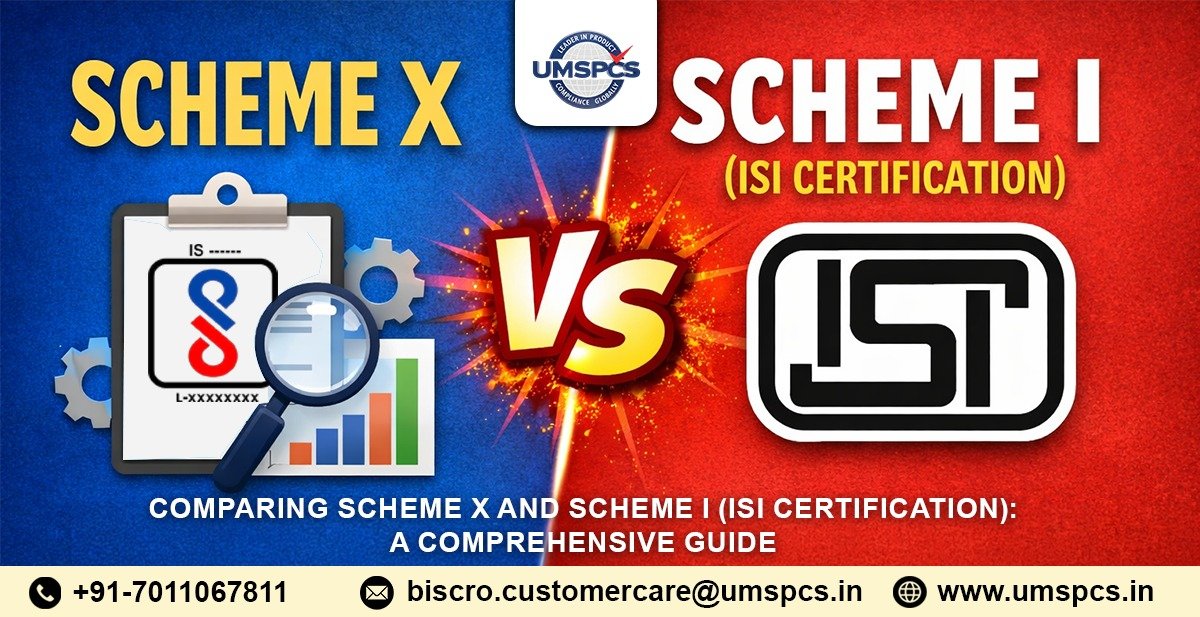
In India, product security, reliability, and conformity are not just beneficial to companies but are also required by the law. In order to make sure that all products arriving or existing in the market of India in accordance with the required Indian standards, the Bureau of Indian Standards (BIS) supervises several kinds of certification schemes. Scheme I, which is also referred to as ISI certification and more recently upgraded scheme X, represents both key elements of this structure. All manufacturers, sellers, or companies who want to acquire compliance and market access should know the difference, usages, and benefits associated with both approaches.
What Is Scheme I (ISI Certification)?
In line with scheme II of BIS conformity assessment regulations, scheme I serves as the BIS product certification scheme. The ISI mark certificate, a standard mark that ensures the product, which
Is in line with the essential Indian Standards and also commonly utilised in India for identifying it.
Key Features of ISI Certification (Scheme I)
Scope: This is composed of many different types of products, which include building necessities, consumer protection, materials for industries, electrical devices and safety gadgets.
Applicability: It is applicable for both domestic and foreign producers whose work is to ship products to India using the FMCS under the scheme I.
Process:
- Products undergo evaluation in labs approved by the BIS officials.
- Quality control is made possible through sample testing and factory inspection.
- After an effective evaluation, BIS provides a license to use the ISI mark.
Recognition: In India, the ISI mark is one of the most trusted and dependable symbols, which indicates the excellence quality and security standards using legal force under the Quality Control Orders (QCOs).
Benefits of ISI Certification
Consumer test
Indian consumers always look for the ISI mark as it is the oldest indicator for verifying the excellence of quality and safety.
Market access
Several categories of product demands for the ISI mark, whose absence can give rise to the prohibition of sale or import in India.
Brand Credibility
It assures the quality for both the local and global brands.
What Is Scheme X Certification?
More specifically, with the Omnibus Technical Regulation (OTR) structure along with a Quality Control Order, Scheme X serves as a BIS certification procedure built to accommodate specific danger, complication, or manufacturing product that can not fit easily under the traditional ISI product list.
Defining Features of Scheme X
Extended Strictness: In comparison to traditional Scheme I approvals, the compliance requirements—which include inspections, records, inspections, and quality security—are exceedingly strict.
Product Concentration: Focuses on industrial tools, transformers, pumps, powerful machinery, electrical equipment, management gears, and other items that are essential for secure operation.
Examination in Depth: Frequently calls for extensive technical dossiers, complicated inspections of factories, and complete factory assessments.
Required for Certain Categories: Scheme X imposes mandatory regulations for certain industrial product categories in updated Quality Control Orders.
Scheme X vs. Traditional ISI Certification
| Feature | Scheme I (ISI Certification) | Scheme X |
| Product Scope | Broad; consumer + industrial | High-risk industrial, electrical & machinery |
| Level of Rigour | Moderate | High |
| Audits & Testing | Standard factory inspections + sample testing | Deep documentation review + detailed audits |
| Cost & Duration | Generally lower and faster | Higher compliance costs, longer timelines |
| Market Focus | Domestic and global consumer products | Complex industrial, electrical and safety-critical goods |
| Recognition | Required across hundreds of product categories | Required as specified by QCOs |
Why manufacturers are concerned about the differentiation
The process requires much more than just confirming the correct box to achieve BIS compliance
- Complexion and rejection in compliance can arise from incorrect specifications
- Improves the costs as a result of unapproved inspections or revisions
- Product shipments are done at access points only.
- Fines, damage to brand image and legal consequences may arise.
How can UMSPCS help with your BIS certification journey
Both of the schemes I and Scheme X certification processes include essential technical and procedural steps which consists of the following:
- Making detailed paperwork of technicals.
- Scheduling the testing of products with BIS-approved labs only.
- Monitoring the compliance and factory inspections
- Handling the after certification services and ongoing tracking
- Validating successful and accurate document submission
Depending upon the application submission for the distribution of BIS certificates, UMSPCS provides end-to-end support.
In conclusion
Getting along with India’s BIS conformance, which calls for detailed differences between the Scheme I and Scheme X. Scheme X provides an extra degree for trusting these risky machines and essential industry equipment, whereas Scheme I get in line to function from a basic framework for safety and product quality within a comprehensive range.
Market plans, product type, and legal needs all have a selective role in the best course of action. You are allowed to go and enhance the Indian market to avoid costly delays and simplify your compliance journey through expert support, like UMSPCS.
Frequently Asked Questions (FAQs):
1. What is Scheme I (ISI Certification)?
Scheme I is a BIS programme that allows manufacturers to utilise the ISI mark after following the required Indian standards.
2. What is Scheme X?
Scheme X is a BIS certification scheme that is mainly for the high risks and industrial products that demand an in-depth technical evaluation.
3. What is the key difference between Scheme I and Scheme X?
Scheme I has a huge range of products by verifying the standard compliance, whereas Scheme X consists of solid inspections and paperwork for difficult industrial products.
4. Is Scheme X mandatory?
Yes. Scheme X is compulsory for products that come under the Quality Control Orders (QCOs).
8. How can UMSPCS help?
UMSPCS gives a complete guide on preparing documentation, testing, submission of application, and inspections, which help both scheme I and scheme X certification.
❓ Ask a Question
Have any doubts? Fill the form below and our team will respond shortly.