BIS Certificate of Conformity (COC) – Complete Compliance Guide for India
In India, the Bureau of Indian Standards (BIS) is the regulatory authority responsible for the standardization and certification of products. It operates under the BIS Act, 2016, which ensures that products entering the Indian market comply with the required Indian Standards.
BIS mandates conformity certification for a wide range of products, including electronic devices, IT equipment, appliances, safety devices, telecom products, and many others.
One of the key compliance mechanisms under BIS is the Certificate of Conformity (CoC).
Get Your Free Expert Consultation
What is a BIS Certificate of Conformity (COC)?
The Bureau of Indian Standards (BIS) is responsible for issuing the BIS Certificate of Conformity (CoC), which carries legal recognition and validates that products comply with the necessary Indian Standards and regulatory requirements. It serves as proof that the product has undergone testing, evaluation, and meets all required safety and performance standards.
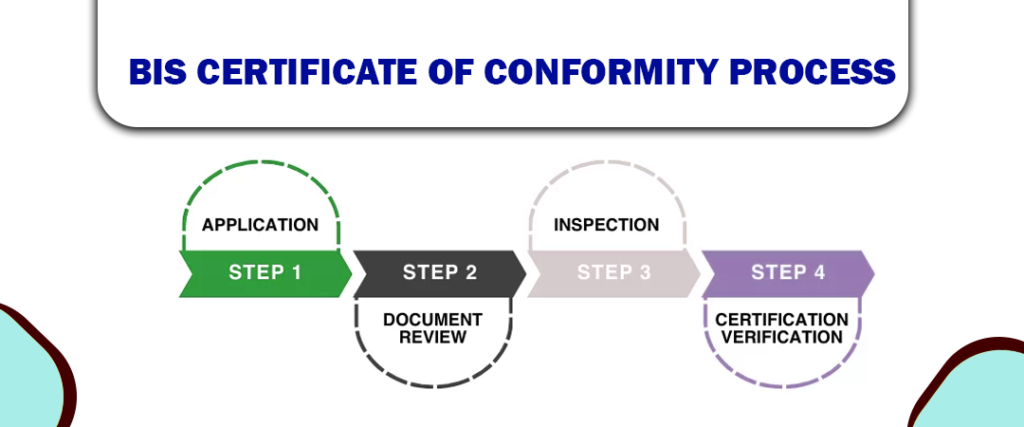
To ensure continuous quality control during manufacturing, a certificate is issued only after document verification, laboratory testing, and factory audits. Products that fall under mandatory certification cannot be legally manufactured, imported, sold, or distributed in India without BIS approval. Non-compliance can result in penalties and legal action.
The BIS CoC not only guarantees consumer safety and regulatory compliance but also facilitates safe market access, thereby enhancing a brand’s credibility and business reliability.
Types of BIS Certificate of Conformity
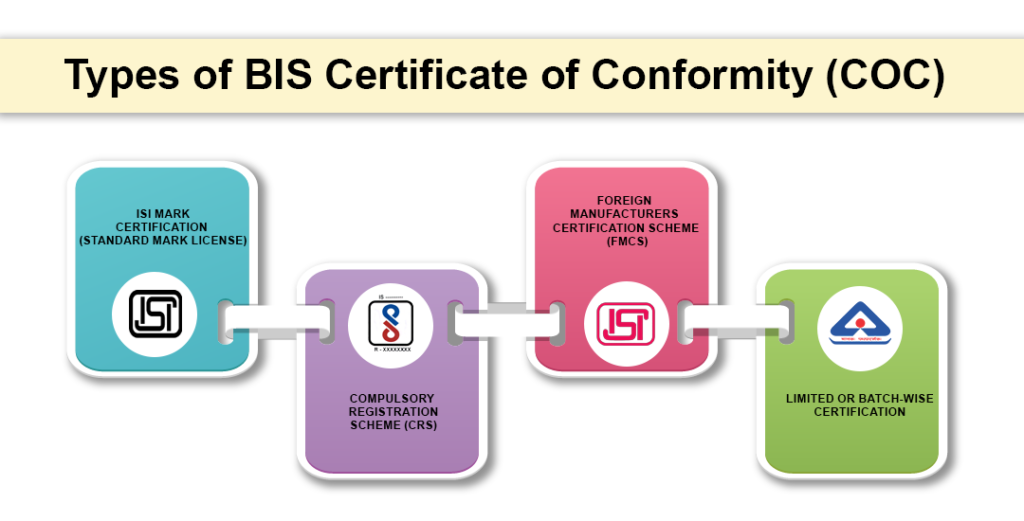
The Bureau of Indian Standards (BIS) operates multiple certification schemes, tailored according to the product category and the applicable regulatory framework.
1. ISI Mark Certification (Standard Mark License)
After the approval of your license, you can show the ISI mark on your products as a manufacturer.
This certification usually consists of the following:
● Electric wires and cables
● Cement
● LPG cylinder valves
● Pressure cookers
● Automotive components
● Industrial machinery
● Safety equipment
ISI Mark Certification process consists of product testing, factory audits, and continuous monitoring.
2. Compulsory Registration Scheme (CRS)
The BIS CRS programme products consist of electronics and IT devices. Manufacturers need to undergo testing in BIS approved labs only and do registration before offering for sale.
Usually, this consists of products that include the following:
● Mobile phones
● Laptops and tablets
● LED lamps and lighting products
● Microwave ovens
● Power banks
● Adapters and chargers
● Audio/video equipment
● UPS systems
Under the CRS Certification, the factory inspection doesn’t seem compulsory prior to the registration, whereas it is necessary to gain compliance acceptance.
3. Foreign Manufacturers Certification Scheme (FMCS)
In India, it is important to gain BIS certification for the foreign manufacturers through FMCS.
Primary Requirements include the following :
● Choose an Authorised Indian Representative (AIR)
● Factory inspection done by BIS officials only
● Testing of product samples
● Complete documentation compliance with accuracy
This programme makes sure that the products that are imported need to follow the required standards as Indian manufactured products do.
4. Limited or Batch-wise Certification
BIS might give approval to a few quantities or batch based certification based upon the product category and regulatory requirements.
Difference Between BIS COC and Other Certifications
Several businesses assume that only ISO or CE certification is sufficient for Indian compliance. However, the BIS Certificate of Conformity (COC) is distinct and is also mandatory wherever applicable.
| Criteria | BIS Certificate of Conformity | ISO / CE Certification |
|---|---|---|
Authority |
Government of India (BIS) |
Private or EU bodies |
Legal Requirement |
Mandatory for notified products |
Voluntary (in India) |
Product Testing |
Mandatory in approved labs |
Varies |
Factory Audit |
Required (in many schemes) |
Depends on the standard |
Market Access |
Required for the Indian market |
Required for EU or global markets |
Even if a product holds international certifications, the BIS COC is compulsory for regulated products in India
Products Covered Under BIS COC
| Category | Product Examples | Applicable Scheme (General) |
|---|---|---|
Electronics & IT Products |
Mobile phones, Laptops, Tablets, LED lights, Power banks, Adapters, UPS |
Compulsory Registration Scheme (CRS) |
Telecom Equipment |
Routers, Modems, GSM devices, IoT devices |
CRS / Specific QCO |
Electrical Appliances |
Electric fans, Irons, Rice cookers, Kettles, Switchgear |
ISI Mark / CRS |
Household & Consumer Goods |
Microwave ovens, Set-top boxes, Audio/Video equipment |
CRS |
Industrial Products |
Cement, Steel products, Electrical cables |
ISI Mark Scheme |
Safety Equipment |
Helmets, Gas cylinders, LPG valves, Pressure cookers |
ISI Mark Scheme |
Automotive Components |
Brake linings, Wheels, Auto lamps |
ISI Mark Scheme |
Toys & Children’s Products |
Electric toys, Non-electric toys |
ISI Mark Scheme |
Chemicals & Materials |
Certain polymers, Chemicals under QCO |
ISI Mark Scheme |
Construction Materials |
Pipes, Fittings, Building Materials |
ISI Mark Scheme |
Requirements for BIS Certificate of Conformity
Receiving a BIS Certificate of Conformity (COC) requires adherence to various compliance criteria, including technical, procedural, and regulatory conditions. These are governed by the Bureau of Indian Standards under the BIS Act, 2016, as well as relevant Quality Control Orders (QCOs). While the specific requirements may vary depending on the certification scheme (ISI, CRS, or FMCS), the fundamental framework remains consistent.
The following is a brief overview of the primary requirements for obtaining a BIS COC:
1. Applicability Confirmation
Finding which of the product is required to obtain required BIS certification is the very first and most critical requirement. This involves figuring out the right Indian Standard (IS number) and proving if the product is included by a Quality Control Order that was officially issued. Technical evaluation is necessary at this moment due to faulty product classification will often result in rejection or compliance violations.
2. Compliance with Relevant Indian Standard (IS)
The product has to strictly conform to the technical specifications stated in the appropriate Indian Standard. These guidelines respond with:
● Safety specifications
● Benchmarks for performance
● Specifications for construction and materials
● Limits that are mechanical or electrical (where applicable)
● Instructions for labelling and marking
Prior to testing, the product's requirements and design have to conform to the standard.
3. Product Testing in BIS-Recognized Laboratory
Testing is an essential requirement. For evaluation in line with the corresponding Indian Standard, samples of products are required to be delivered to a laboratory that has been approved or authorised by the BIS. Testing is carried out in the lab with regard to safety, performance, durability, and other established standards. Submission of an application calls for an accurate and acceptable test assessment report. Retesting may be necessary and necessary changes must be made if the product fails testing
4. Manufacturing Infrastructure & Quality Control System
BIS demands that the manufacturer uphold a sufficient quality control system in the factory for services like the Foreign Manufacturer Certification Scheme (FMCS) and ISI Mark.
The production plant needs to show:
● Procedures for inspecting raw materials
● Process-level quality control
● Capability to test the finished product
● Test devices that have been verified
● System for maintaining records
● Skilled technical employees
The factory need to be successful to effortlessly manufacture goods that adhere to the appropriate Indian Standard.
5. Factory Inspection (Where Applicable)
A factory inspection has been carried through by BIS officials in advance of certification in ISI and FMCS schemes.
Officers check during inspection to make sure:
● Method of production
● System for quality assurance
● Testing the availability of equipment
● Records of calibration
● Capability of sample testing
● conformity to the established requirements
Prior to licence approval, a successful inspection is required.
6. Authorised Indian Representative (For Foreign Manufacturers)
An Authorised Indian Representative (AIR) are required to be chosen by foreign producers who export regulated goods to India.
The AIR is in charge of:
● Submitting the BIS application
● Working together with BIS officials
● Supervising renewals and compliance
● Working as a legal representative in India
During the application process, the appropriate authorisation documents and agreements need to be provided.
7. Proper Documentation Submission
At the moment of application, reliable and thorough documentation must be provided. This includes the following
documents on company incorporation
● Details of manufacturing
● Technical details of the product
● Test results
● Artwork labelling
● Documents for quality control
One among the most serious explanations for delays is inadequate or incorrect documentation.
8. Marking and Labeling Compliance
Following BIS COC approval, the product has to include the licence or registration number and the appropriate standard mark (ISI mark or Registration mark). The marking's measurement, layout, and position need to all conform to BIS regulations. Penalties or a denial of certification might result from improper or unlawful use of the mark.
9. Fee Payment
The BIS-mandated application fee, testing fees, examination fee (if applicable), and yearly licence fee all have to be paid by those who apply. Without correct confirmation of fee payment, certification is impossible to complete.
10. Ongoing Compliance & Surveillance
Obtaining BIS certification is an ongoing procedure. Following certificate release, the manufacturer is required to continue following Indian Standards.
Documents Required for BIS Certificate of Conformity (COC)
1- Company Documents
| Document Type | Details |
|---|---|
Incorporation Certificate |
Proof of company registration |
GST Registration |
Valid GST certificate |
Address Proof |
Registered office address proof |
Authorization Letter |
Authorized signatory declaration |
2. Technical Documents
| Document Type | Details |
|---|---|
Product Specifications |
Technical details as per applicable IS standard |
Bill of Materials (BOM) |
List of components/raw materials used |
Circuit Diagrams |
Required for electrical/electronic products |
User Manual |
Product usage and safety instructions |
Product Photographs |
Clear images of product and packaging |
Label Artwork |
Marking design as per BIS guidelines |
3. Test Reports
| Requirement | Details |
|---|---|
BIS-Recognized Lab Report |
Valid test report confirming compliance with relevant Indian Standard |
4. Manufacturing Documents
| Document Type | Details |
|---|---|
Factory Layout |
Layout of production unit |
Production Process |
Step-by-step manufacturing flow |
Quality Control Procedures |
Internal QC system details |
Testing Equipment List |
Details of in-house testing instruments |
5. For Foreign Manufacturers
| Document Type | Details |
|---|---|
AIR Agreement |
Appointment of Authorized Indian Representative |
Power of Attorney |
Legal authorization document |
Manufacturer Authorization |
Declaration from manufacturing unit |
Timeline for BIS Certificate of Conformity (COC)
| Stage | Estimated Duration |
|---|---|
Documentation Preparation |
1–2 Weeks |
Product Testing |
2–6 Weeks |
BIS Evaluation |
2–4 Weeks |
Factory Inspection (If Required) |
1–3 Weeks |
Total Estimated Timeline |
6–12 Weeks (Average) |
Label Artwork |
Marking design as per BIS guidelines |
The timeline for obtaining the certificate may vary depending on the complexity of the product, the accuracy and completeness of documentation, and the availability of laboratory scheduling.
Common Challenges in BIS Certificate of Conformity (COC)
Obtaining a BIS Certificate of Conformity (COC) from the Bureau of Indian Standards is a structured process; however, many businesses encounter delays due to compliance gaps or procedural errors. Understanding these common challenges helps manufacturers and importers prepare effectively and avoid costly mistakes.
Incorrect product classification
Although finding a BIS Certificate of Conformity (COC) through the Bureau of Indian Standards appears to be a well-organised procedure, many businesses experience complications because of errors in procedure or defects in compliance. Manufacturers and importers may prepare more effectively and stay clear of expensive blunders by being aware of common obstacles.
Incomplete technical documentation
Among the most common problems is wrong product classification. An application may be rejected if an improper Indian Standard (IS) has been selected or if it is submitted through the inappropriate certification scheme. preparing for starting the process, a complete technical assessment of the product class is recommended.
Laboratory test failures
An additional significant obstacle is unfinished technical documentation. BIS queries are frequently brought about by inadequate product specifications, confusing circuit diagrams, erratic labelling artwork, or an incorrect Bill of Materials (BOM). Initial approval procedures can be severely delayed by even minor documentation oversights.
Factory audit issues
While production facilities fail to be adequately ready for inspection, factory audit problems may take place. Inspection results may be poorly affected by inadequately configured testing devices, inaccurate quality control documentation, or unqualified technical employees.
Labeling errors
Inaccuracies in labelling are frequently ignored. Responses throughout assessment as well as consequences after certification may result from improper use of the BIS mark, absence of required information, or failure to follow marking presentation standards.
Delayed responses to BIS queries
The authorisation periods are more prolonged by late answers to BIS enquiries. To avoid your request getting placed on hold, it is essential to communicate with BIS authorities in a manner that is prompt and precise. Due to the legal, technical, and procedural requirements involved in the BIS COC process, expert assistance is essential for minimising mistakes and unwarranted holdups.
How UMSPCS Helps with BIS Certificate of Conformity (COC)
The Bureau of Indian Standards holds the responsibility for issuing the BIS Certificate of Conformity (COC), which can appear complex due to paperwork, testing, and compliance requirements.
UMSPCS provides complete assistance for BIS certification, which includes the following:
- Correct product classification and IS standard identification
- Documentation preparation and verification
- Coordination with BIS-recognized labs for testing
- Factory audit preparation (for ISI & FMCS)
- CRS Registration and ISI Mark support
- Authorized Indian Representative (AIR) services for foreign manufacturers
- Labeling and marking compliance guidance
With expert support from UMSPCS, manufacturers and importers can avoid delays, reduce rejection risks, and obtain BIS approval smoothly and efficiently.
Regulatory Authority & Legal Framework
BIS COC operates under:
- BIS Act, 2016
- Indian Standards (IS)
- Quality Control Orders (QCOs)
- Government compliance notifications
The Bureau of Indian Standards holds the authority to suspend or cancel licenses, conduct inspections, and penalise non-compliant businesses.
With expert guidance from UMSPCS, manufacturers and importers can navigate the BIS certification process confidently, ensuring smooth market entry and long-term regulatory compliance in India.
FAQs – BIS Certificate of Conformity (COC)
BIS Certificate of Conformity (COC) is in charge of the Bureau of Indian Standards, which makes sure that the product aligns with the required Indian Standards (IS) and Quality Control Orders (QCOs)
UMSPCS gives complete guidance on this, which consists of the product identification, paperwork, coordination in lab testing, factory audit, AIR services, and approving compliance.
On average, 6-12 weeks, which is based upon the category of product and testing requirements.
Products that are listed under the QCOs are required to have the BIS COC, which includes electronics, IT products, electrical devices, security equipment, industrial products, toys and construction material.
COC are required by Indian manufacturers, foreign manufacturers, importers, and brand owners of the listed products.
The price depends on the category of products, lab testing fees, suitable scheme, and government charges
Legal compliance, easy market entry, builds trust among the owners and production