In today’s highly competitive market of international trade. Exporters have to perform more than just conveying high quality products. Foreign consumers expect security, alignment, and uniformity. ISO certification should be maintained in such case. ISO certification for exporters serves more than just a paperwork, it serves as a strategic tool which promotes the accession of global markets and facilitates the creation of ongoing business ties.
What Is ISO Certification?
International Standards make sure that products, services, and procedures provide safety, quality and reliability of the product, which is imposed by the International Organisation for Standardisation. Before accepting ISO certification for exporters, an independent assessment indicates that procedures of an organisation align with the standards and selected ISO standard.
ISO standards assist businesses in simplifying the process, enhancing product quality, minimising dangers, and follow the worldwide regulatory expectation. It offers easy market access into foreign markets and build trust among the international consumers.
Why ISO Certification Is Important for Exporters
1. Builds Global Credibility
Customers might fail to identify your company’s name as you ship your products. ISO certification is used as proof that the product is in line with the worldwide accepted norms. Consumers feel assured that the product you sell fulfils the international quality standards which promotes trust.
Before completing agreement, several big companies request or demand that the providers receive an ISO certification.
2. Ensures Compliance with International Regulations
Different countries have different regulations. Due to the ways they operate being planned, tracked, and continuously examined, ISO certified companies have greater ability to stick to the global regulation. This reduces the risk of delays, penalties, or package refusals.
3. Improves Product Quality and Consistency
Quality Assurance Systems are the primary focus of regulations like ISO 9001. Exporters will make sure a uniform level of quality, decrease the errors, and improve client satisfaction through putting such standards into effect.
Maintaining extended export deals that require consistent product quality.
4. Enhances Environmental and Social Responsibility
Consumers are getting more conscious globally about worker security and environmental responsibility.
Certifications including:
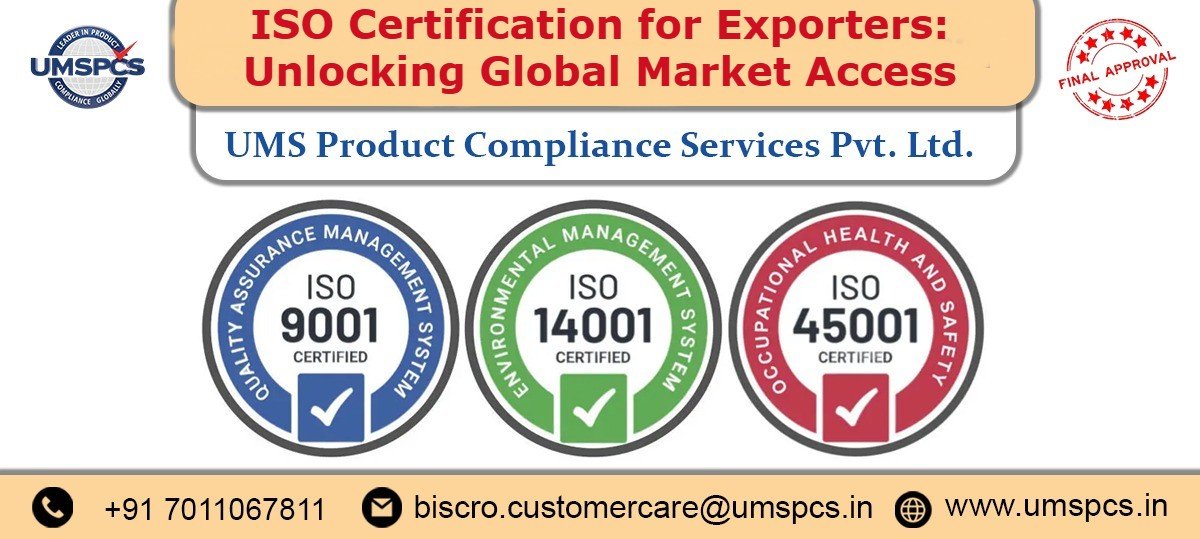
- ISO 14001 – Environmental management system.
- ISO 45001 – Security in the workplace and health.
Exporters are able to demonstrate a commitment to ethics and accountabilities by complying with ISO 45001, which has a important impact on the choices of foreign consumers.
5. Competitive Advantage in International Tenders
ISO certification is an essential requirement for several global purchasing agreements and government contracts. Exporters gets an edge over their competitors along with the access to increase.
Key ISO Certifications Relevant for Exporters
Exporters might require various ISO standards based on the country:
- ISO 9001- For global quality control.
- ISO 14001- For companies that are concerned about the environment.
- ISO 45001- For employee healthcare and security at work.
- ISO 22000- For exporting companies of food and drinks.
- ISO 27001- For safety of data and info.
The variety of products you are marketing, as well as the intended market of export, will influence what kind of certification is best for you.
Read also Blog: Integrated ISO Certification 9001, 14001 & 45001
How ISO Certification Supports Export Growth
✔ Strengthens Business Systems
Ongoing internal inspection, documentation and tracking are all being mandated by the ISO. The following improves production, reduces mistakes in operations, and improves internal effectiveness- all are essential for properly handling foreign purchases.
✔ Boosts Customer Confidence
Manufacturers with organised structure are often chosen by foreign buyers. They feel assured through the ISO certification that your processes are reliable and organised.
✔ Reduces Business Risks
There are several financial, legal, and transportation issues related to exporting. ISO system makes certain smooth operations through supporting for ensuring the detection of potential threats and the execution of measures to prevent them.
✔ Facilitates Long-Term Partnerships
Companies alongwith certification, are viewed as reliable and skilled. This promotes the establishment of long term relationships with importers, distributors, and foreign partners.
Steps to Obtain ISO Certification
Usually, the ISO certification consists of the following procedures:
- Gap analysis to rate the current system.
- Development of the required paperwork.
- Placing the management structure into effect.
- Improvement and internal review.
- Review of certification by an accredited company.
- Distribution of certification.
- Ongoing inspection of monitoring.
The process might seem difficult, but it is much easier alongwith an appropriate pathway.
How UMSPCS Can Help Exporters
UMSPCS, provides expert guidance regarding ISO certification for exporters, from execution to paperwork.
UMSPCS assists businesses as follows:
- Understand the necessary ISO standard.
- Set up the paperwork structure to ensure compliance.
- Conduct an internal review.
- Perform inspection for certification.
- Make sure of quick and easy compliance.
UMSPCS assists exporters reach compliance in an efficient and affordable way. Companies that are planning to grow globally might wanyt to find more about their company at before starting their ISO certification process with satisfaction.
In Conclusion:
Exporters who are seeking to accomplish profitable global growth are now required to get ISO certification. It boosts efficiency in operation, promises compliance, builds credibility, and gives easy access to the global market.
ISO certification emerges as an essential asset in an international market, in which success can be measured through trust and quality. Putting efforts in ISO certification is a smart and logical move for exporters who are aiming to improve their brand’s reputation and stand out globally.
Receiving ISO certification is a systematic and manageable process using an appropriate execution partner, like UMSPCS, that allows exporters to gain actual access to the global market and a prosperous business.
Frequently Asked Questions:
- Q. What is the ISO certification for exporters?
A- ISO certification is a globally known permit which is in charge of the International Organisation for Standarisation which checks if a company is in line with international standards for quality, safety, and efficiency. For exporters, it supports in building trust among foreign consumers.
- Q. Is the ISO certification is compulsory for export business?
A- ISO certification is not a law mandate for all exporters. As several of international consumers, government tenders, and foreign markets need ISO certified suppliers, which makes it more beneficial for the growth of exporters.
- Q. How can ISO certification assist in access of global market?
A- ISO certification boosts credibility, which make sure compliance gets in line with global regulations, minimises shipment danger, and accelerates approval among foreign consumers which assists exporters to enter into fresh market more easily.
- Q. Is it necessary for small exporters to apply for the ISO certification?
A- Yes. small or moderate exporters can easily apply for the ISO certification. Several of MSMEs receive ISO certification to stand out in the global market and boost the efficioency of operation.
- Q. Who among all can assist with the ISO certification for exporters?
A- UMSPCS, being a professional, skilled consultant who supports exporters by documentation, execution, internal inspection, and certification procedure, making the compliance journey smooth and effective.
❓ Ask a Question
Have any doubts? Fill the form below and our team will respond shortly.