In the scenery of food safety and public health, where some of the categories carry as much gravity as infant nutrition. Infant milk substitutes act as the key and are often seen as a sole source of sustenance at the most essential window of human development for infants who are not breastfed or asking for nutritional supplementation. The margin for issues in manufacturing is zero because infants have immune systems which are not mature and have high nutritional demands for their body weight.
As per this, the government of India, through the Bureau of Indian Standards (BIS) has categorised infant milk which comes under mandatory certification. The governing standard, which is IS 14433, confirms that each tin or packet of infant formula sold in India gets aligned with solid quality, safety, and nutritional benchmarks. Getting the ISI Mark is not only a marketing advantage, but it is a solid legal necessity to get market access for manufacturers and importers.
What is BIS ISI Certification for Infant Milk Substitutes (IS 14433)?
BIS ISI Certification for Infant Milk Substitutes IS 14433 is the Indian Standard which prescribes the demands, methods of sampling, and rigorous testing protocols for infant milk substitutes. The standard was made to guarantee that such products are formed to assist optimal growth through mimicking the nutritional profile of breast milk as closely as possible while handling absolute chemical and microbiological purity.
The standard certainly categorises such products into two types, which are as follows:
- Type I: Infant Milk Food – Products rely on milk of cow or buffalo or a mixture thereof, and other nutrients.
- Type II: Infant Formula – Products depend on milk of cow or buffalo or a mixture thereof, or other nutrients including hydrolysed proteins (cow, goat, or soy-based).
The 2022 version is a revision of IS 14433 with more accurate guidelines to get in line with global safety standards, which confirms that the Indian market is at the forefront of food safety for children.
The Paramount Importance of ISI Certification for Infant Milk Substitutes
The compulsory part of the ISI Mark for infant milk substitutes acts as an essential part because of the following:
Public Health Protection: Their aim is to avoid malnutrition and foodborne diseases in infants. The government confirms that products provide essential caloric density and micronutrients through imposing standards.
Legal Compliance: in accordance with the IMS Act (Infant Milk Substitutes, Feeding Bottles and Infant Foods Act) and the BIS Act which is a criminal offence to manufacture, stock, or sell infant milk substitutes without having the ISI mark.
Consumer Confidence: The ISI logo is one among the most recognised signs for quality in India. It works as a “hallmark of trust,” which indicates that the product has gone through third-party verification for a parent.
Standardisation of Quality: Certification confirms that regardless of whether a product is made in Bangalore or imported from abroad, it should get the exact same safety threshold which make a level playing field for the industry.
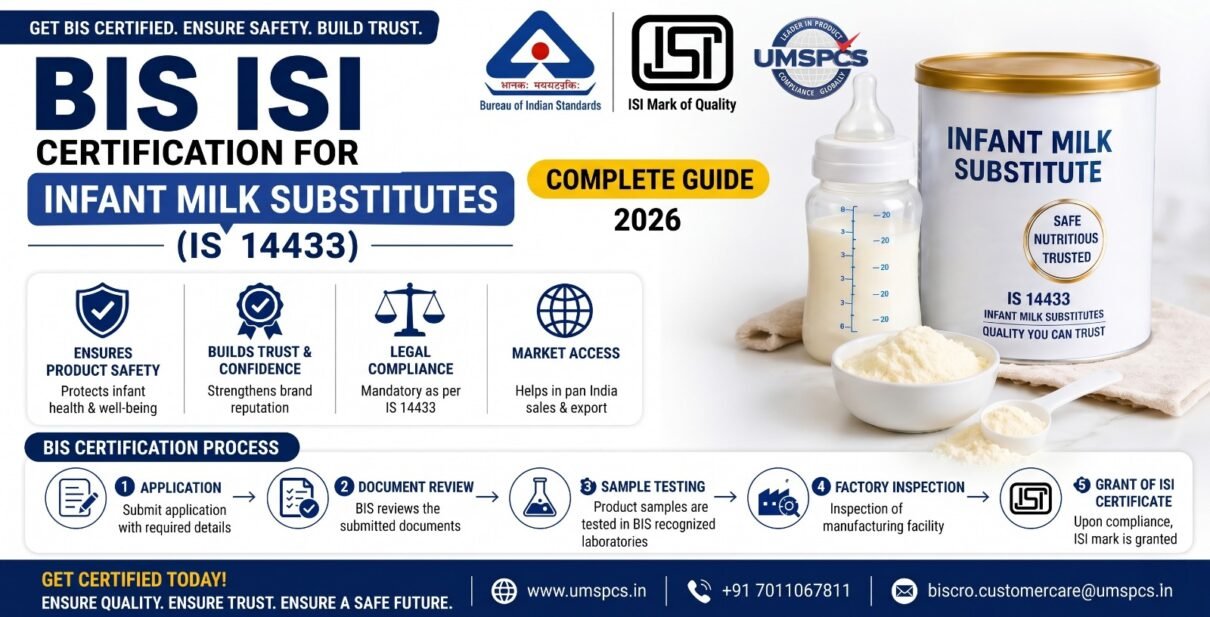
The Bis ISI Certification Procedure: A Step-by-Step Roadmap
The BIS Certification procedure gets aligned with a structured and systematic approach. In 2026, the whole process is highly digitised by the Manak Online portal, which confirms clarity, quick processing, and better tracking for applicants.
1. Identify the Applicable Standard
The initial step is to give surety that your product comes under the appropriate Indian Standard like IS 14433. This confirms that the products gets aligned with the required quality, safety, and performance benchmarks.
2. Application Submission
Manufacturers should upload a formal application (Form V) by the Manak Online portal in line with the prescribed charges. The application consists of detailed information about the following:
- Manufacturing unit
- Production process
- Management structure
- Technical and quality control staff
3. Factory Inspection
BIS hired an official to examine the manufacturing facility after the applications are inspected. The officers inspects during this visit which is as follows:
- Production process and infrastructure
- Hygiene and working conditions
- Quality control measures
- Competence of technical staff
4. Product Sampling & Independent Testing
Random product samples are collected directly from the production line during the inspection. Such samples are sealed and delivered to a lab approved by BIS for detailed testing as per the parameters specified in IS 14433.
5. Review of Test Reports
The lab uploads the report outcome to the BIS regional office once tested. The application goes to the next stage when products gets every certain safety, quality, and performance standards
6. Grant of License
BIS grants the certification license after getting successfully verified by inspection and test outcomes. This enables the manufacturers to show the ISI mark on the product in line with the separate license number (CM/L) which confirms compliance in line with Indian standards.
Rigorous Technical Requirements
Obtaining certification under IS 14433, where the product should get align with a difficult matrix of demands, which are as follows:
1. Nutritional Composition
The standard is compulsory for accurate ranges of macro and micronutrients. This consists of minimum and maximum levels of proteins, carbohydrates, and fats. It also asks for certain fortification of vitamins (A, D, E, K and B complex) and minerals (Calcium, Sodium, Potassium, and Iron) to confirm the infant gets a balanced diet.
2. Microbiological Safety
The microbiological standards are remarkably strict. The product should be completely free from pathogens like salmonella, Escherichia coli, and Listeria. Total bacterial count are also capped in low levels for microbiological safety.
3. Physical and Chemical Purity
Manufacturers should confirm that the product is free from scorched particles, excessive moisture and harmful contaminants such as heavy metals like lead, arsenic, or pesticide residues.
Documentation Checklist ISI Certification for Infant Milk Substitutes
A successful application depends on meticulous paperwork. Manufacturers are ask to give the following:
Proof of Business: Factory license, GST registration, and incorporation certificate
Plant Layout: Detailed map of the manufacturing unit
Process Flowchart: complete production process (raw material to final product)
List of Machinery: Details of every manufacturing equipment
Testing Equipment: In-house lab instruments with valid calibration certificates
Technical Staff Info: Qualifications of chemists, microbiologists, and the QC team
BIS ISI Certification for Infant Milk Substitutes for Navigating the Landscape with UMSPCS
The pathway of regulatory compliance in the dairy and infant nutrition area is often full of technical difficulties and complex paperwork. This is where professional expertise steps in.
UMSPCS is a top tier technical consultancy located in Noida which is certainly formed to bridge the gap in between complex Bureau of Indian Standards (BIS) regulations and your business objectives. UMSPCS provides complete surety for local and foreign manufacturers who want to get into the Indian market as a dedicated consultant for BIS ISI certification.
Their workforce of experts specialises in the following:
- Gap Analysis: find out what your facility demands to meet IS 14433 standards prior to the official audit.
- End-to-End Application Management: managing the documents and portal submissions to confirm a seamless procedure.
- Laboratory Setup Guidance: assisting manufacturers to get the necessary in-house testing infrastructure asked by BIS.
By working together in accordance with experts who know refinement of Indian regulatory standards where businesses can prevent from the common drawbacks of application denials and project postponements. You can explore their full range of Bis consultancy services at UMSPCS.
Conclusion
In India, BIS ISI Certification for infant milk substitutes under IS 14433 is not just a regulatory difficulty but an essential pillar of child safety. Such measures confirm that the most vulnerable members of society are safeguarded from substandard nutrition, while the demands are comprehensive and the procedure is rigid.
Getting this certification is a statement of quality and a commitment to excellence for manufacturers. By getting aligned with such standards and utilising the appropriate technical assistance where companies can contribute to a safer, healthier future for upcoming generations while getting their place in a growing and vital market. In a world of infant nutrition, where quality is not just an option but it is mandatory.
Read more also: BIS Certificate for Foreign Manufacturers
Frequently Asked Questions (FAQs)
- Is BIS ISI Certification mandatory for infant milk substitutes in India?
Yes, BIS ISI Certification under IS 14433 is compulsory for infant milk substitutes in India. Manufacturers and importers are not able to legally sell such products without the ISI mark in accordance with government regulations.
- What is IS 14433 in BIS certification?
IS 14433 is the Indian Standard which specifies the quality, safety, nutritional composition, and testing requirements for infant milk substitutes to confirm safe consumption for infants.
- How long does it take to get BIS ISI Certification for infant milk?
The certification process usually requires 4 to 6 months which is based on documentation accuracy, product testing results, and factory inspection clearance.
- What documents are required for BIS certification under IS 14433?
Required documents consist of a factory license, GST registration, plant layout, process flowchart, machinery details, testing equipment list, and qualifications of technical staff.
- What are the main tests conducted under IS 14433?
Products are tested for nutritional composition, microbiological safety, and chemical purity, which consist of checks for harmful bacteria, heavy metals, and proper nutrient levels.
- Can foreign manufacturers apply for BIS certification for infant formula?
Yes, foreign manufacturers can get the BIS Certification through the FMCS (Foreign Manufacturers Certification Scheme) to get the BIS certification and sell infant milk substitutes in India.
- What happens if a company sells infant milk without BIS certification?
Selling infant milk substitutes without having the BIS certification is a legal offense and can result in penalties, product seizure, or business shutdown under the BIS Act and IMS Act.
- How can a BIS consultant help in IS 14433 certification?
A professional consultant like UMSPCS assists in line with documentation, application filing, lab setup guidance, and compliance support to give surety to faster approval and avoid rejection.
❓ Ask a Question
Have any doubts? Fill the form below and our team will respond shortly.