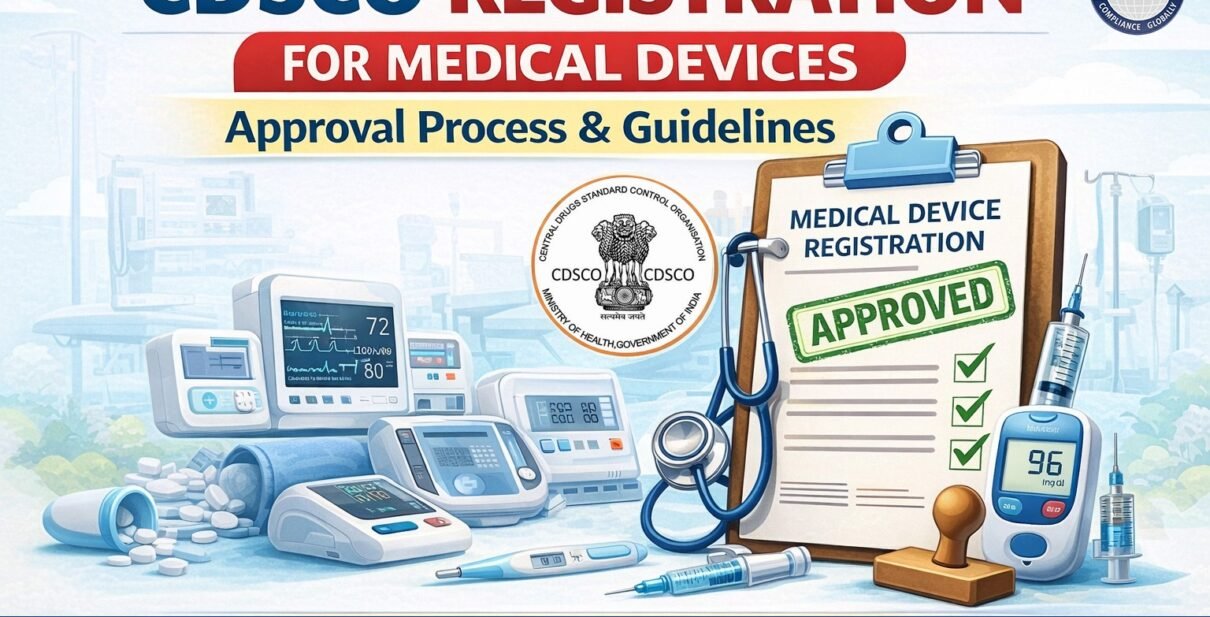
The medical device industry is growing excessively which is driven through the boost in demand of healthcare, technological advancements, and government regulations. Every medical device should get aligned with regulations which have been imposed by the Central Drugs Standards Control Organisation (CDSCO) to confirm safety, quality, and effectiveness.
Knowing about CDSCO registration is necessary to function lawfully in India regardless of whether you are a manufacturer, importer, or distributor. In this blog, we will demonstrate the procedure of approval, guidelines, and primary requirements in a simple and easy manner.
What is CDSCO Registration for Medical Device?
CDSCO registration for Medical Device is a compulsory permit which is in demand for the medical devices prior to manufacturing, importing, or selling products in India. CDSCO functions under the Ministry of Health and Family Welfare and manages medical devices under the Drugs and Cosmetics Act, 1940 and Medical Devices Rules, 2017.
Medical devices consisting of instruments, appliances, implants, or software which are employed for diagnosis, prevention, monitoring, or treatment of diseases.
Without having the CDSCO approval you need to get the followings:
- You cannot legally sell or import devices
- Your products may be seized at customs
- You may face legal penalties or bans
Classification of Medical Devices
CDSCO specifies medical devices depending on the risk level which can get decides the approval procedure:
- Class A (Low Risk) – Surgical dressings, thermometers
- Class B (Low-Moderate Risk) – Infusion pumps, catheters
- Class C (Moderate-High Risk) – Ventilators
- Class D (High Risk) – Implantable devices, life-support systems
Higher risk devices demand solid evaluation and paperwork.
CDSCO Registration vs Licensing
Medical devices get voluntarily registered according to the upgraded regulations which are as follows:
- Mandatory licensing is now required for most medical devices
- Applies to Class A, B, C, and D devices
- The process is completed through the CDSCO Sugam Portal
This shift confirms solid compliance and better patient safety.
CDSCO Approval Process for Medical Devices
The CDSCO registration procedure goes with a structured complete approach which are as follows:
1. Device Classification
Find out the risk category like class A to D which determines the followings:
- Type of license required
- Regulatory pathway
- Documentation level
2. Appoint Authorized Agent (For Importers)
Foreign manufacturer should hire an Indian Authorised Agent (IAA) who will do the followings:
- Submit applications
- Communicate with CDSCO
- Ensure compliance
3. Prepare Documentation
A complete technical dossier is needed which consists of the followings:
- Device Master File (DMF)
- Plant Master File (PMF)
- ISO 13485 Certificate
- Free Sale Certificate (FSC)
- Clinical evaluation reports
- Labeling and packaging details
4. Application Submission
Application are uploaded online through the SUGAM portal by using various forms which are given as follows:
- MD-14 – Import License
- MD-7 / MD-8 – Manufacturing License
- MD-12 / MD-16 – Test License
5. Review & Query Handling
CDSCO evaluates the application as follows:
- Raises queries if documents are incomplete
- Applicant must respond within the timeline
- Additional testing or evaluation may be required
6. Inspection & Audit
For specific device classes which are as follows:
- Manufacturing site inspection is conducted
- Quality Management System (QMS) is evaluated
- Compliance with ISO standards is verified
7. Grant of License
After every requirements are fulfilled which are as follows:
- CDSCO issues the license
- The product can be legally manufactured or imported
The whole procedure usually requires 6-9 months or more which is based upon device difficulty.
Key Guidelines for CDSCO Registration
To confirm seamless approvals, we have to follow essential guidelines of CDSCO which are as follows:
1. Compliance with Medical Device Rules, 2017
Every device should get aligned with safety, performance, and quality standards which are specified under such rules.
2. Use of Sugam Portal
Every application should upload digitally through the official portal for transparency and tracking.
3. Quality Standards (ISO 13485)
Manufacturers should implement a Quality Management System which is align with the ISO standards.
4. Labeling Requirements
Labels should consist of the followings:
- Manufacturer details
- Batch number
- Expiry date
- Usage instructions
5. Post-Market Surveillance
Even after approval, you have to get the followings:
- Adverse events must be reported
- Product recalls must be managed
- Compliance must be maintained
Documents Required for CDSCO Registration
Required documents for CDSCO registration consists of the followings:
- Covering letter
- Power of Attorney (for importers)
- ISO 13485 Certificate
- Free Sale Certificate
- Device Master File
- Plant Master File
- Clinical data (if applicable)
- Test reports
- Declaration of conformity
Accurate paperwork is essential to prevent postpones or denials.
Common Challenges in CDSCO Approval
Businesses usually face difficulties like the followings:
- Incorrect device classification
- Incomplete documentation
- Delay in query response
- Lack of regulatory knowledge
Such difficulties can usually slow down the approval time.
How UMSPCS Helps in CDSCO Registration
Tracking CDSCO regulation might seem difficult for new manufacturers or importers. This is why expert consultants like UMSPCS have an essential role.
UMSPCS gives complete assistance which consists of the followings:
- Device classification guidance
- Documentation preparation
- Application filing on Sugam portal
- Query handling and follow-ups
- Compliance management
In accordance with 600+ successful projects and strong industry expertise where UMSPCS gives surety to a seamless, quick, and reliable registration procedure. Their workforce has updated the upgraded CDSCO guidelines, to assist businesses prevent expensive error and postpones.
Why CDSCO Registration is Important
CDSCO registration is not only a legal demand, but it boosts trust and credibility among the market.
Key Benefits:
- Ensures product safety and quality
- Builds brand reputation
- Enables smooth market entry
- Reduces regulatory risks
- Improves customer confidence
It also gets aligned with Indian medical devices in line with the foreign regulatory standards.
Read more also: BIS Certification Consultant in Noida Sector 1 to 66 – ISI, CRS & FMCS
Conclusion
CRSCO registration for medical devices is an essential step for every business which is getting into the Indian healthcare market. In accordance with rigid regulations and documentation demands, by getting known about the approval procedure which is necessary for seamless compliance.
Each step should get carefully handled from classification and documentation to permit and after market surveillance. Working together with experienced consultants like UMSPCS will make the procedure faster, simpler and more efficient.
Confirming complete compliance in accordance with the CDSCO guidelines when you want to manufacture or import medical devices in India to prevent postpones and confirms successful market access.
Read more also: BIS Certificate in Gurgaon
FAQs
1. Is CDSCO registration mandatory for all medical devices?
Yes. Most medical devices in India demand CDSCO licensing which depends on their risk classification.
2. How long does CDSCO approval take?
On average, CDSC approval usually requires device category and paperwork.
3. Can foreign companies apply directly?
No. They should appoint an Indian Authorised Agent for foreign companies to apply.
4. What is the validity of the CDSCO license?
Licenses are usually valid for a longer term but it demands ongoing compliance.
5. What happens if a device is sold without CDSCO approval?
Penalties, product ban, or lawsuits can be happened when you sale without having the CDSCO approval
- What is the CDSCO Sugam Portal?
The CDSCO Sugam Portal is an online platform used for submitting applications, tracking approvals, and managing medical device registrations in India.
- Is ISO 13485 certification mandatory for CDSCO registration?
Yes, ISO 13485 certification is generally required as it ensures that the manufacturer follows a proper Quality Management System for medical devices.
- Can CDSCO registration be rejected?
Yes, applications can be rejected due to incorrect classification, incomplete documentation, or failure to meet regulatory requirements. Proper guidance helps avoid rejection.
9. What is the CDSCO Sugam Portal?
The CDSCO Sugam Portal is an online platform used for submitting applications, tracking approvals, and managing medical device registrations in India.
10. Is ISO 13485 certification mandatory for CDSCO registration?
Yes, ISO 13485 certification is generally required as it ensures that the manufacturer follows a proper Quality Management System for medical devices.
11. Can CDSCO registration be rejected?
Yes, applications can be rejected due to incorrect classification, incomplete documentation, or failure to meet regulatory requirements. Proper guidance helps avoid rejection.
❓ Ask a Question
Have any doubts? Fill the form below and our team will respond shortly.