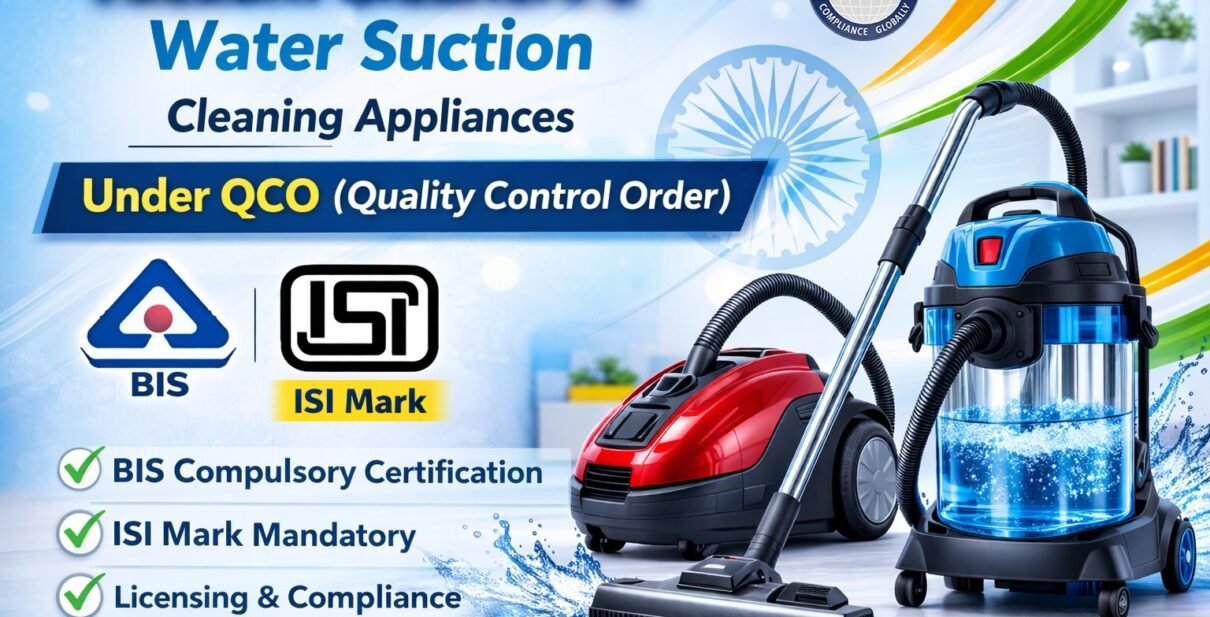
Vacuum cleaners and water suction cleaning devices serve as essential cleaning tools that find applications in residences, workplaces, restaurants, hospitals, and manufacturing facilities. These devices do an excellent job of getting rid of dirt, trash, and liquid waste, which helps keep things clean and healthy. prior to offering them to India, you have to ensure that sure the devices are safe and conform to Indian standards. This is because they use electric motors and internal wiring systems.
The Bureau of Indian Standards (BIS) holds the charge of maintaining safety and quality rules in India. Before these products can be sold, manufacturers and importers have to comply with the Indian Standard that applies and get the right certification.
Applicable ISI Standard for Vacuum Cleaners
Most of the time, vacuum cleaners and other electrical cleaning tools are addressed by:
IS 302 (Part 1): Safety of Household and Similar Electrical Appliances
The following safety requirements are described in this standard:
- Defense regarding electric shock
- Strength in mechanics
- Limits on heating
- Fire risks
- Resistance to insulation
- Current leakage
Vacuum cleaners that stick to IS 302 (Part 1) have been proven that they will fulfill critical safety standards and be suitable for usage in homes and businesses.
Quality Control Order (QCO) and Mandatory Compliance
A Bis Quality Control Order (QCO) is given out through the Indian government to require certification for particular products. A product isn’t possible to marketed, shipped, or expo, rted in India after it was officially declared over a QCO as long as it complies with the applicable Indian Standard and obtains certification.
- Certification under IS 302 (Part 1) is now required for vacuum cleaners and water suction cleaning equipment accepted by the relevant QCO.
- The product has to support the ISI mark.
- Before entering the market, manufacturers has to get approval.
The last day to submit for the notified product is March 19. It is illegal for importing or sell unauthorized or non-compliant goods through India after this date.
If the QCO is not followed, there could be:
- Financial fines
- Seizure of a product
- Rejection of customs clearance
- Legal action
Certification Process Overview
Manufacturers have to stick to the BIS product certification procedure in order to conform to the standards of the QCO and the Indian Standard.
The standard procedures consist of:
- Application acceptance to BIS
- Examining technical documentation
- Product sample testing in labs accredited by BIS
- Examination of production sites
- Permission to utilise the ISI mark
The ISI mark certificate, which denotes compliance with Indian safety regulations, can be applied by the manufacturer after approval.
Compliance for Foreign Manufacturers
With the goal to sell vacuum cleaners to India, foreign manufacturers have to be certified by the Foreign Manufacturers Certification Scheme. During the following steps:
- The foreign manufacturing plant is examined
- Product samples undergo testing in accordance with Indian Standards.
- After successful compliance, approval is awarded.
- Products covered by the QCO are unable to pass Indian customs without certification.
When Is Additional Regulatory Approval Required?
Vacuum cleaners are usually only subject to BIS regulations. Nevertheless, if the suction instrument belongs to a medical equipment and is designed to be legally utilised in a hospital and medical facility, it might require authorisation from the central drugs standard control organisation. Medical level vacuum devices also have to comply with medical standards and also to the electrical safety rules.
Documents Required for Certification
In general, manufacturers suffer to offer a number of things:
- Papers that are associated by establishing a business.
- Confirmation of location and manufacturing facility.
- Information regarding how the product is constructed.
- Procedure for verifying the quality.
- Information regarding the testing facilities throughout.
- Details about products being tested in BIS approved labs.
It is extremely significant to be equipped with correct and current documents, particularly because the deadline is getting closer on March 19, 2016.
Benefits of Certification
There are various benefits to becoming certified according to the appropriate Indian Standard.
Various advantages of getting certification in line with the appropriate Indian Standards are as follows:
- Legal permit to sell products in the market
- In accordance with the QCO regulations
- Boosting consumer confidence
- Enhance brand credibility
- Prevent dangers associated with regulations
- Improve the institutional markets
Certified products indicate confirmation with imposed standards of quality and security.
How UMSPCS Can Assist
For producers and importers of vacuum cleaners and water suction cleaning equipment, UMSPCS gives comprehensive bis consulting and compliance support. Among the services they offer are help with:
UMSPCS helps with the following:
- Testing of products in BIS-approved labs only.
- Preparing complete paperwork
- Submission of the application online through the BIS portal
- Preparing for factory audits
- Coordinating with BIS and handling the query
- Support in the approval of the license
- Support in renewal, amendment, and monitoring
UMSPCS works with Indian manufacturers, importers, and foreign manufacturers, ensuring faster approvals and zero compliance risks. Get early certification and expert advice as the QCO’s deadline is on March 19 2026.
Conclusion
In accordance with the Quality Control Order imposed in India, vacuum cleaners and water suction cleaning appliances must comply with the IS 302 (part-1). It is not legal to manufacture\, sell. Or bring uncertified products after the deadline which is on March 19 2026.
By getting compliance on time it boosts consumer confidence, regulatory safety, and ongoing market access. Manufacturers and importers are allowed to get a smooth compliance in Indian market by selecting appropriate certification procedures with experienced consultants like UMSPCS before the effective date.
Frequently Asked Questions (FAQs)
- Which standard applies to vacuum cleaners in India?
Usually it comes under IS 301 (part-1): safety of household and similar electrical appliances.
- Is certification mandatory?
Yes, it is listed under a Quality Control Order (QCO). The Bureau of Indian Standards provides certification which is essential.
- What is the compliance deadline?
The stated product’s deadline is on 19 March 2026.
- What happens after 19 March if not certified?
Uncertified products are not allowed to be manufactured, imported, or distributed in the Indian market. It can result in penalties and product seizure.
- Do foreign manufacturers need approval?
Yes. Foreign manufacturers need to receive certification prior to exporting to India.
❓ Ask a Question
Have any doubts? Fill the form below and our team will respond shortly.