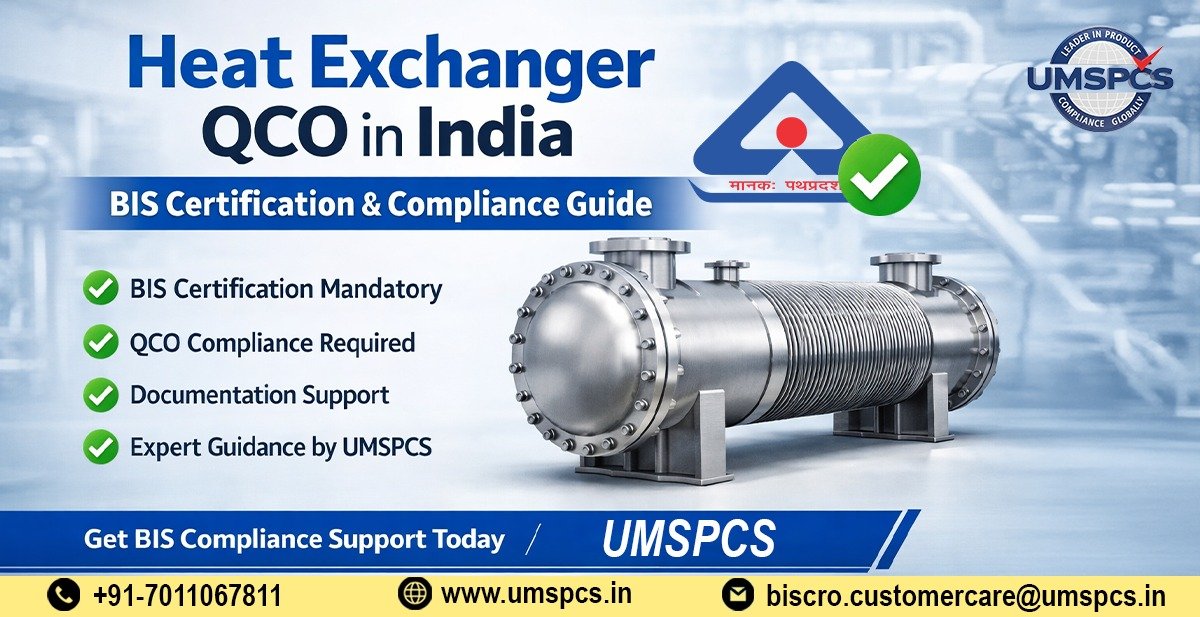
In several commercial and industrial applications, heat exchangers are essential components. Heat exchangers promote effective transfer of heat from a certain medium to another in many different kinds of settings, including power plants, refineries, HVAC systems, chemical industries, and food processing facilities. Quality and safety serve as vital due to these kinds of items work in environments with extreme pressures and temperatures. The Indian government issues Quality Control Orders (QCOs) for regulated products, which include heat exchangers, with the goal of verifying this.
This blog addresses Heat Exchanger QCO, how important it is, the effect it has on importers and manufacturers, and how business owners can effortlessly comply with regulations with the support of experienced compliance consultants like UMSPCS. It is the best consultant for Heat Exchanger QCO in India.
What Is a Heat Exchanger?
A piece of machinery designated as a heat exchanger is constructed for transmitting heat between multiple fluids by not permitting them mix together. Such fluids might be gases, liquids, or a mixture of both. Heat exchangers serve in manufacturing processes to obtain wasted electricity, increase energy efficiency, and heat or cool fluids.
Some common heat exchanger types include:
- Heat exchangers with both the tube and the shell
- Heat exchangers with plates
- Heat exchangers that use air cooling
- Heat exchangers that rotate
Maintaining ongoing quality standards becomes essential with regard to their essential usage and safety consequences.
Understanding Heat Exchanger QCO
The Indian government provides Quality Control Orders (QCOs) in line with the Bureau of Indian Standards (BIS) framework. before a product is permitted to be made, shipped, traded, or distributed in India, a QCO demands that it meet specific Indian Standards.
- When a Heat Exchanger QCO is received:
- Products need to satisfy applicable Indian Standards (IS)
- BIS certification is needed for importers and manufacturers.
- It is prohibited for non-certified products to make it into the Indian market.
Businesses that do not comply may face legal action from authorities.
Ensuring product safety, performance, durability, and consumer protection is a QCO’s primary goal.
Why Is Heat Exchanger QCO Important?
Boilers, pressure systems, and manufacturing facilities constitute some of the most important environments in which heat exchangers are often used. Bad heat exchangers can cause:
- Equipment failure and leakage
- Inefficiency and energy loss
- Accidents and safety risks
- expensive maintenance and leisure time
- Penalties enforced by law for noncompliance
The government guarantees that only reliable, certified, and tested heat exchangers can be sold in the Indian market through the use of a QCO. This raises the overall quality of the product while protects industries, employees, and end users.
Who Must Comply With Heat Exchanger QCO?
The following are covered by the Heat Exchanger QCO:
- Indian producers of heat exchangers
- Heat exchangers are exported to India by foreign manufacturers.
- Traders and importers of regulated heat exchangers
Before supplying products, both domestic and foreign manufacturers have to conform to BIS guidelines, carry out testing in authorized laboratories, and receive the appropriate certification.
BIS Certification Requirements for Heat Exchangers
BIS certification under a QCO is consists of:
- Finding the correct Indian Standards
- Product testing in labs which is only approved by BIS
- Quality audit and factory inspection
- Submission of test reports and technical documents
- ISI marking and BIS license issuance
Without professional assistance, the process may appear challenging and lengthy, especially for those applicants who are submitting applications for the first time.
Difficulties Faced by the Manufacturers
Finding out whether the products came under the mandatory categories
- Deciding which BIS scheme is correct
- Coordinating with testing and factory inspections
- Preparing correct technical documentation
- Tracking and following-up communications with BIS
These challenges are magnified for foreign manufacturers who may have little experience with Indian regulatory frameworks.
How UMS Product Compliance Services Helps You
If your business is getting tracked by product compliance in India, UMS Product Compliance Services (UMSPCS) – Trusted BIS Certification Consultants in India gives expert support from start to finish. UMSPCS is a full-service regulatory consultancy that helps in manufacturers and brands get BIS Certification—and other regulatory approvals—without stress or delays.
What UMSPCS Offers
UMSPCS simplifies the whole BIS Certification journey by complete guidance from product evaluation to license permit.
UMSPCS Services Include:
- BIS testing coordination with the approved labs
- Complete documentation preparation
- BIS portal filing and application management
- Factory inspection preparation & support
- Query handling and follow-ups with BIS
- License grant assistance
- Renewal, amendment & surveillance support
UMSPCS works with Indian manufacturers, importers, and foreign manufacturers, ensuring faster approvals and zero compliance risks.
Advantages of Sticking to Heat Exchanger QCO
There are many perks for sticking to QCO requirements:
- Legal permit to sell products into the Indian market.
- Improves quality and safety of the product.
- Build trust among customers and business clients.
- Get benefits in proposals and projects over your competitors.
- It minimises any chances of penalties and issues regarding businesses.
Businesses may change compliance from a challenge to a business strength with the support of UMSPCS’s professional guidance.
In Conclusion
A crucial legal measure for ensuring the conformity, safety, and qualityof heat exchangers used across Indian industries is the Heat exchangers QCO. In order to operate safely, manufacturers and importers must understand QCO necessities and obtain the BIS certification.
By working together with experienced compliance consultant, UMSPCS made the whole process easier, quicker, and free of errors with experienced compliance consultant. UMSPCS supports businesses to get complete compliance while focusing on growing and creative thinking from understanding standards to achieving certification.
Getting QCO compliance through the correct expert guidance is not just a necessity but it is also beneficial to your company. If you aim to import or manufacture Heat exchanger into the Indian market.
Frequently Asked Questions (FAQs)
- Q. Who needs to comply with Heat Exchanger QCO?
A- The following entities must comply with Heat exchanger QCO which includes, Indian manufacturers, foreign manufacturers exporting to India, and Importers and traders dealing with heat exchangers.
- Q. In India what’s actually a Heat exchanger QCO is?
A- A government regulation is identified as the Heat exchanger QCO (Quality control order) was approved through the Bureau of Indian Standards (BIS) system. It calls for specific heat exchangers to get BIS Certification before producing, importing, or selling in India.
- Q. Does the heat exchangers are required to get certified by the BIS?
A- Yes, with the issued QCO, manufacturers and importers must strive to get BIS certification and stick to the necessary Indian Standard (IS). It is strictly forbidden to offer for sale to non-certified products.
- Q. Is it necessary for the foreign manufacturers to submit an application for BIS certification?
A- Yes, with the goal to finish the certification process, foreign manufacturers may want to seek help from an Authorised Indian Representative (AIR) and participate with the appropriate BIS Schemes.
❓ Ask a Question
Have any doubts? Fill the form below and our team will respond shortly.