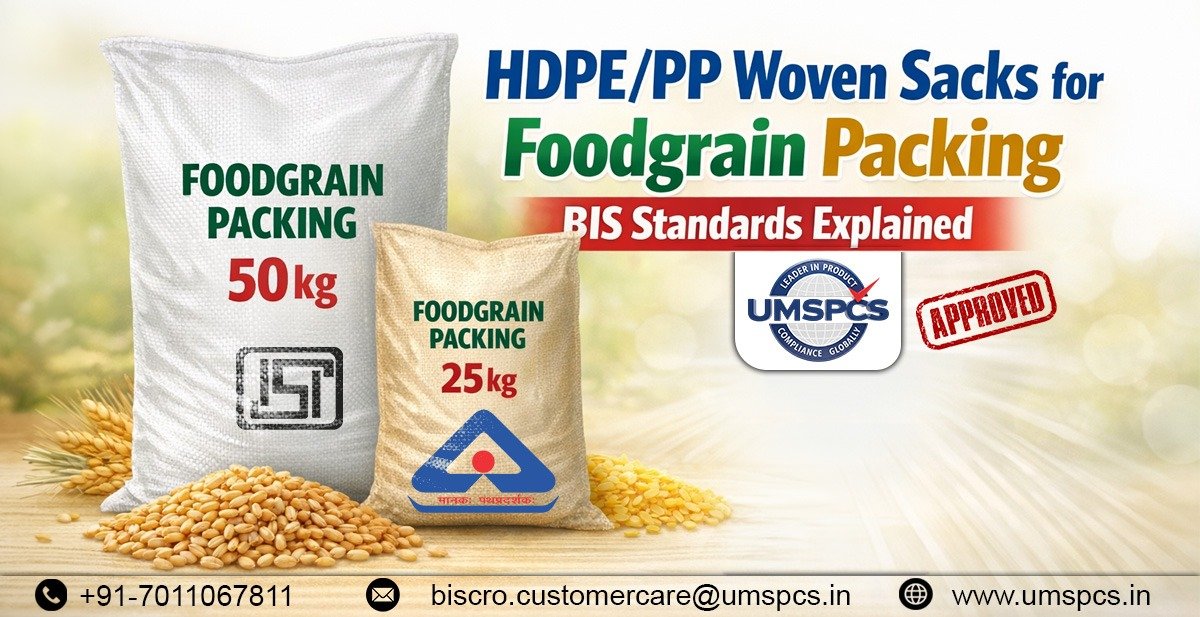
Packaging has an essential role in keeping the superiority of quality and safety food grains during the storage and transportation. In India, food grains like rice,wheat, pulses and millets are usually transported in 25kg or 50 kg bags which is a huge quantity. The Bureau of Indian Standards (BIS) takes the charge of imposing certain standards for HDPE and PP woven sacks which are used in packaging of food grains by also giving surety to durability, safety, and standardisation
The manufacturer makes such sacks to get aligned with ISI Certification and BIS standards for giving surety of quality and reliability. This blog looks over the BIS standards which are applicable to HDPE/PP woven sacks for foodgrain packing and also what are the procedures of getting BIS certification in India.
What are HDPE/PP Woven Sacks?
HDPE (High Density Polyethylene) and PP (Polyoropulene) woven sacks are used rapidly in packaging of materials made for bulk storage and transportation of food grains. Such sacks are created through weaving plastic tape made from the HDPE or PP polymers for generating solid, lightweight, and durable fabric.
Such sacks are favour for packaging of food grain as they serves various of benefits:
- High tensile strength
- Lightweight and cost-effective
- Resistance to moisture and chemicals
- Easy handling and stacking
- Suitable for long-distance transportation
Such sacks are widely used in procurement systems, warehouses, and the public distribution systems because of their durability and flexibility.
BIS Standard for HDPE/PP Woven Sacks for Foodgrains
BIS certification for HDPE/PP woven sacks which are used in packaging of food grains for keeping good quality and safety standards.
1. IS 14887:2014 – Woven Sacks for 50 kg Foodgrains
IS 14887:2024 defines the needs for HDPE/PP woven sacks which are used for the packaging of food grains in 50 kg bags which consist of wheat, rice, and pulses.
This standards defines the following:
- Material specifications
- Construction requirements
- Fabric density and dimensions
- Strength and durability parameters
- Testing methods and marking requirements
The standard gives validation that the sacks which are used in transportation of food grains are strong to go through stacking and transportation.
2. IS 16208:2015 – Woven Sacks for 25 kg Foodgrains
BIS has imposed IS 16208:2015 for HDPE/PP woven sacks for smaller packaging sized, which are used for packaging food grains in 10kg, 15kg, 20kg, 25kg, and 30kg
The standard includes specifications related to:
- Sack dimensions and weight
- Fabric breaking strength
- Seam strength and durability
- UV resistance
- Ash content and elongation limits
These parameters help in giving validation to sacks which handles their integrity regarding storage and transportation.
Mandatory ISI Certification for Woven Sacks
Manufacturers must get the BIS ISI certification prior to selling such products in India in accordance with the Textiles- HDPE/PP woven sacks (quality control) order 2020.
Primary requirements of this consists of the following:
- Compliance with the relevant Indian Standard (IS 14887 or IS 16208)
- Product testing in BIS-recognized laboratories
- Obtaining a BIS license
- Marking each sack with the ISI mark
In India, Manufacturing, importing or sell of such sacks is not legal without having the ISI certification.
Key Technical Requirements Under BIS Standards
BIS Standards defines various technical parameters to gives surety of products quality which includes the followings:
| Parameter | Requirement |
| Sack Dimensions | Must comply with standard length and width |
| Fabric Density | Defined number of ends and picks per dm |
| Breaking Strength | Ensures sack durability |
| Seam Strength | Prevents tearing during handling |
| UV Resistance | Maintains durability during storage |
| Ash Content | Ensures material purity |
Such tests make certain that these sacks can carry the heavy load safely without tearing or leaking the food gains.
Importance of BIS Certification
1. Legal Requirement
In every aspect wood products distributed domestically in India need to possess BIS Certification for Cooking Ranges, Hobs and Ovens in India which has to conform to the Quality Control Order.
Products which do not have a valid certification may be seized in the market, inspected at ports, or taken off the market, which could lead to fines, penalties, and a lack of market access.
2. Quality Assurance
The ISI mark and BIS certification gives relief to consumers and builders for confirming certain quality, safety and functionality standards. This could be equally essential in construction, marine applications, and infrastructure projects where poor supplies can gives rise to dangers and financial loss.
3. Market Status and Competitive Benefit
BIS-certified products come with the ISI mark that is familiar to Indian consumers and businesses. This mark displays the brands by boosting trust among consumers and chances of getting government tenders to the export market and having huge contracts of buying which seems beneficial for your company.
- Protection Against Substandard Products
Highly rigorous certification standards make certain that unsafe plywood with poor binding agents or insufficient bonding — frequently seen in less expensive imported or local unapproved products — continues to stay out of the market, improving overall industry quality.
BIS Certification Process for HDPE/PP Woven sacks for foodgrain packing
The process for being certified in BIS is tightly controlled and structured. For proper adherence to IS 14887, manufacturers have to take specific measures.
Step 1: Find the Required Standard
Manufacturers have to keep an eye on all test requirements and should confirm that they meet the required Indian Standards IS 14887.
Step 2: Product Testing
HDPE/PP sacks provides samples which will go through the inspection in BIS approved labs to get the following support:
- Absorption of shock
- Resistance to expansion
- Guarding for electricity
- Strength of the chin strap
Testing should be pass to get the certification.
Step 3: Application Submission
The manufacturer uploads an application with BIS and includes:
- Descriptions of products and diagrams
- Test outcomes
- Documents concerning manufacturing processes
- Instructions for quality control
Step 4: Factory Inspection
BIS inspects factories to confirm the following:
- Manufacturing capacity
- Systems for managing quality
- In-house testing facilities
- Batch control and identification
Step 5: Grant of BIS License
The manufacturer receives a license to use the ISI Mark on HDPE/PP Woven sacks for foodgrain packing only if the product and factory meet the BIS requirements.
Step 6: Check in and Renewal of previous certification
Certification in BIS is removable. To promise ongoing compliance, sample testing and surveillance inspection should take place constantly. After some time, licenses are meant to get renewed.
Documents Required for BIS Certification
Manufacturers should provide various documents when applying for the BIS Certification in India.
Primary documents includes the followings:
- Business license of the manufacturer
- Factory registration documents
- Product technical specifications
- Manufacturing process details
- Product test reports from BIS-approved labs
- Quality control manual
- Authorized Indian Representative (AIR) details for foreign manufacturers
- Trademark registration (if applicable)
Correct documentation is necessary for a simple and smooth certification procedure.
How UMSPCS Can Help
The IS 14887 might seem difficult to get a BIS Certification without getting any expert assistance.
How UMSPCS offers assistance:
- Inspection of product effectiveness under QCO 2025.
- Finding the right Indian standards.
- Preparation and confirmation of documentation.
- Interaction with the BIS and laboratory testing.
- Uploading enquiries and keeping an eye on them.
- Services for MSMEs, importers, and manufacturers for fast approvals
- Minimal chances of rejection or failure.
Our professionals assure that your company is fully compliant, legally secure, and market-ready.
BIS FMCS Certification for Foreign Manufacturers
Manufacturers should get the BIS Certification for foreign manufacturers if they are selling polyethylene water storage tanks outside the nation or importing it into the Indian market.
The Foreign Manufacturers Certification Scheme (FMCS) enables manufacturers from foreign to get the BIS approval and sell their products into the Indian market. This procedure consists of factory audits through BIS officials and product testing in line with the Indian standards.
After the approval, foreign manufacturers are able to use the ISI mark, which gives validation to their products which is in line with the similar standards of quality like those in India.
Conclusion
HDPE and PP woven sacks has an essential role in storage and transportation of food grains all over India. BIS has imposed strict regulations like IS 14887:2014 (50 kg sacks) & IS 16208 ( small capacity like 25kg) to keep handling the quality and safety standards
In India, manufacturers should have ISI certification with BIS regulations prior to selling such products. Compliance with such standards makes certain that these standards are durable, safe, and reliable regarding the supply chain.
Companies who need to get the BIS ISI Certification can hire professional assistance from UMSPCS, which gives expert consultancy services for BIS permits.
Frequently Asked Question (FAQs)
- What are HDPE/PP woven sacks used for?
HDPE/PP woven sacks are in use for packaging and transporting food grains which has rice, wheat, and pulses in packaging of 25kg and 50 kg.
- Which BIS standards apply to woven sacks for foodgrains?
The BIS standards which are applicable for 50 kg sacks are IS 14887:2014 and IS16208:2015 for 25kg sacks.
- Is ISI Certification mandatory for HDPE/PP woven sacks?
Yes. Manufacturers should get the ISI certification with the BIS Certification prior of selling such sacks.
- How can manufacturers apply for BIS Certification?
Manufacturers should upload an application to BIS for getting product tests done properly, go through factory audits, and get the license for using the ISI mark.
- How can UMSPCS help in BIS Certification?
UMSPCS gives expert assistance for paperwork, uploading applications, testing of products and end-to-end support for BIS ISI Certification.
❓ Ask a Question
Have any doubts? Fill the form below and our team will respond shortly.