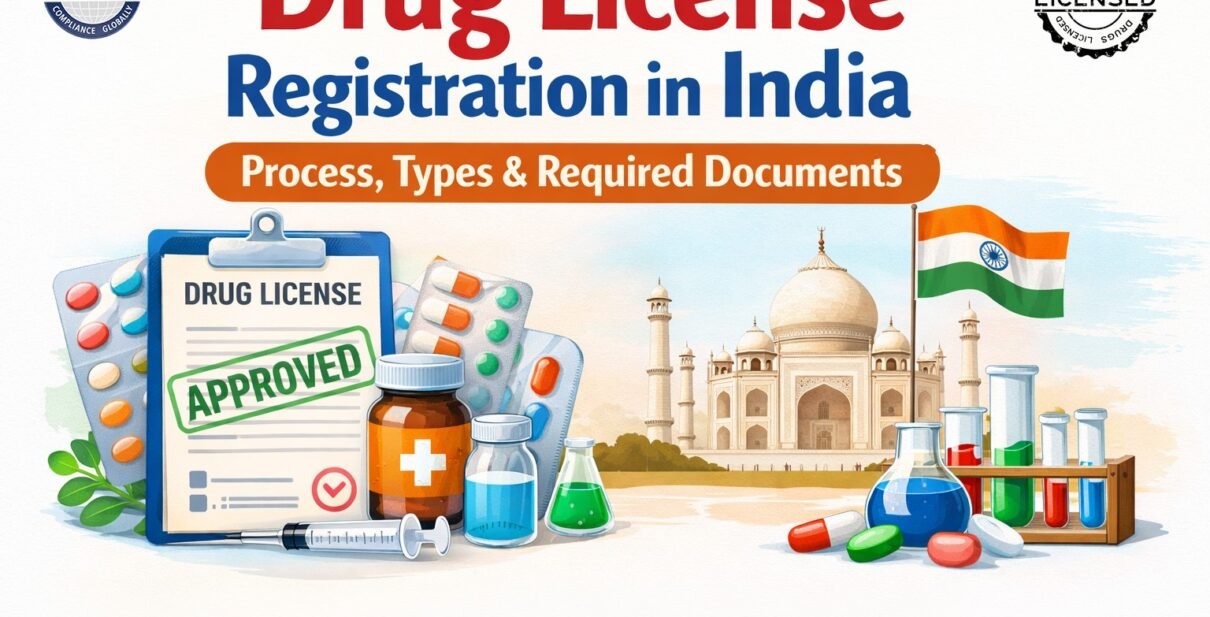
In India’s excessive regulated pharmaceutical sector where receiving a drug license is not only a legal requirement but it’s an essential step towards confirming public safety, product quality, and business credibility. Regardless of whether you’re starting a pharmacy, manufacturing medicines, or selling drugs, an official drug license is compulsory under the Drugs and Cosmetic Act, 1940.
This detailed blog demonstrates the drug license registration process in India, its types, required documents, and compliance demands which assists businesses in tracking the regulatory framework with confidence.
What is a Drug License in India?
A drug license is a legal authorization imposed by regulatory authorities which allows individuals or companies to make, sell, store, distribute, or import drugs and pharmaceutical products. Central Drugs Standard Control Organisation (CDSCO) which is aligned with the State Drug Control Department that regulates the issuance of such licenses.
Every activity in relation to drugs is seen as illegal and can give results to fines, which consists of lawsuits and penalties.
Regulatory Authority Governing Drug Licenses
In India, Drug license function at two levels which are as follows:
- Central Authority: Central Drugs Standard Control Organization (CDSCO)
- State Authority: State Drug Licensing Authorities (SDLA)
The CDSCO holds the responsibility of approvals of new drugs, imports, and clinical trials while state officials manage the retail and wholesale licenses.
This dual regulatory system confirms rigid monitoring of drug quality, safety, distribution all across the nation.
Types of Drug Licenses in India
There are various kinds of required Drug licenses which are based upon the nature of the business as follows:
1. Retail Drug License (RDL)
This license is in demand for distributing medicines directly to consumers by pharmacies or medical stores. It is issued to chemists, hospitals, and dispensaries.
2. Wholesale Drug License (WDL)
This is issued to businesses who are working in excessive selling of drugs to retailers, hospitals, or other wholesalers.
3. Manufacturing Drug License
Demands for companies that have manufacturing pharmaceuticals which consist of allopathic, ayurvedic, or cosmetic products.
4. Loan License
This license is issued to businesses that do not own manufacturing facilities but utilise another licensed manufacturer’s infrastructure.
5. Import License
Compulsory for importing drugs or medical devices into the Indian market which is regulated by CDSCO.
6. Multi-Drug License
Needed when a business functions in various states in accordance with more than one unit.
Every kind of license is issued depending on certain business activities and regulatory demands.
Eligibility Criteria for Drug License
Businesses should get align with specific eligibility conditions to apply for a drug license in India given as follows:
- Minimum area requirement (generally 10–15 sq. meters for retail/wholesale)
- Proper storage facilities (including refrigeration for certain drugs)
- Qualified personnel (registered pharmacist for retail license)
- Compliance with Good Manufacturing Practices (for manufacturers)
Such conditions give surety in managing and storing of pharmaceutical products.
Step-by-Step Process for Drug License Registration
The procedure of getting a drug license consist of various stages which are as follows:
Step 1: Determine License Type
Find out the correct license which depends on your business model like retail, wholesale, manufacturing, etc.
Step 2: Prepare Documentation
Prepare every required document consisting of identity proof, office details, and technical qualifications.
Step 3: Online Application
Applications for CDSCO license are uploaded on the SUGAM portal whereas state licenses are uploaded through respective state portals.
Step 4: Inspection by Authorities
Drug inspectors check the places, storage facilities, and compliance in accordance with regulatory standards.
Step 5: Approval & License Issuance
The license is granted by allowing legal functioning of the business once getting verified successfully.
Step 6: Renewal & Compliance
Drug licenses should get renewed periodically and businesses should handle compliance in accordance with evolving regulations.
Documents Required for Drug License Registration
The documents demand might get differ which is based upon the license type, but usually it consists of the followings:
Basic Documents
- Identity proof (PAN, Aadhaar, Passport)
- Address proof of the applicant
- Passport-size photographs
Business Documents
- Constitution of the firm (Proprietorship/Partnership/Company)
- Partnership deed or MOA/AOA
- GST registration certificate
Premises Documents
- Rent agreement or ownership proof
- Layout plan of the premises
- Storage facility details (refrigerator, cold storage)
Technical Documents
- Qualification certificates of pharmacist/competent person
- Appointment letter of technical staff
- Experience certificates (if applicable)
Additional Documents (for Manufacturers/Importers)
- GMP certificate
- Product details and technical specifications
- Labeling and packaging information
Accuracy of documentation is essential to prevent postpones or denials of the application.
Importance of Drug License Registration
Receiving a drug license provide various of benefits which are as follows:
- Legal Compliance: Ensures adherence to Indian pharmaceutical laws
- Consumer Safety: Guarantees quality and safe drug distribution
- Business Credibility: Builds trust among customers and stakeholders
- Market Access: Enables legal sale, distribution, and expansion
Compliance is directly linked to business success and reputation is a regulated industry like pharmaceuticals.
Challenges in Drug License Registration
The registration procedure might be difficult because of the followings:
- Multiple regulatory authorities
- Extensive documentation requirements
- Frequent updates in compliance norms
- Technical and legal complexities
Businesses usually face postpones because of incomplete application or lack of regulatory knowledge,
Why Choose Expert Consultants for Drug License Registration?
Procedure can get simplified through professional consultancy services which are given below:
- Identifying the correct license type
- Preparing and reviewing documentation
- Ensuring compliance with CDSCO and state norms
- Handling application filing and follow-ups
This reduces the possibilities of denials and accelerates the time of approval.
About UMSPCS – Your Trusted Compliance Partner
UMSPCS provides expert guidance and complete assistance for businesses who want a stress-free drug license.
UMPCS supports businesses to track difficult licensing procedures efficiently in accordance with experts of regulatory compliance. Their services consist of the followings:
- Drug license registration (Retail, Wholesale, Manufacturing)
- CDSCO approvals and compliance
- Documentation and application support
- End-to-end regulatory consultancy
UMSPCS is known for its professional expertise, clear procedures, and client oriented approach which makes it a more reliable partner for pharmaceutical businesses all across the nation.
Read more also: Legal Metrology Registration in India: Process, Fees & Compliance
Conclusion
Drug license registration in India is an essential requirement for everyone who are working in the pharmaceutical sector. From knowing about the kinds of license to preparing the correct documents and getting aligned with correct procedures where each step has an essential role in confirming compliance.
In accordance with rigid regulations which are imposed by the Central Drugs Standard Control Organisation and state authorities where businesses should remain upgraded and compliant to function successfully.
Working together with experts like UMSPCS which makes the whole procedure seamless, efficient and mistake free by allowing you to concentrate on your business growth while confirming regulatory compliance.
Read more also: World Manufacturer Identifier Certification
FAQs
1. Is a drug license mandatory in India?
Yes. It is legally in demand for manufacturers, seller, and distributors of drugs in India.
2. Who issues drug licenses in India?
CDSCO and state drug authorities which issues drug licenses based upon on the type.
3. How long does it take to get a drug license?
It usually requires 30-60 days based upon the kind of license and paperworks.
4. Can I apply for a drug license online?
Yes. applications should get uploaded on SUGAM portal or state portals.
5. What happens if I operate without a drug license?
Functioning without having a license can result to penalties or lawsuits.
❓ Ask a Question
Have any doubts? Fill the form below and our team will respond shortly.