In India’s strictly controlled industry, Product security, quality, and to check if it is complying to the Indian Standards are not just beneficial but also essential to companies that is in operation. It is also essential to understand the ISI certification and registration in India regulatory structurer to sell you products legally in India. In this Blog, we’ll explain what is ISI certification, how the registration process take place, how it is different from the FMCS, and how UMSPCS can help in speeding up your compliance journey.
What Is ISI Certification?
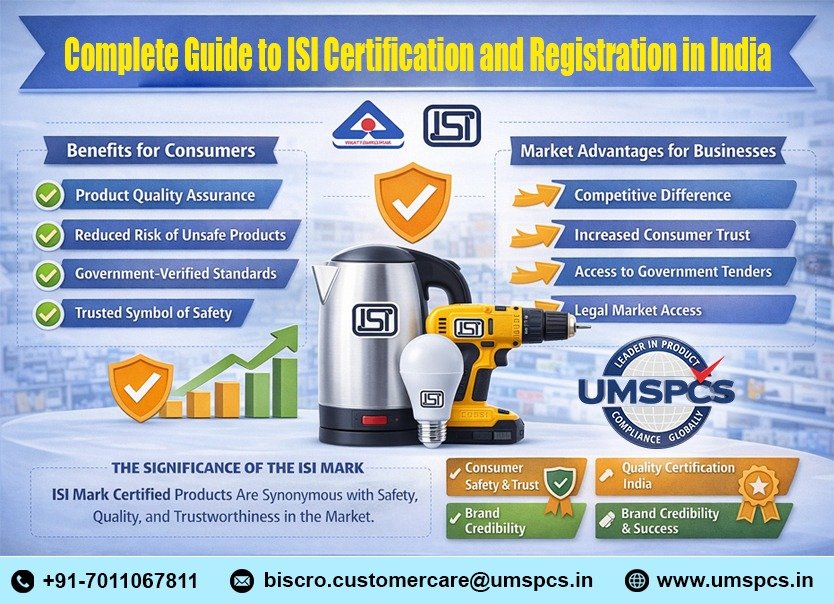
ISI mark is one of the most recognised indicator of quality. India’s national standards organisation, the Bureau of Indian Standards is responsible for imposing the BIS Act of 2016. The ISI mark on products confirms that it meet all the required Indian Standards of quality, safety, and functionality.
ISI certified products includes:
- Electrical components like cables, switches, wires, and kitchenware..
- Constructional equipment like cement and steel
- Security and gas appliances
ISI mark is the important element of ISI certification which shows on the packaging of products with a unique license number, often spelt as “CM/L – XXXXXXX.
Why ISI Certification Matters
Legal advantages: Products are not allowed to get sold in the Indian market without having the ISI mark.
Trust among customers: The ISI mark provides a stress free environment for consumers product in accordance with the Product’s quality and safety.
Access to market: Government tenders, agreement distribution, and selling chains all required the certified products.
Brand credibility: In Indian market, ISI mark can enhance your brand’s image or reputation.
What Is FMCS (Foreign Manufacturers Certification Scheme)?
Foreign Manufacturers Certification Scheme (FMCS) is a BIS scheme for products that are manufactured outside India and are aiming to sell their products in Indian market. FMCS give allowance to foreign manufacturers to use the ISI mark and get the BIS certification with particular regulatory guidelines.
In accordance with FMCS:
- Only the foreign factory can choose an Authorised Indian Representative (AIR) for itself in India.
- Testing of products should only be done in laboratory that are approved by the BIS.
- Verification of quality and factory inspection are conduct by the BIS.
- After approval, manufacturers will be granted by the license to use the ISI mark for exporting.
FMCS makes sure that the imported products should must follow the safety regulations and Indian standards which is applicable to products that are made in India.
Differences Between ISI Certification and FMCS
ISI and FMCS, both are relevant to the BIS and quality standards, as they respond to varieties of consumer and regulatory needs.
| Aspect | ISI Certification (Domestic) | FMCS (Foreign Manufacturers) |
| Who It Applies To | Indian manufacturers | Overseas manufacturers exporting to India |
| Objective | Certify products made within India | Certify foreign goods to meet Indian standards |
| BIS Mark | ISI mark on domestic products | ISI mark on imported goods |
| Factory Audit | Conducted in domestic factories | Conducted on foreign facilities |
| AIR Requirement | Not required | Mandatory — must appoint an Authorized Indian Representative |
| Regulatory Scheme | BIS Scheme I (Standard Mark) | FMCS under BIS Act & Conformity Regulations |
In simple words, FMCS is for foreign companies to work in order to verify and import products into India with necessary requirements of safety and quality, as the ISI certification is for companies that are located in India to allow the products that they produce.
Step-by-Step ISI & FMCS Registration Process
1. Find out the Product Applicability
- ISI certification is compulsory to find whether your product fulfils the requirements.
- Verify if the product manufactured outside India applies to FMCS.
2. Collect Required Documents
Examples of required documents are as follows:
- Registration for business and legal paperwork
- Factory framework and in detail manufacturing process.
- List of product classifications and raw materials.
- Quality managements also requires paperwork like the ISO certificate.
- Outcomes for product testing only if required.
Other documents includes factory structural details, paperwork of authorisation, and nomination for AIR, are what foreign manufacturers requires with FMCS.
3. Product Testing
BIS approved laboratories are compulsory for test samples as testing makes it sure that the product must comply with the correct Indian Standards.
4. Factory Audit
- BIS inspectors complete the audits by verifying the production and quality security processes.
- With FMCS, this audit is subject to units of foreigners.
5. Submit Application
To submit an application and necessary paperwork, use BIS’s online portal or a compliance partner.
6. Grant of License
The implementation of the Standard Mark/ISI mark is permitted by the license of BIS, only if all the requirements are fulfilled successfully.
7. Post-Certification Obligations
nesses.Before expiration of products, reported changes, conforming quality standards, and continuous checking on products to verify if it meet all necessary requirement for approved products, we need to regenerate the certification.
How UMSPCS Can Help You Get BIS & ISI Certification
BIS certification can be complicated, time consuming, and filled with documents, irrespective of whether it is FMCS or ISI. UMS Product Compliance Services (UMSPCS), one of the top compliance professionals which will make the process more simple and understandable.
The Reasons for Selecting UMSPCS
Complete support: This consists of every sight of inspection and submission of documents and test managements.
Legal Consultation: For every variety of products, our team has understanding of BIS registration.
Faster responses: Avoid postponements and rejections that are reduced by the simpler procedure.
Guidance for Foreign Manufacturers: Complete support to the AIR coordinations and applications of FMCS.
After-approval services: These services includes regulatory updates, renewals, and monitoring of inspections.
The time and stress involved in BIS registration can be significantly decreased by contracting with a compliance partner like UMSPCS.
Working together with a compliance partner like UMSPCS, which reduces the time and stress comes with the BIS registration.
In Conclusion
Obtaining an ISI certification and registration in India is required to get legal access to the market. It is important to understand the process, paperwork requirements, and legal necessity, no matter whether you’re a local manufacturer or a foreign supplier.
By satisfying the safety regulations, certified products build the trust among the customers and business partners for a successful, efficient, and simple compliance journey by working with a professional compliance partner like UMSPCS.
Frequently Asked Questions (FAQs)
- Q. What is the ISI certification in India?
A- ISI mark is one of the most recognised indicator of quality. India’s national standards organisation, the Bureau of Indian Standards is responsible for imposing the BIS Act of 2016. The ISI mark on products confirms that it meet all the required Indian Standards of quality, safety, and functionality.
- Q. Is it compulsory for all products to get the ISI certification?
A- No. ISI certification is compulsory only for the products stated in the Quality Control Order (QCO) implemented by the Indian Government. ISI certification is mandatory for products like electrical appliances, cement, steel and gas appliances.
- Q. What is the difference between ISI and FMCS?
A- FMCS is for foreign companies to work in order to verify and import products into India with necessary requirements of safety and quality, whereas the ISI certification is for companies that are located in India to allow the products that they produce.
- Q. What is the FMCS under BIS?
A- The Bureau of Indian Standards for foreign manufacturers which is introduced by the FMCS certification scheme. It make sure that the imported product should meet all the Indian safety and quality standards before entering into the Indian market.
- Q. How much time it require to get the ISI certification in India?
A- On average, 30-90 days, depending on your product testing, verification of documents, and inspections of factories. Delays are caused by the improper documents or failure of test outcomes.
❓ Ask a Question
Have any doubts? Fill the form below and our team will respond shortly.