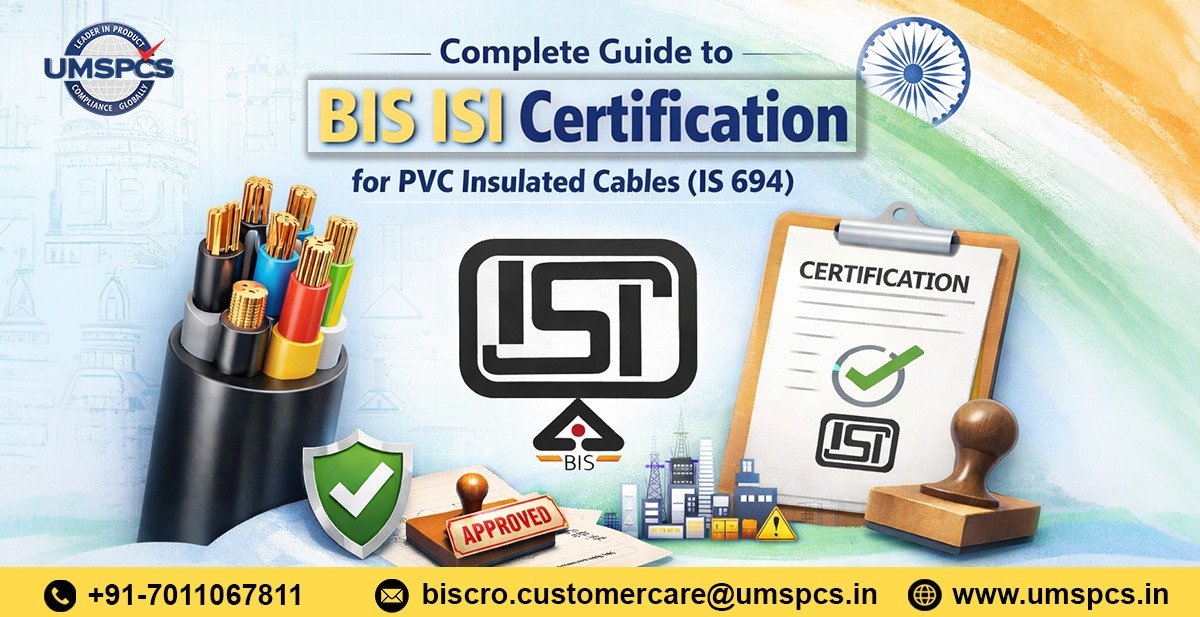
The wiring for electricity is a crucial component of contemporary construction. Secure and dependable wiring assure that electricity travels quickly and safely coming from homes to massive factories. Polyvinyl Chloride (PVC) insulating detached and wrapped wires and cords along with solid and movable conductors for ratings of voltages through as high as 1100 V constitute some of the most frequently encountered kinds of cables used in India.
These cables have to conform to the Bureau of Indian Standards (BIS) rules and get BIS ISI certification for PVC insulated cables (IS 694) in order to keep safety and quality standards high. The accreditation makes certain that these wires connect the standards for reliability, security, and efficiency prior to they are permitted to be marketed in India.
Understanding PVC Insulated Cables
Polyvinyl Chloride (PVC) is used as an an insulator in PVC wrapped cable assemblies. PVC is an increasingly common option as it endures for a long time, is lightweight, is resistant to humidity, and has become cheap. These wires can be used to send electricity in homes, businesses, and factories.
These cables will either be covered or not, and they may consist of flexible or rigid cables that are constructed from copper or aluminum. PVC insulates the conductors to preserve electricity from leaking out as well as safeguarding the wire to degradation from surroundings.
BIS Standard for PVC Insulated Cables
IS 694:2010 is the Indian Standard that can be applied to these kinds of cords. It sets technical norms and necessities for making PVC-insulated cables and cords that can handle currents up through and including 1100 volts.
The standard includes the following:
- Cables with one core and more than one core
- Conductors that are stiff and bendable
- Conductors made of copper and aluminum
- Cables that are not covered and those that are covered in PVC
- Cables that are round and flat
People employ cables like this for electricity, illumination, and overall electrical installations in their houses, workplaces, and factories.
Types of PVC Insulated Cables Covered Under IS 694
The IS 694 standard organizes connections into groups that depend on variables like the substance of the conductor itself, the type of insulator, and the kind of connection.
1. Based on Conductor Type
Class 1 (solid) and Class 2 (stranded) conductors are fixed conducting materials.
Adaptable Conductors : Class 5 conductors utilized in cables and appliances that are extensible
2. Based on Conductor Material
Copper wires (without any coating or tinned)
Aluminum wires
3. Based on Insulation Type
- Type A
- Type C
- Type D
4. Based on Sheath Type
Standard cables (01 and 02)
Cables that are flame retardant (FR)
Cables that are FR-LSH (Flame Retardant Low Smoke and Halogen)
These groups assist makers make cables that work well in a variety of electrical setups and weather conditions.
Applications of PVC Insulated Cables
PVC insulated cables with a voltage rating of up to 1100 V have been employed in many industries because they are both secure as well as beneficial.
1. Residential Wiring
People often utilize these wires to wire up the lights, controls, and connections inside their homes.
2. Commercial Buildings
The cables they produce are used by offices, malls, and other buildings to power their lighting and other electrical installations.
3. Industrial Installations
Industries use PVC-insulated wires for connecting machines, systems for control, and electrical wiring.
4. Appliances and Equipment
Fans, refrigerators, power tools, and other electrical devices depend on adaptable PVC cables.
PVC cables are secure and trustworthy for transmitting electricity in an assortment of circumstances due to they are strong and insulated.
Importance of BIS Certification
In India, a lot of electrical goods need to be issued BIS certification to make certain that they are secure and of good quality. Prior to being permitted to be produced, brought into, or offered for sale in India, PVC insulated cables that meet IS 694 need to possess ISI Mark certification.
Key Benefits of BIS Certification
- Ensures Product Safety
The insulating material durability, conducting condition, and fire resistance of approved wire were all examined.
- Compliance with Indian Regulations
To constitutionally distribute cables for electricity in India, manufacturers need to abide by BIS rules.
- Improved Consumer Trust
The ISI mark indicates to consumers which the item being purchased exceeds the nation’s high standards.
- Market Access
With BIS certification, companies can grow their companies and enter sectors that are controlled.
Testing Requirements for BIS Certification
Cables need to continue through a number of tests in BIS-approved labs in order to receive BIS ISI certification for PVC insulated cables (IS 694). These inspections make sure that the connections are secure and work as they should.
Some common tests are:
- Test for resistance in conductors
- Test for the thickness of insulation
- Test for high voltage
- Test for insulation resistance
- Test for heat shock and aging
- Test for flame retardants
These examinations make absolutely certain the link works effectively throughout various electrical and environmental situations.
BIS Certification Process for Manufacturers
There are many actions in the BIS certification process that involve making sure that IS 694 is followed precisely.
Step 1: Find the Required Standard
Manufacturers have to keep an eye on all test requirements and should confirm that they meet the required Indian Standards (IS)694:2010.
Step 2: Product Testing
Marine Plywood samples undergo examination in labs approved by BIS to assess the following:
- Absorption of shock
- Resistance to expansion
- Guarding for electricity
- Strength of the chin strap
For certification to be accepted, testing must be successful.
Step 3: Application Submission
The manufacturer uploads an application with BIS and includes:
- Descriptions of products and diagrams
- Test outcomes
- Documents concerning manufacturing processes
- Instructions for quality control
Step 4: Factory Inspection
BIS inspects factories to confirm the following:
- Manufacturing capacity
- Systems for managing quality
- In-house testing facilities
- Batch control and identification
Step 5: Grant of BIS License
The manufacturer receives a license to use the ISI Mark only if the product and factory meet the BIS requirements.
Step 6: Monitoring and Renewal
Certification in BIS is removable. To guarantee ongoing compliance, sample testing and surveillance inspections take place regularly. After some time, licenses need to be renewed.
How UMSPCS Helps with BIS Certification
Obtaining BIS certification may seem challenging and require an extended period for producers. This refers to in which UMSPCS comes to the rescue.
UMSPCS offers qualified consulting services that assist manufacturers achieve BIS certification without any problems. They offer the following products and services:
- Help with BIS standards that apply
- Preparing documents
- Submitting an application with BIS
- Coordinating testing of products
- Help throughout the factory inspection
- Help before the BIS license gets authorized
Businesses could have made certain they follow the regulations faster while preventing excess time in their certification procedures by getting help from UMSPCS.
Read more also: BIS Certification for Spin Extractors in India
Conclusion
Polyvinyl Chloride insulated cables involving both rigid and flexible conductors can be found in residential, commercial, and industrial settings for electrical wiring. prior to such cables are permitted to be offered in India, they need to satisfy IS 694:2010 standards while obtaining BIS ISI certification for PVC insulated cables (IS 694) to make certain that they are secure and of good quality.
BIS certification demonstrates that those wires are reliable and will function well in an assortment of situations. UMSPCS is capable of helping producers get BIS certification through offering qualified guidance and conformity assistance throughout start to finish.
Making sure that products conform to BIS standards not exclusively makes them better, but it establishes credibility with customers while also rendering an organization more visible within the Indian electric marketplace.
Frequently Asked Questions (FAQs)
- What is the BIS standard for PVC insulated cables up to 1100 V?
The BIS standard for PVC insulated cables is IS 694:2010.
- Is BIS certification mandatory for these cables?
Yes. BIS ISI certification is compulsory for manufacturers or sellers who are selling these cables in the Indian market.
- Where are PVC insulated cables used?
PVC insulated cables are employed in residential wiring, commercial buildings, industries, and electrical appliances.
- What types of conductors are used in these cables?
These sorts of cables are used for rigid and flexible conductors which are composed of copper and aluminium.
- What tests are required for BIS certification?
BIS certification has some common tests which are conductor resistance, insulation resistance, high voltage, and flame retardant tests.
- Who needs BIS certification for these cables?
Manufacturers and importers must get the BIS certification.
- How long does BIS certification take?
On an average, for about 4-6 weeks which are mainly based upon testing and documentation.
- How can UMSPCS help?
UMSPCS gives complete support with documentation, application submission, testing coordination, and entire BIS certification assistance.
❓ Ask a Question
Have any doubts? Fill the form below and our team will respond shortly.